
From "Hooking Up" to Knowledge Management: Redefining SNS for the Intellectual Age
Redefining Social Network Services: A Solution to Personal Information and Knowledge Management
This paper proposes a PIKM-oriented model for Social Network Services (SNS) to transform them from mere socializing tools into robust platforms for Personal Information and Knowledge Management. The core method integrates individual intellectual capital with structured collaboration, introducing the concept of a "Knowledge Network of Practice."
TL;DR
In the mid-2000s, while the world was obsessed with the social "explosion" of MySpace and early Facebook, researchers Tingting Jiang and Daqing He saw a fundamental flaw in the SNS trajectory. In their seminal work, they argue that SNS should not just be about communication, but about Personal Information and Knowledge Management (PIKM). They propose a model where social connections are the infrastructure for "Knowledge Networks of Practice," solving the perennial issues of trust and network fragmentation.
The "Broken" Social Link: Distrust and Fragmentation
Despite the popularity of early social networks, the authors identified three "silent killers" of the SNS ecosystem:
- Distrust: Digital "friendship" became a vanity metric. People added connections for courtesy or visibility, diluting the actual reliability of the network.
- Fragmentation: Users were forced to manage professional identities on one site (like LinkedIn) and personal ones on another, creating an artificial wall between facets of human life.
- Duplication: Every new platform required "reinventing the wheel"—importing contacts and rebuilding networks from scratch.
The authors' insight was profound: the problem wasn't the technology, but the motivation. By shifting the goal from social interaction to collaborative work, trust and identity would naturally align.
Methodology: The PIKM Framework
The researchers reimagined SNS through the lens of intellectual capital. They transitioned the focus from Social Networks ("Who knows who") to Knowledge Networks ("Who knows what").
The Seven Principles of PIKM
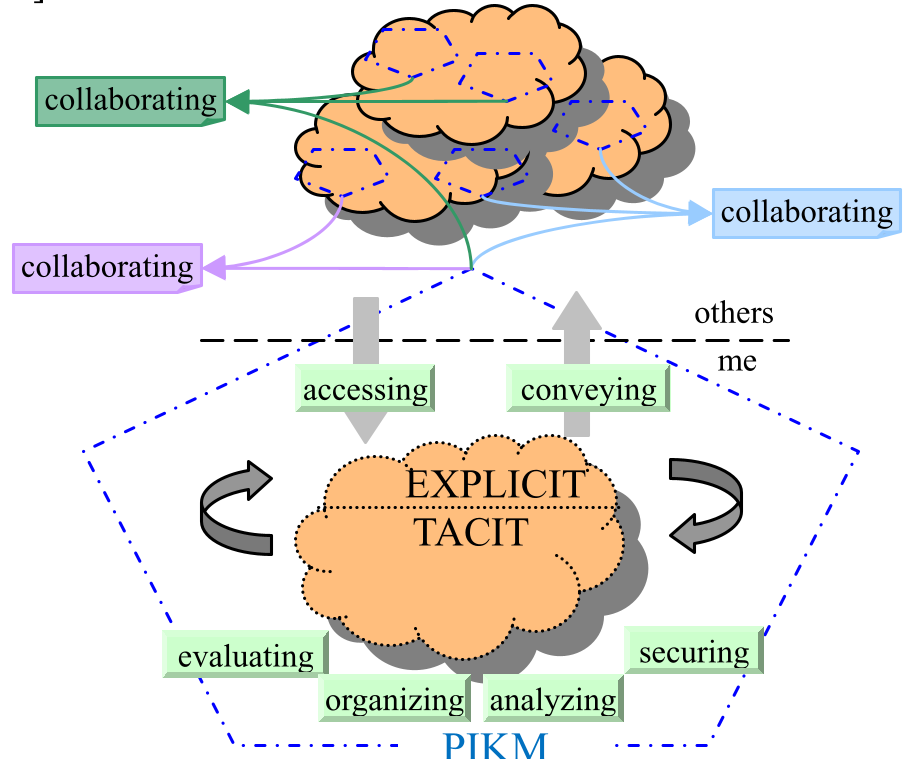
The paper integrates seven core activities: Accessing, Evaluating, Organizing, Analyzing, Conveying, Collaborating, and Securing. As shown in the framework below, collaboration is the "glue" that connects the private cloud (individual knowledge) to the public cloud (shared information).
The Four-Module Solution
To realize this vision, they proposed a system architecture that feels surprisingly modern:
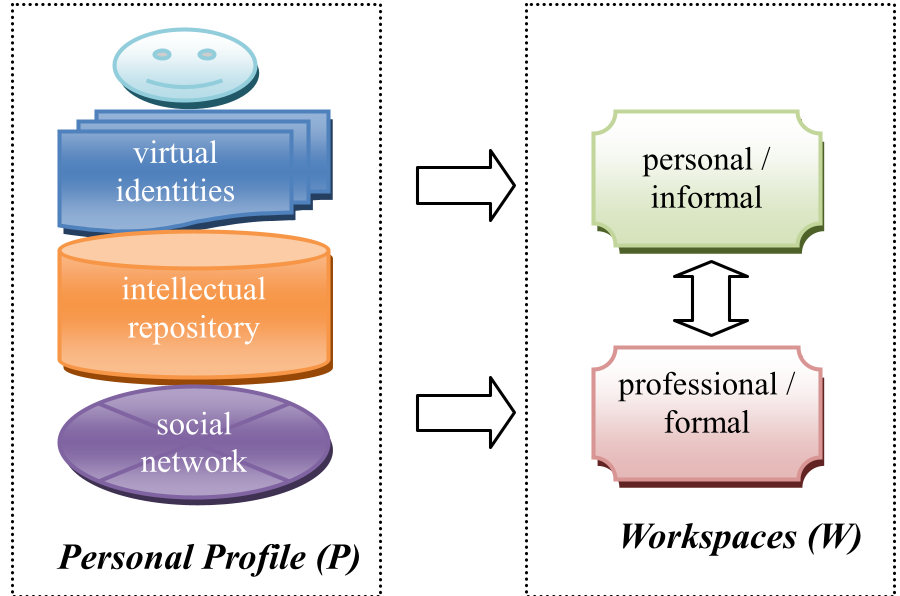
- Personal Profile Module: Supports multiple virtual identities under one account, allowing users to show "hobbies" to friends but only "expertise" to colleagues.
- Collaboration Workspace: A dedicated area where social and professional tasks converge.
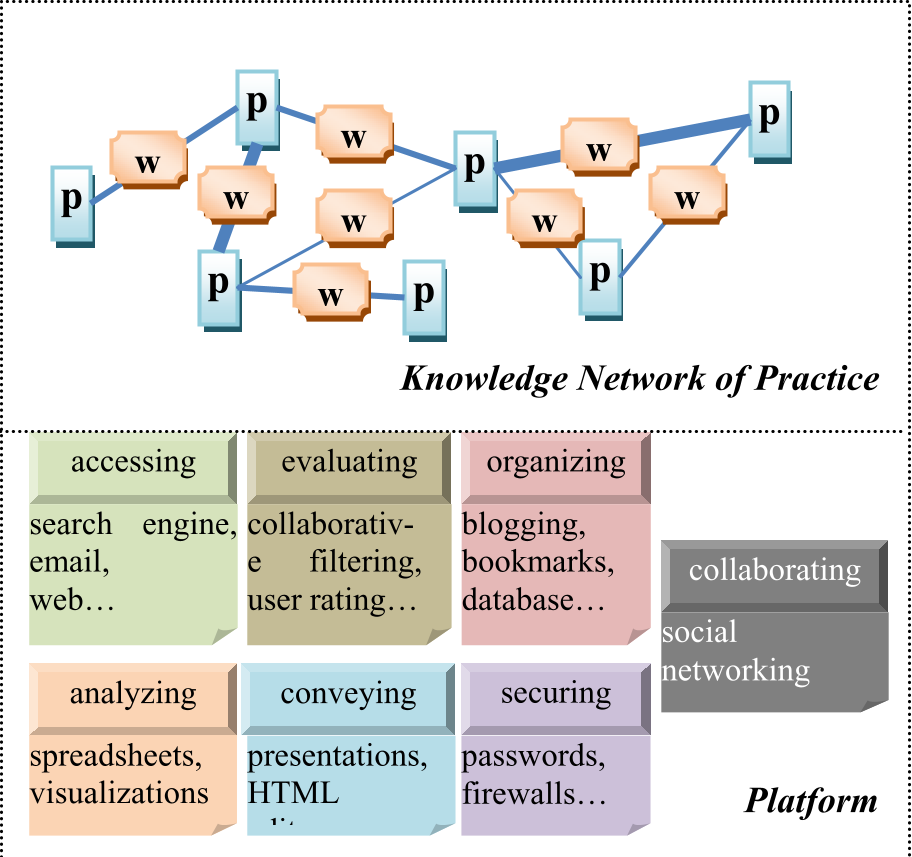
- Knowledge Network of Practice: The "Graph" where users are nodes and shared workspaces are the edges.
- Platform Module: An extensible suite of tools (email, tagging, blogs) that avoids the need for external, disconnected services.
Scientific Impact: Quantifying Relationships
One of the most innovative aspects of this model is how it handles relationship strength. Instead of a binary "Friend/Not Friend," the Knowledge Network of Practice uses the thickness of links. If two people share five professional workspaces and three personal ones, their link is "thicker," signifying higher trust and multi-faceted interaction.
Critical Insight & Conclusion
While this paper was written before the rise of the "Creator Economy" or modern tools like Notion and Obsidian, its core thesis remains incredibly relevant. The authors correctly predicted that the value of a social network is not found in the number of connections, but in the velocity and trust of the knowledge flowing through them.
Takeaway: We are still struggling with the fragmentation the authors warned about. The move toward "Integrated Workspaces" (like Google Workspace or Microsoft 365) is effectively the realization of their "Platform Module." However, the industry has yet to fully implement the "Knowledge Network of Practice" in a way that allows a user's intellectual capital to travel seamlessly across different professional contexts.