
SAP: Harnessing Social Intuition and Poisson Prediction to Solve Opportunistic Network Congestion
Reducing Congestion for Routing Algorithms in Opportunistic Networks with Socially-Aware Node Behavior Prediction
This paper introduces Socially-Aware Prediction (SAP), a routing algorithm for opportunistic networks that mitigates network congestion by leveraging social ties and Poisson-based encounter prediction. SAP significantly outperforms the established BUBBLE Rap protocol, achieving a hit rate improvement of up to 36% while drastically reducing delivery costs.
TL;DR
Opportunistic networks (OppNets) thrive on the "store-carry-and-forward" paradigm, but they often suffocate under their own traffic. The Socially-Aware Prediction (SAP) algorithm breaks this cycle by replacing blind replication with high-precision forwarding based on a node's social context and a Poisson-modeled encounter history. The result? A massive reduction in delivery costs (down to 1/30th of baseline) and a significantly higher hit rate.
The Congestion Crisis in Social Routing
In an opportunistic network, nodes (usually mobile devices carried by humans) act as carriers. Current State-of-the-Art (SOTA) protocols like BUBBLE Rap use social centrality to identify "popular" nodes to act as relays. While effective for delivery, this creates a massive bottleneck:
- Hub Overload: Popular nodes are bombarded with messages, leading to frequent buffer overflows.
- Inefficient Dropping: When a buffer is full, most algorithms drop the oldest message, even if that message was seconds away from meeting its destination.
- Endless Replication: Without a "stopping" mechanism, copies of messages proliferate indefinitely, wasting bandwidth.
Methodology: The SAP Utility Framework
The researchers from University Politehnica of Bucharest proposed a utility-based approach that answers two questions: How likely is this node to meet the destination soon? and How socially relevant is this node to the message's community?
1. The Mathematical Intuition
The utility is a weighted sum of two specific components:
- (Short-term Prediction): This uses a Poisson Distribution to estimate the number of encounters in the next 24 hours. If a node has a history of meeting the destination at specific times, spikes.
- (Social Context): This evaluates the node's "popularity" (number of social contacts) and whether it belongs to the same community as the destination.

2. Smart Buffer Management
Unlike BUBBLE Rap, SAP doesn't just forward everything. It calculates the utility of all messages during a contact. If the buffer is full, it keeps only the "cream of the crop"—the messages with the highest utility—ensuring that nodes carry data they are actually likely to deliver.
Experiments: Dominating the Baselines
The authors tested SAP against BUBBLE Rap using two distinct mobility traces: UPB 2012 (dense academic environment) and St. Andrews (sparse town-wide environment).
Hit Rate and Efficiency
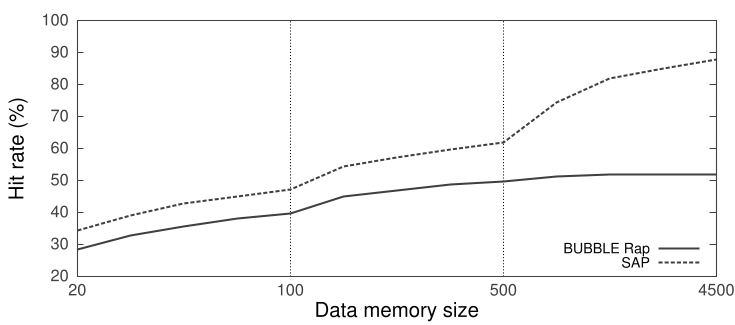
As shown in the results, SAP doesn't just deliver more; it delivers more efficiently.
- Hit Rate: In the UPB trace, SAP outperformed BUBBLE Rap by up to 36%.
- Delivery Cost: This is where SAP truly shines. While BUBBLE Rap's delivery cost (total messages sent) skyrocketed to over 6000 as memory increased, SAP remained stable at 224. This indicates that SAP avoids the "replicate everything" trap.
Eliminating Buffer Overflows
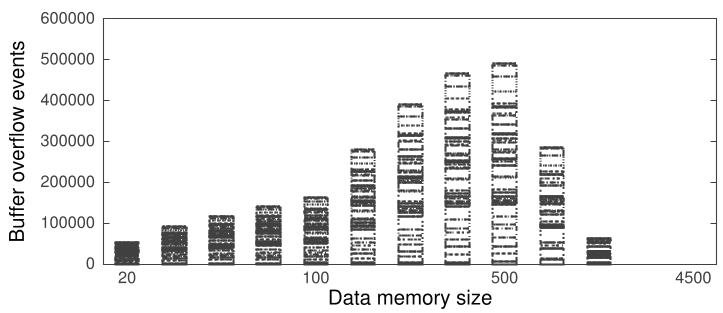
By using utility-based dropping, SAP significantly reduces the frequency of buffer overflow events. In high-memory scenarios, SAP experiences zero overflows, whereas BUBBLE Rap continues to struggle due to its reliance on older-first dropping policies.
Critical Insight & Conclusion
The genius of SAP lies in its Inductive Bias: human mobility is not random but follows social and temporal patterns (Poisson behavior). By quantifying these patterns into a utility score, SAP transforms the network from a chaotic broadcast system into an intelligent, directed forwarding mesh.
Takeaway for the Future: As we move toward 6G and ubiquitous edge computing, the "social intelligence" of nodes will be a critical factor in managing limited spectrum and battery life in decentralized networks.
Limitations: The Poisson model assumes a level of regularity (like a university schedule). In highly chaotic environments with zero routine, the predictive power of may degrade, relying heavily on the more static social component.