
Sophisticated Graph Pruning: Leveraging Mathematical Morphology for Social Media Simplification
Reducing Interactions in Social Media: A Mathematical Approach
This paper introduces a novel framework for social media network simplification using Mathematical Morphology. By treating Twitter interaction graphs as complete lattices, the author applies morphological operators—dilation, erosion, opening, and closing—to reduce node complexity while preserving essential community structures and high-value actors.
TL;DR
Social media networks are becoming increasingly dense and unreadable. This paper proposes a mathematically rigorous approach to "clean" these networks using Mathematical Morphology. By treating users and tweets as elements in a lattice, the method uses operations like Opening and Closing to merge redundant interactions, reducing a chaotic Twitter graph of 3,000+ nodes to a clear, queryable structure of just over 200 nodes without losing the "backbone" of the conversation.
The Visualization Crisis in Complex Networks
As social media grows, the "hairball" effect—where graphs become so dense they appear as solid masses—hinders our ability to find real influence. Most prior work relies on random sampling or basic clustering, which often slices through the underlying logic of the network. The author's insight is that social interactions share geometric similarities with digital images: they have density, connectivity, and "forms." Therefore, tools from Image Processing (Mathematical Morphology) can be adapted to "erode" noise and "dilate" important connections.
Methodology: The Geometry of a Tweet
The core innovation lies in treating a Twitter graph as a complete lattice. In this space:
- Erosion (): Finds the infimum (minimum) value in a neighborhood. It "shrinks" the influence of nodes that don't meet specific interaction thresholds.
- Dilation (): Finds the supremum (maximum). It "grows" the influence of highly connected or highly engaged nodes.
- Opening () & Closing (): These are the filters. Opening removes small, isolated interaction clusters (noise), while Closing fills gaps between closely related communities to merge them.
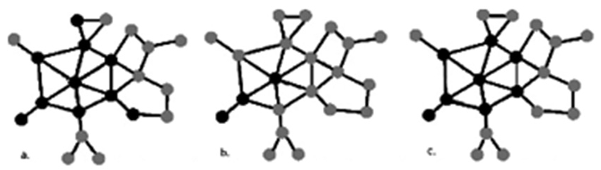 Fig 1. Visualizing the impact: (a) Original random graph, (b) Eroded version, (c) Dilated version.
The paper defines merging conditions based on node metadata: Mentions (), Favorites (), and Retweets (). Two nodes are fused into a new node only if their attribute differences fall within the bounds of thresholds and .
Experiments: Sorting the #noalaeropuerto Chaos
The researcher tested this on a real-world political trend from Mexico involving 3,399 users. By applying iterative morphological filters, the complexity was reduced drastically while keeping the "Essential" actors visible.
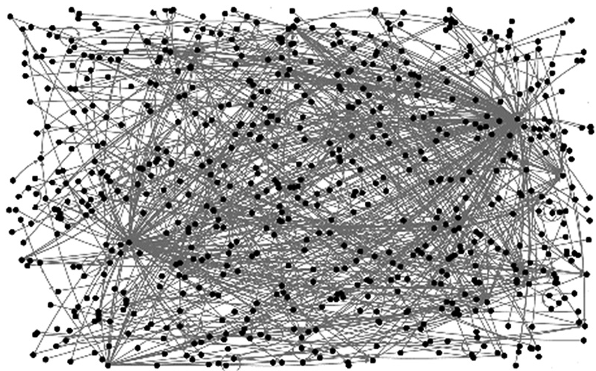 Fig 2. The network at 50 iterations: simplified to 509 nodes, revealing the clear "hubs" of interaction.
The study reveals a "Logarithmic" efficiency: the most significant simplifications happen early (first 5-10 iterations), where the morphological operators identify and merge the most obvious redundancies. Later iterations refine the structure.
Critical Analysis & Future Outlook
While the method is mathematically elegant, its success heavily depends on the choice of Structuring Element (SE) and the thresholds and . If the thresholds are too aggressive, the "Closing" operation might merge distinct communities that should remain separate.
Takeaway: This work bridges the gap between pure algebraic signal processing and social science. By moving away from simple "sampling" toward "morphological filtering," we can treat social data not just as a list of links, but as a topological surface that can be smoothed and sharpened to reveal the truth. Future extensions could integrate this with Cypher queries to allow users to interactively "zoom" into network levels of abstraction.
Final Summary
- Task: Simplify complex Twitter interaction graphs.
- Method: Lattice-based Mathematical Morphology (Opening/Closing).
- Impact: Reduction of node count by >90% while maintaining interaction metadata for efficient querying.