
Pairwise Crowdsourcing: Solving the Uncertainty Crisis in Top-k Ranking
Reducing Uncertainty of Probabilistic Top-k Ranking via Pairwise Crowdsourcing
This paper introduces a pairwise crowdsourcing model to reduce uncertainty in probabilistic top-k ranking queries. By selecting the most informative object pairs for human comparison, the system refines possible world probabilities to achieve SOTA results in ranking confidence.
TL;DR
In uncertain databases, processing top-k queries often yields low-confidence results due to noisy or subjective data. This paper proposes a pairwise crowdsourced cleaning model that asks humans to compare pairs of objects rather than guess exact values. Utilizing a novel PB-tree index and entropy-based selection, the researchers achieved a 30x improvement in result quality while maintaining sub-minute processing speeds for hundreds of thousands of objects.
Context: The Trouble with "Uncertain" Rankings
Modern applications, from Yelp reviews to AI-based age estimation, deal with data that isn't 100% certain. In a probabilistic database, an object (e.g., a photo) is represented as a set of mutually exclusive "instances" with associated probabilities.
The problem? When you ask for the "top-2 youngest photos," the resulting set might only have a 48% confidence level. Prior cleaning methods tried to "fix" individual objects (Singleton Cleaning), but for subjective tasks—like "how good is this restaurant?"—humans are much better at saying "A is better than B" than providing an absolute score for either.
The Core Innovation: Pairwise Entropy Reduction
The paper shifts the focus from value probing to relationship verification. By asking a crowd of experts to verify if , we can eliminate "possible worlds" that contradict the human feedback, thereby concentrating the probability on the most likely top-k sets.
1. The PB-tree (Probabilistic B-tree)
To find the best pair to crowdsource (the one that reduces uncertainty the most), the system must evaluate a quadratic number of candidates. The authors designed the PB-tree to solve this. It clusters objects using a "dominance" relationship, allowing the algorithm to prune entire branches of object pairs that are guaranteed not to provide high information gain.
 Fig 1: The challenge of probabilistic top-k is the explosion of "possible worlds." The PB-tree organizes these to make cleaning manageable.
2. Efficiency through Bounds
Calculating the exact Entropy Improvement is a combinatorial nightmare. The authors introduce a bound-based algorithm that estimates quality improvement by looking only at the most significant instance pairs, avoiding the need to enumerate every possible top-k combination.
Performance: From Days to Minutes
The results are striking. In scalability tests, a Brute-Force (BF) approach takes over a million seconds (several days) to select a pair for a large dataset. In contrast, the optimized OPT method (using PB-tree and bound-based pruning) finishes in roughly one minute.
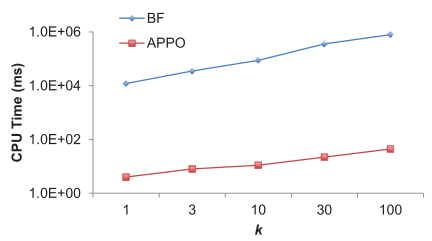 Fig 2: Overall elapsed time comparison. Note how the BF method (blue line) explodes while the optimized methods (red/green) remain near-constant.
Key Breakthroughs:
- 30x Quality Gain: Compared to random selection, the proposed entropy-maximizing selection yields substantially higher confidence in the final ranking.
- Worker Accuracy: Real-world tests on the AgeGuessing platform showed that while only 6% of workers could guess an exact age, 94% were correct in comparing which of two people was older.
Critical Insight & Future Outlook
The genius of this work lies in recognizing that human intuition is comparative, not absolute. By mathematically modeling this intuition through entropy and possible-world semantics, the authors bridge the gap between noisy machine data and human expertise.
Limitations: The model currently assumes workers are "mostly correct" and uses majority voting. However, in highly adversarial or specialized domains, a more complex "worker reliability" model might be needed.
What's Next? This pairwise approach is ripe for expansion into Probabilistic Graphs (e.g., verifying if a connection exists between nodes) and Aggregate Queries, where groups of objects are ranked together. It marks a significant step towards "Crowd-AI" hybrid databases that are both scalable and trustworthy.