
Reducing Ranking Uncertainty: Why Comparing Pairs Outperforms Direct Cleaning
Reducing Uncertainty of Probabilistic Top-k Ranking via Pairwise Crowdsourcing
2018-04-01
Summary
Problem
Method
Results
Takeaways
Abstract
The paper introduces a pairwise crowdsourcing model to reduce uncertainty in probabilistic Top-k ranking queries. It proposes the use of domain experts to perform binary comparisons between objects, utilizing a Probabilistic B-tree (PB-tree) and bound-based optimization algorithms to select the most informative pairs under a limited budget.
## Executive Summary
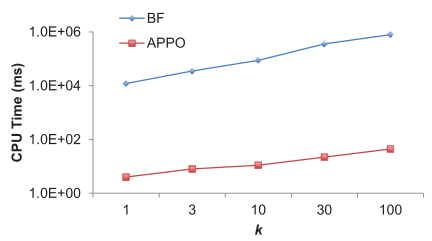
**TL;DR**: Ranking objects in uncertain databases (like noisy sensor data or subjective user ratings) often yields low-confidence Top-k results. This paper moves away from trying to "fix" individual data points. Instead, it uses a **pairwise crowdsourcing model** where humans compare two objects at a time. By selecting the most informative pairs using a new index structure (**PB-tree**), the authors improve Top-k result quality by up to 30x faster than traditional methods, turning a days-long computation into a one-minute task.
**Academic Positioning**: This work bridges the gap between **probabilistic databases** and **human-in-the-loop (HITL) computing**, specifically optimizing the "Value of Information" for object-level ranking tasks.
## The Problem: The Subjectivity Trap
Current data cleaning for Top-k queries usually follows a "singleton model"—trying to determine the exact value of an object (e.g., "What is the exact age of the person in this photo?"). However, for subjective data (ratings, beauty, age), humans are notoriously bad at absolute estimation but excellent at **relative comparison** (e.g., "Person A is older than Person B").
Prior work focused on instance-level cleaning, which doesn't translate well to object-level applications where we care about the set of top objects, not their specific noisy values.
## Methodology: The Core Innovations
### 1. Entropy as a Quality Metric
The authors use Shannon Entropy to measure the "chaos" of the Top-k results. If the probability is spread across many different possible sets of Top-k objects, entropy is high (bad quality). The goal is to select pairs $(o_x, o_y)$ to crowdsource that maximize the **Expected Quality Improvement (EI)**.
### 2. The PB-tree (Probabilistic B-tree)
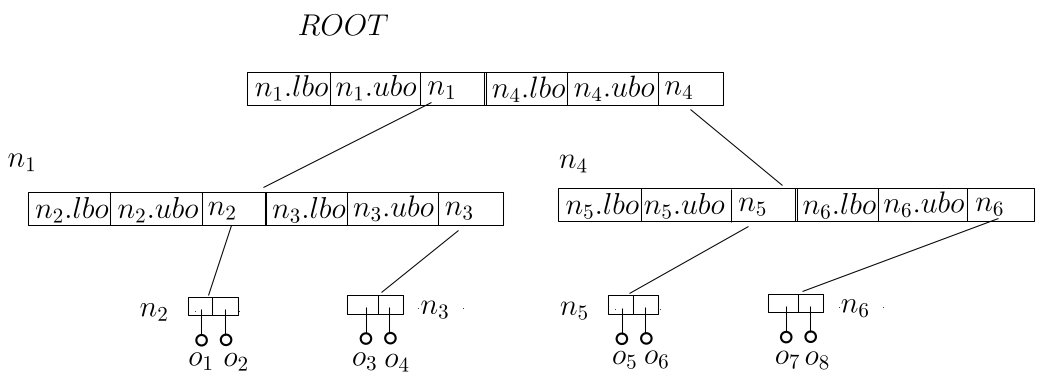
Searching for the best pair is a $O(n^2)$ problem—prohibitive for large datasets. The **PB-tree** clusters objects based on their probabilistic distributions. Nodes in the tree store "pseudo-objects" representing the upper and lower bounds of the objects within them.
### 3. Bound-Based Optimization
Calculating EI exactly is #P-hard because it involves summing over every possible world. The authors side-step this by deriving mathematical **lower and upper bounds** for the entropy change. This allows the algorithm to prune vast branches of the search space that cannot possibly contain the optimal pair.
## Experiments and Results
The authors tested their approach on the **AgeGuessing** website and **IMDB** movie ratings.
* **Effectiveness**: Their "SQ" (Single Quota) selection method consistently outperformed random selection. In multi-pair scenarios, their greedy heuristic (HRS2) effectively managed the redundancy between overlapping pairs.
* **Efficiency**: The contrast was most stark in scalability. As the number of objects grew to 100,000, the brute-force approach (BF) became mathematically unfeasible, while the PB-tree approach stayed near-linear.
## Critical Analysis & Conclusion
**Takeaway**: The real value of this paper lies in its recognition that **relative information** is often cheaper and more accurate than **absolute information**. The PB-tree offers a robust way to index uncertainty.
**Limitations**: The model assumes that workers are generally consistent (though it allows for noise through a probability bias). In ultra-noisy environments or adversarial crowdsourcing, the deterministic assumption of the crowd's answer might need to be relaxed into a fully Bayesian update.
**Future Outlook**: This framework is highly extensible to graph databases (determining if an edge exists) and multi-criteria decision-making where weights are inherently uncertain.