
Beyond the Paradox: Why IT Investment in Healthcare Isn't a Magic Bullet
Reexamining the impact of information technology investment on productivity using regression tree and multivariate adaptive regression splines (MARS)
This study re-examines the "IT productivity paradox" in the healthcare sector by applying non-parametric data mining techniques—Regression Trees (RT) and Multivariate Adaptive Regression Splines (MARS). It investigates how IT investments impact hospital productivity (Adjusted Patient Days) under varying conditions and regulatory environments (the DRG system).
TL;DR
Is more IT always better for hospital productivity? This seminal study suggests the answer is a resounding "No." By moving away from traditional linear regressions and using sophisticated data mining techniques like Regression Trees (RT) and Multivariate Adaptive Regression Splines (MARS), researchers found that the impact of IT is highly conditional. IT only boosts productivity when balanced correctly with non-IT labor and capital, and its effectiveness shifted dramatically after the introduction of the DRG reimbursement system.
The Problem with Traditional "Black Box" Models
For decades, economists used the Cobb-Douglas production function to measure how IT spending translates to output. However, these models often treated IT as a global variable—assuming that every dollar spent in IT has the same marginal effect whether the hospital is small, large, understaffed, or over-capitalized. This led to the "Productivity Paradox," where massive IT investments didn't always show up in the bottom line.
The authors argue that the real question isn't whether IT works, but under what conditions it works.
The Methodology: RT and MARS
To capture the "messy" reality of hospital operations, the study employed two non-parametric techniques:
- Regression Trees (RT): These create "If-Then" rules to partition the data into segments where the variables behave differently.
- MARS: This technique breaks the data into piecewise linear segments. It finds "knots"—points where the relationship between IT and productivity changes direction.
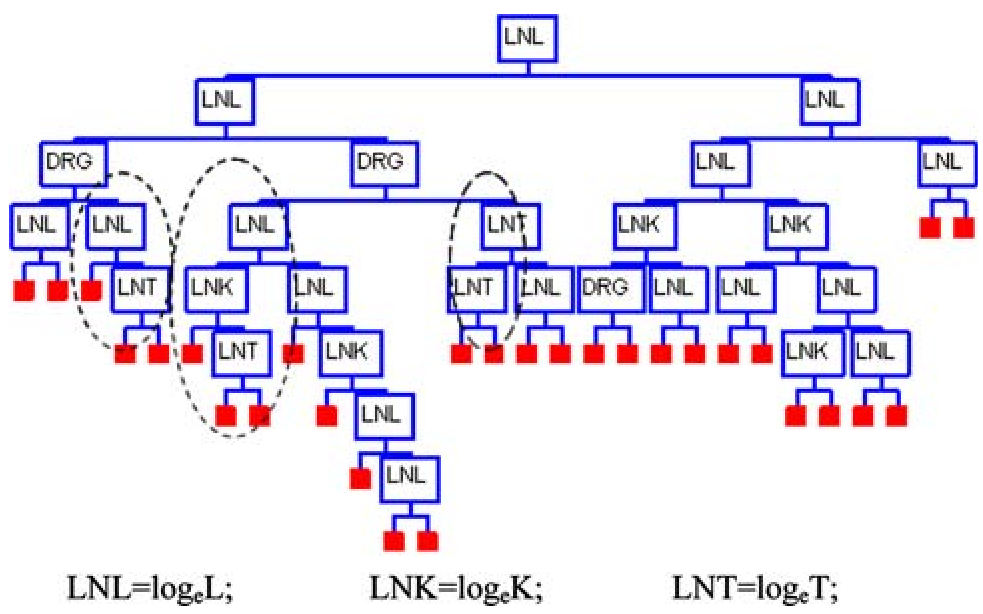 Figure: The RT topology shows how variables like Non-IT Labor and IT Stock interact to predict patient days.
Key Insights: The Conditionality of IT
The study’s findings reveal a complex landscape of "knots" and "thresholds":
1. The Labor Complementarity
A common management temptation is to substitute IT for human labor to cut costs. However, the MARS model suggests that IT impact is often positive only if Non-IT Labor exceeds a certain threshold. Essentially, IT doesn't replace workers; it empowers skilled workers. Without the right staff level, IT systems can actually become a burden.
2. The DRG Regulatory Shift
The introduction of Diagnostic Related Groups (DRG) in 1983—which shifted hospitals from "get paid for what you spend" to "get paid a flat fee per diagnosis"—fundamentally changed IT's role. Before DRG, IT impact was simpler; after DRG, the relationship became hyper-contingent on the balance between IT stock and non-IT capital.
3. Thresholds of Diminishing Returns
MARS identified specific points where IT went from being a productivity booster to a "paradoxical" drain. For instance, in certain scenarios, if the log of IT Stock exceeded 13.570, the marginal productivity gain dropped to zero or even turned negative.
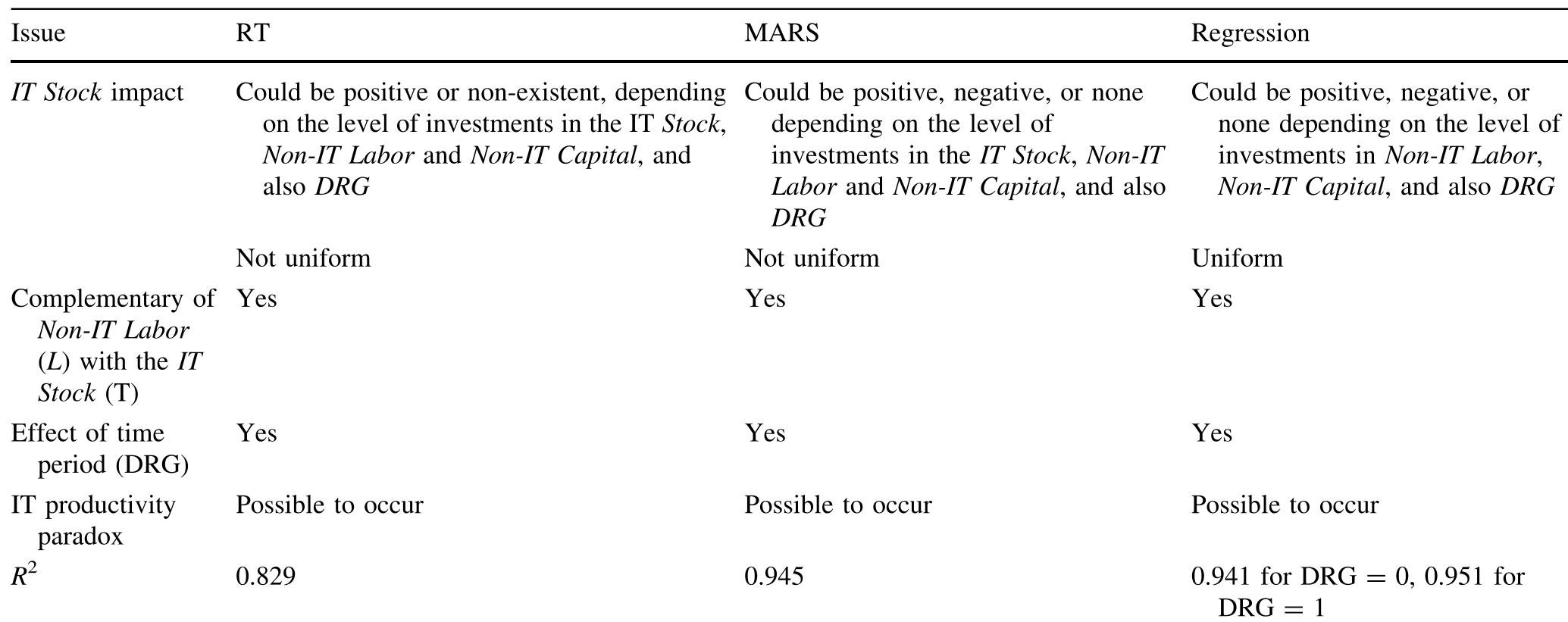 Table: Comparison of RT, MARS, and Traditional Regression performance.
Critical Analysis: Why This Matters Today
While this paper was published in 2008 using 1990s data, its core message is more relevant than ever in the era of AI and Electronic Health Records (EHR).
- Strategic Budgeting: Managers shouldn't just "invest in IT." They need to perform "What-If" analyses to see if their current labor force and capital equipment can actually support the new technology.
- Non-Linearity is King: The high of MARS (0.945) compared to linear models proves that the "average" effect of IT is a myth.
- Administrative IT vs. Medical IT: The study notes that Administrative IT can drive down costs or slow growth, but only when carefully calibrated with non-IT capital.
Conclusion
The "Productivity Paradox" wasn't necessarily a failure of technology, but a failure of calibration. This research proves that IT is part of a delicate ecosystem. For IT to provide value, it requires a "fit" between the technology, the people (Non-IT Labor), and the physical infrastructure (Non-IT Capital).
Future Outlook: As we integrate AI into healthcare, we must ask the same questions: Does the hospital have enough "non-AI labor" to handle the output? Or are we reaching a "knot" where more technology will actually slow us down?