
Refined Behavior Analysis: Bridging Context and User Action via Semantic FCA
Refinement Strategies for Correlating Context and User Behavior in Pervasive Information Systems
The paper introduces refinement strategies for ubiquitous computing environments using Formal Concept Analysis (FCA) to correlate user behavior with contextual data. By incorporating frequency-based and ontology-driven semantic measures, the authors develop a method to identify context elements that significantly impact application usage.
TL;DR
In the world of Pervasive Information Systems (PIS), data is everywhere, but relevance is rare. This paper addresses the "equality trap" of Formal Concept Analysis (FCA)—where rare events are treated the same as frequent habits. By introducing semantic ontologies and frequency-based refinement, the authors provide a surgical method to identify which context elements (like location or time) actually drive user behavior, enabling far more precise personalization.
The Problem: The "Big Data" Weakness of FCA
Formal Concept Analysis is a powerful mathematical tool for clustering, but it typically relies on a binary formal context (a table of 1s and 0s).
- The Flaw: If you use an app once at a restaurant and 100 times at home, a standard FCA lattice might weight "Restaurant" and "Home" equally.
- The Consequence: The resulting Galois lattices become cluttered with noise, making it impossible for service providers to know whether an app recommendation is truly contextually appropriate or just a statistical fluke.
Methodology: High-Frequency and Semantic Refinement
The authors propose a "Refinement Strategy" that filters raw data before it ever hits the FCA algorithm. This is done through two distinct lenses:
1. Frequency Measures (F vs. Fs)
- Statistical Frequency (F): A simple count of occurrences divided by total interactions.
- Semantic Frequency (Fs): This uses a Context Ontology (see below). It normalizes frequencies within specific categories (e.g., comparing "Home" only against other "Locations" rather than against "Time" or "Network"). This ensures that a single connection type like "3G" isn't drowned out by dozens of different locations.
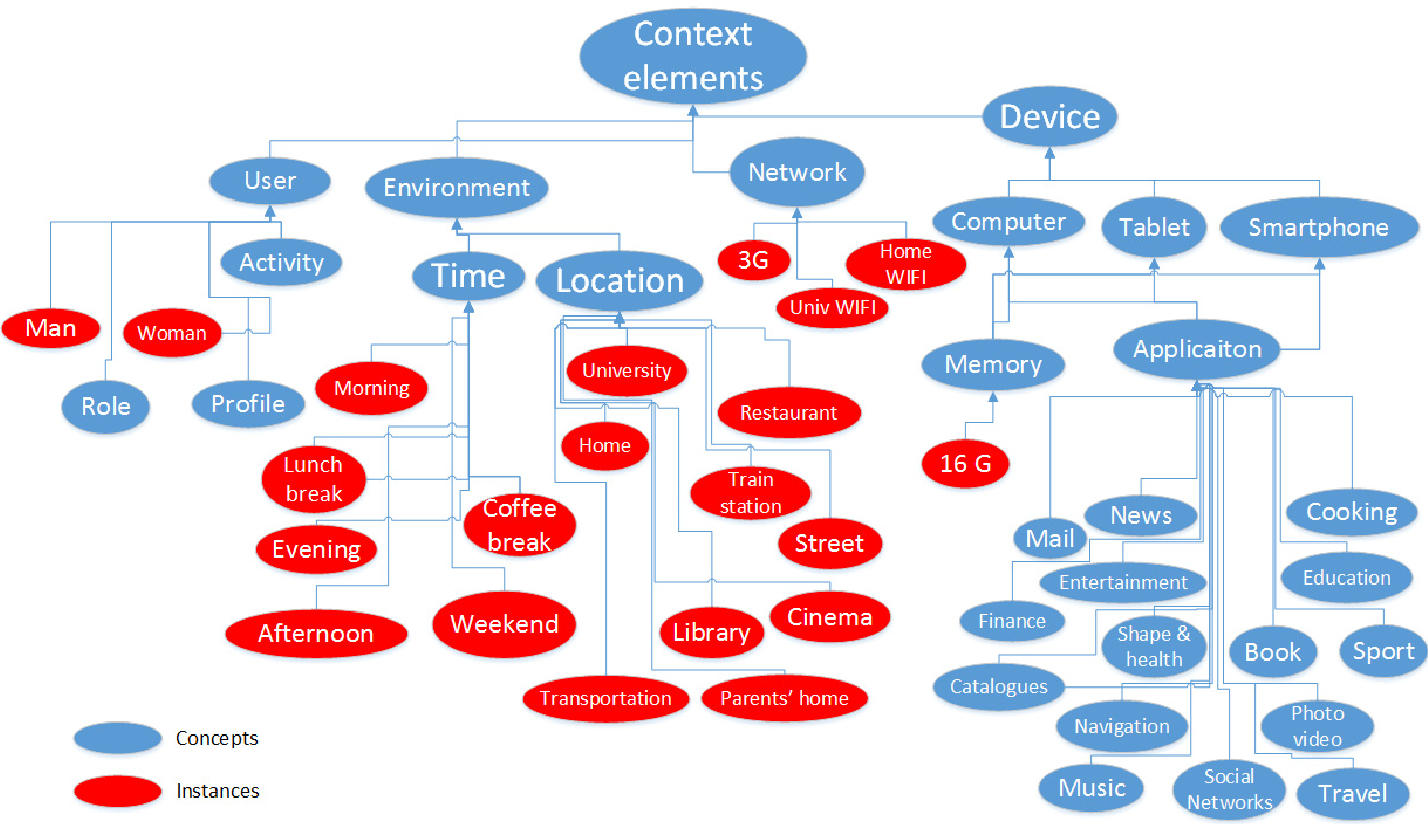
2. Strategy "High" vs. Strategy "Low"
- Strategy High: Focuses on the "1s"—the context elements where usage is significantly above average.
- Strategy Low: Focuses on the "zeros"—identifying contexts where a user rarely uses an app, which is gold for marketers looking for "incentive" opportunities.
The math uses a tuning parameter β:
threshold = average + β * std_deviation
Experiments and Insights
The team tested their methodology on a dataset of 28 tablet users. By applying the Strategy 2 (Semantic High) with β=0, they transformed a generic, messy lattice into a high-precision classification tool.
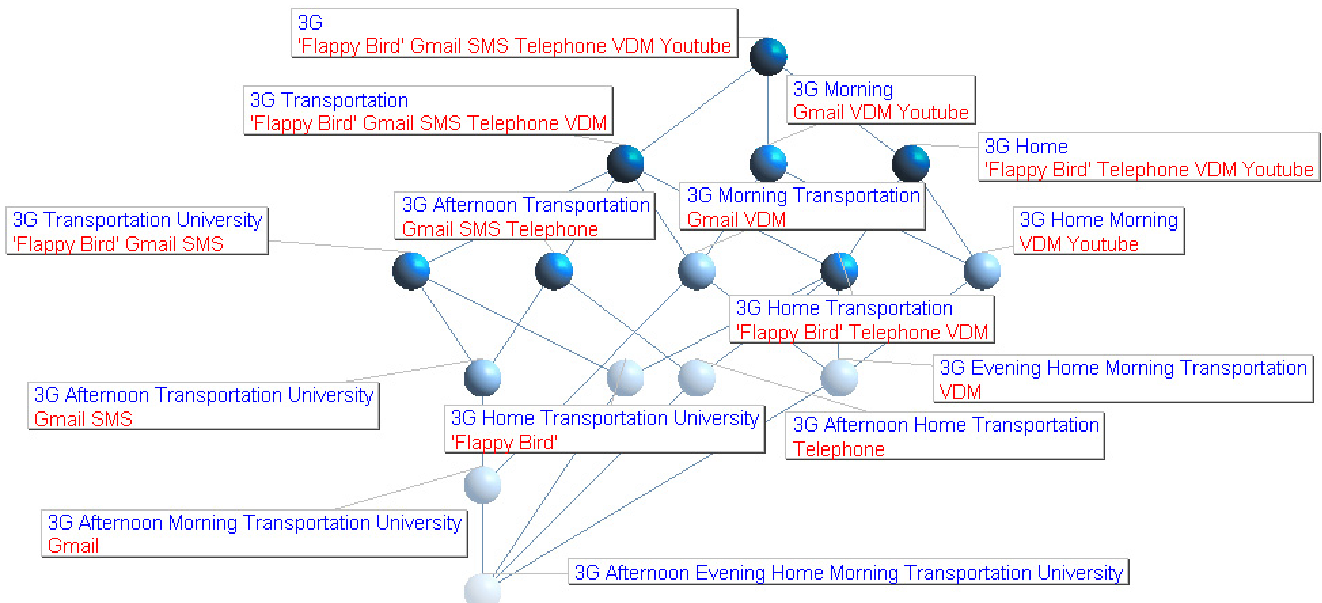 Figure: The refined lattice (S2, β=0) shows much clearer application-context clusters compared to raw FCA.
Key Findings:
- Noise Reduction: Irrelevant context elements like "coffee break" or "lunch break" naturally disappeared from the lattice because they didn't meet the frequency threshold.
- Granularity: Even with fewer context elements, the number of meaningful concepts (clusters) increased, providing a finer-grained map for recommendation engines.
- Semantic Advantage: Using an ontology to weigh context proved superior to raw statistics, as it preserved vital but low-count categories like network connection types.
Critical Analysis & Conclusion
Takeaway
This work demonstrates that "more data" isn't the solution to personalization—"smarter filtering" is. By merging the structural logic of FCA with the semantic depth of ontologies, we can move from simple data mining to true Context-Aware Intelligence.
Limitations & Future Work
The study was conducted offline based on questionnaires. The real test will be moving this to an online, runtime environment where thresholds must adjust dynamically as user habits evolve. Furthermore, the selection of the β parameter is currently heuristic; automated optimization of this threshold remains a promising frontier for future research.
Conclusion
For developers of IoT and pervasive systems, this paper offers a roadmap to move beyond "one-size-fits-all" algorithms toward systems that understand the weight of a user's world.