
RSCOC: Solving the CR-VANET Bottleneck through Infrastructure Intelligence and Linear Programming
8181_Regional Super Cluster Based Optimum Channel Selection for CR-VANET.
Summary
Problem
Method
Results
Takeaways
Abstract
This paper introduces the Regional Super Cluster based Optimum Channel Selection (RSCOC) protocol for Cognitive Radio Vehicular Ad Hoc Networks (CR-VANETs). The method leverages Road Side Units (RSUs) to perform historical spectrum sensing and utilizes a Linear Programming Problem (LPP) solved via the Simplex method to allocate the most reliable idle channels to vehicles.
## TL;DR
In the rapidly evolving world of Intelligent Transportation Systems (ITS), the transition to Cognitive Radio Vehicular Ad Hoc Networks (CR-VANETs) is hindered by the overhead of spectrum sensing. This paper introduces **RSCOC**, a framework that shifts the burden of sensing from mobile vehicles to a "Super Cluster" of Road Side Units (RSUs). By applying Linear Programming to historical sensing data, RSCOC improves throughput by 21% and slashes Primary User collisions by over 50%.
## The Motivation: Sensing is a Waste of "Vehicle Time"
Vehicular communication relies on the 5.9GHz DSRC band, which is increasingly congested. While Cognitive Radio (CR) allows vehicles to "borrow" idle spectrum from Primary Users (PUs), the cost is high: vehicles must stop transmitting to sense the environment.
The authors identify a critical gap: **Prior works either burden the vehicle with sensing tasks or fail to account for the high mobility of vehicles crossing multiple infrastructure zones.** If an RSU only knows the spectrum state in its immediate vicinity, a vehicle traveling at 50 m/s will quickly encounter a "blind spot," leading to dropped packets or PU interference.
## Methodology: The Mathematics of Reliability
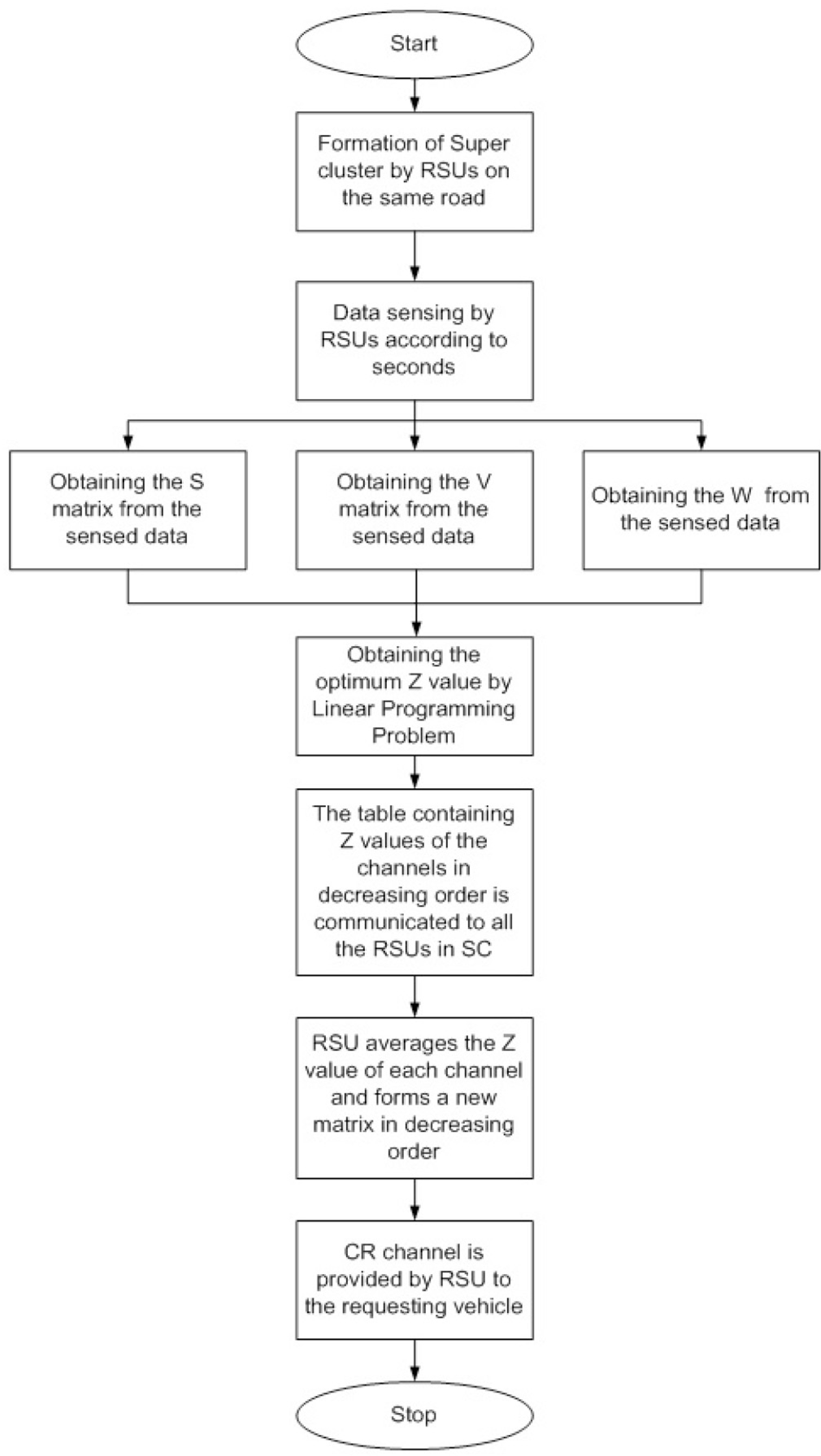
The RSCOC protocol operates on a sophisticated data processing pipeline hosted on the RSU infrastructure.
### 1. The Regional Super Cluster (SC)
Instead of isolated RSUs, the protocol organizes RSUs along a road segment into a **Super Cluster**. They share a common "reliability table," ensuring that the channel assigned to a vehicle remains optimal throughout its transit across the segment.
### 2. Statistical Multi-Dimensional Analysis
The RSCOC doesn't just look at whether a channel is "busy or idle." It constructs a 2D matrix ($60 imes 1440$) for every channel and day, calculating:
* **Mean Occupancy ($S$):** The average time a channel is busy.
* **Intra-minute Consistency ($V$):** How often a channel toggles between busy/idle within a minute.
* **Inter-minute Stability ($W$):** Sharp changes in occupancy between adjacent minutes.
### 3. Optimization via Simplex Method
To find the "Perfect Channel," the authors formulate a Linear Programming Problem (LPP). The goal is to maximize a weighted function:
$$Z = \alpha S' + \beta V' + \gamma W'$$
Using the **Simplex Method**, the RSUs calculate the optimal coefficients ($\alpha, \beta, \gamma$) to rank channels. This ensures the selection isn't just a "best guess" but a mathematically optimized decision based on historical patterns.
## Experimental Evidence
The researchers validated RSCOC against the state-of-the-art **CCMAC** protocol and random allocation using NS-2 and SUMO urban traffic simulations.
### Key Findings:
* **PU Collision Reduction:** The most impressive metric. By predicting PU behavior more accurately, RSCOC reduced collisions with primary license holders by **57.55%**.
* **Throughput & Delivery:** RSCOC achieved a **12% higher PDR** and **21% higher throughput** because it avoids the "sensing gaps" that plague vehicle-centric methods.
* **Scalability:** Even with 50 channels and 10 days of history, the storage requirement is only ~104 Megabits, which is negligible for modern RSUs.
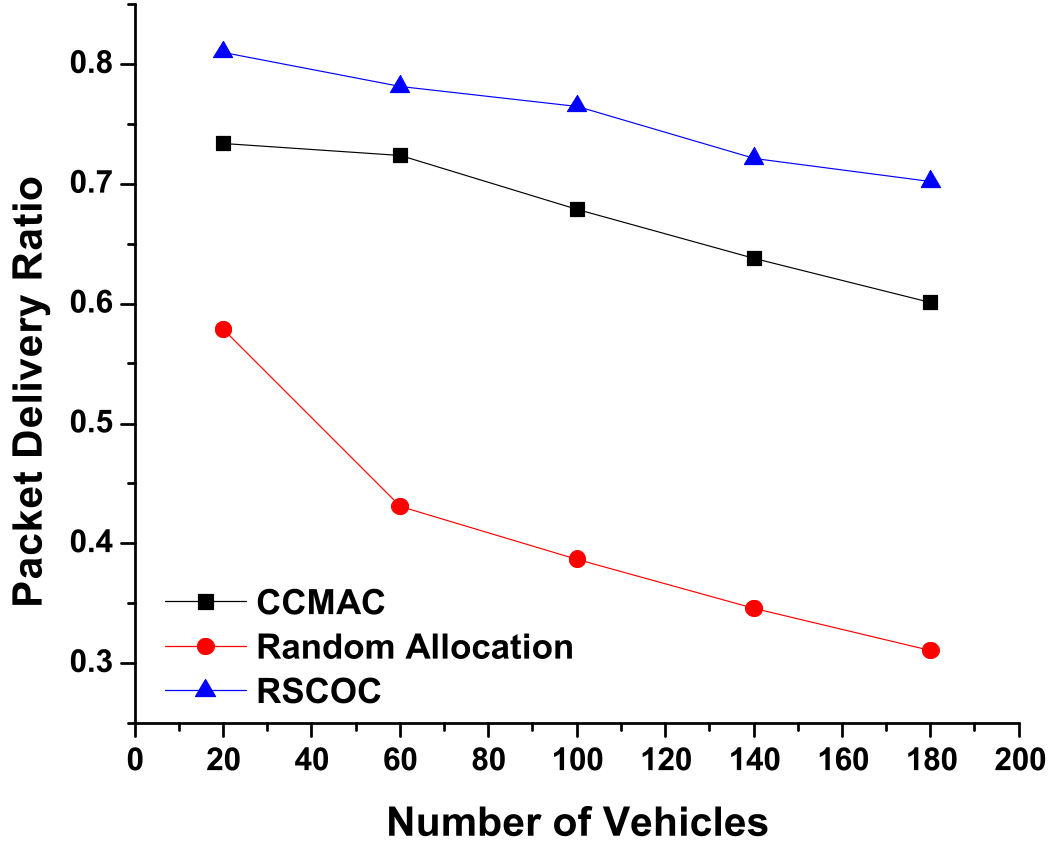
*Fig: RSCOC consistently outperforms CCMAC and Random allocation as vehicle density increases.*
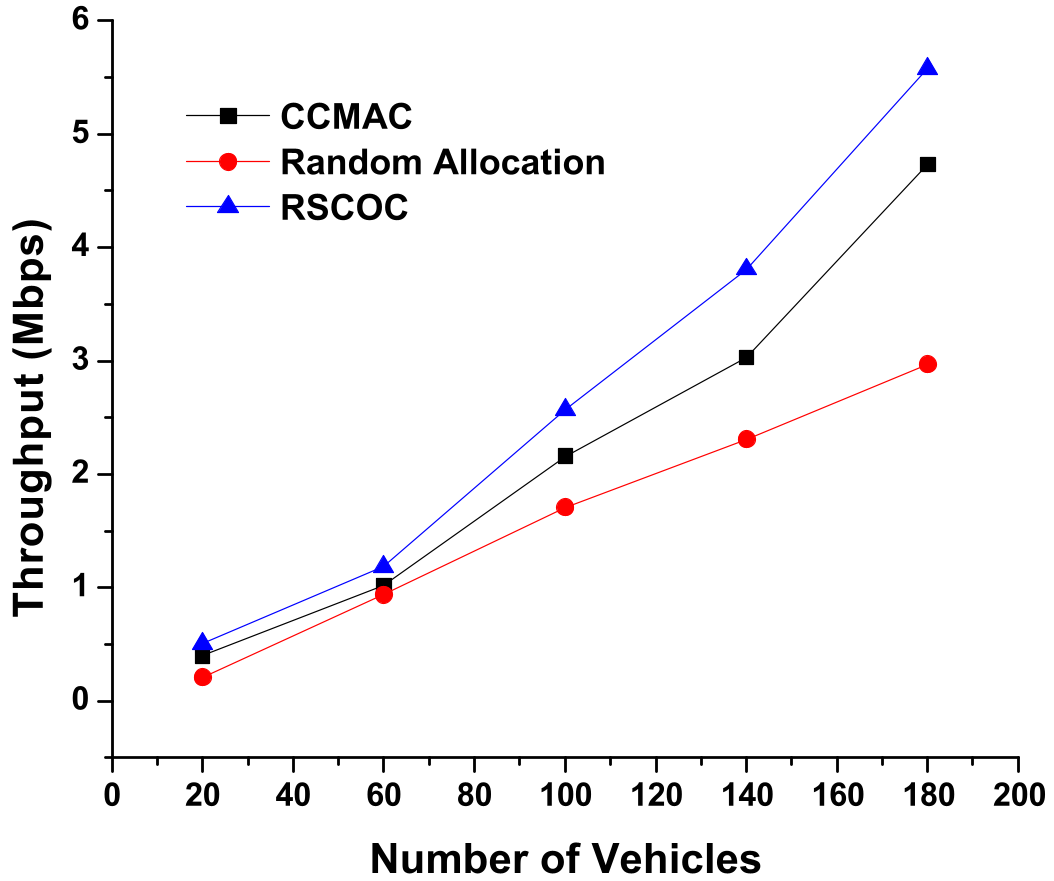
*Fig: Lower delays are achieved by eliminating vehicle-side sensing intervals.*
## Critical Analysis & Conclusion
### Takeaway
RSCOC successfully demonstrates that **Infrastructure-as-a-Sensor** is the superior architecture for CR-VANETs. By offloading computation to RSUs and using global road-segment clusters, the protocol provides the stability needed for high-speed vehicular safety and non-safety messages.
### Limitations & Future Work
While the statistical model is robust, it assumes a degree of periodicity in PU activity (e.g., peak traffic hours). A future iteration could benefit from:
* Integrating **Signal-to-Noise Ratio (SNR)** data to account for physical layer interference.
* Implementing **Deep Reinforcement Learning** to adapt to sudden, non-periodic PU arrivals in real-time.
In summary, RSCOC is a vital step toward making Cognitive Radio a practical reality for the next generation of autonomous and connected vehicles.