
Fingerprint Radio Map Construction: Eliminating Manual Labor with GPR and Crowdsourcing
Regression Assisted Crowdsourcing Approach for Fingerprint Radio Map Construction
The paper introduces a regression-assisted crowdsourcing approach for indoor fingerprinting localization. By integrating Pedestrian Dead Reckoning (PDR) with Bluetooth Low Energy (BLE) beacon proximity, it automates the radio map construction via Gaussian Process Regression (GPR), achieving a localization error below 5.5m for 80% of test cases.
TL;DR
Constructing "Radio Maps" for indoor positioning is notoriously tedious. This paper proposes a system that uses BLE Beacons and PDR (Pedestrian Dead Reckoning) to collect data automatically as users walk normally. By training a Gaussian Process Regression (GPR) model on this crowdsourced data, the system predicts signal strengths across the entire building, achieving high localization accuracy (avg. error ~3.24m) with zero manual site-surveying.
The Motivation: The "Fingerprinting" Bottleneck
Indoor Positioning Systems (IPS) often rely on "Fingerprinting"—a process where a device compares its current signal strength (RSS) to a pre-recorded database. However, building this database (the Radio Map) is a nightmare for researchers and engineers:
- Labor Intensity: You have to stand at every single grid point in a building and record signals.
- Environment Dynamics: If furniture moves or humidity changes, the radio map becomes obsolete, requiring a complete rescan.
- Signal Variance: RSS fluctuates wildly even at a fixed spot, requiring multiple samples per point to get a reliable average.
The authors' insight is to turn every mobile user into a "data surveyor" without them even knowing it.
Methodology: Crowdsourced PDR meets Gaussian Processes
The core of the system is the unsupervised labeling of training data. Instead of a human marking their coordinates, the system uses:
- PDR: Estimates the user's path relative to a starting point using the smartphone's accelerometer and gyroscope.
- Beacon Proximity: Acts as a "reset" or "calibration" point. When a user is very close to a known beacon, the PDR's cumulative error is zeroed out.
The Learning Phase
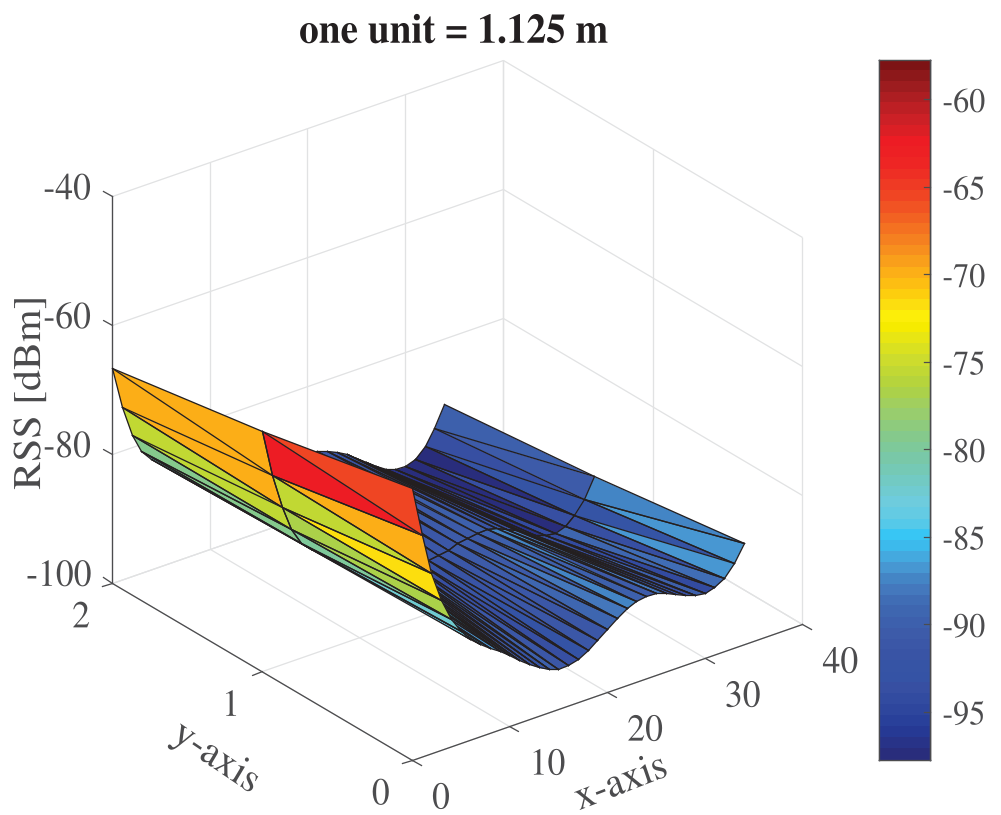
Once data (Location and RSS) is collected via crowdsourcing, it is fed into a Gaussian Process Regression (GPR). GPR is ideal here because RSS distributions typically follow a Gaussian curve. The model predicts:
- Mean RSS: The expected signal value at any coordinate.
- Variance: The uncertainty of that prediction.
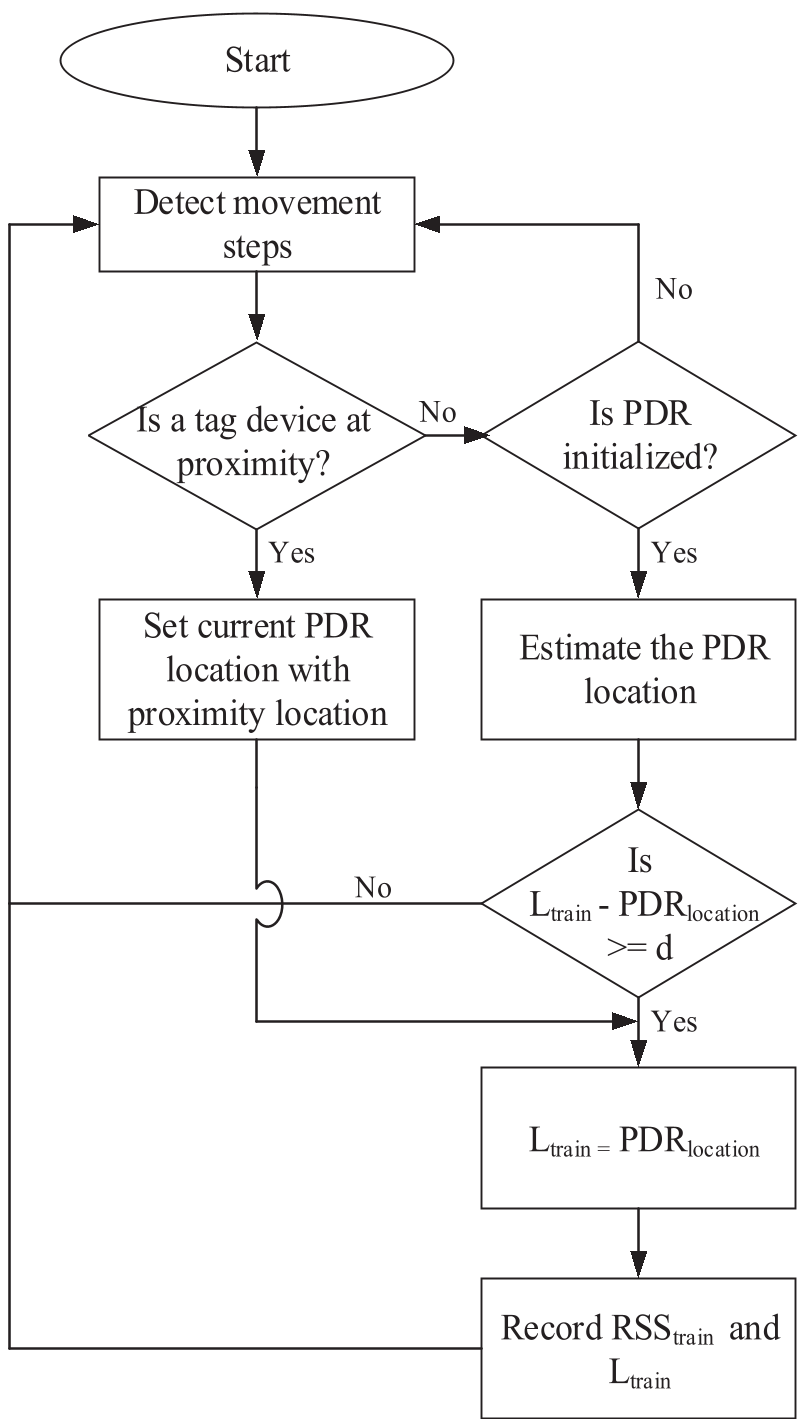
The workflow shows how proximity triggers the recording of training data, which then populates the GPR model.
Experiments & SOTA Comparison
The researchers tested this in an 8th-floor hallway at Chosun University using BLE beacons placed 9m apart.
RSS Prediction Accuracy
The GPR model proved exceptionally accurate. The predicted radio map was compared against a manually measured "Ground Truth" map. The mean difference was a mere 3.87 dBm, suggesting that the model successfully captured the physical characteristics of the hallway's radio environment.
Localization Performance
Using the predicted radio map, they tested two common localization algorithms:
- Maximum Likelihood (ML): Avg. error of 3.24m.
- Wk-NN: Avg. error of 4.01m.
The Cumulative Distribution Function (CDF) shows that 80% of location estimates had an error under 5.5m—a highly competitive result for a system with zero manual training.
Critical Insights & Limitations
The most impressive aspect of this work is the "Valley" of Certainty visualized in the standard deviation plots.
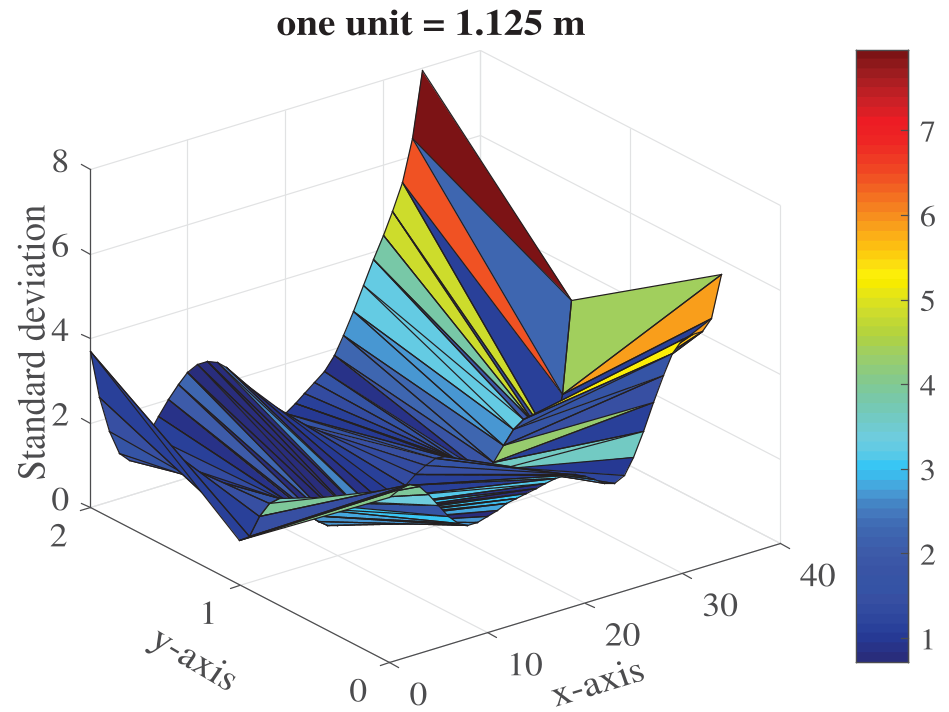
The "valley" in the plot above visually represents the path the crowd worker actually took. Areas further from the path have higher uncertainty (the "peaks"), which tells us exactly where more data is needed.
Challenges to Overcome:
- PDR Drift: Over long distances, PDR accumulates error. While beacons help, more robust filtering (like Kalman or Particle Filters) will be needed for larger buildings.
- Complex Geometry: Hallway experiments are relatively linear. Non-line-of-sight (NLOS) conditions in open offices or multi-room environments will test the kernel functions of the GPR heavily.
Conclusion
This paper provides a blueprint for scalable indoor positioning. By transitioning from "Manual Surveying" to "Regression-Assisted Crowdsourcing," we move closer to IPS deployments that are self-healing and self-updating as users move through the space.