
OSC: Bringing Global Order to Decentralized Social Networks
Regularity Based Decentralized Social Networks
The paper introduces OSC (Online Social Community), a decentralized online social network model based on Law-Governed Interaction (LGI) middleware. It enables the enforcement of global regularities and membership controls in a peer-to-peer environment without a central authority.
TL;DR
The paper proposes OSC (Online Social Community), a model that solves the "anarchy problem" in decentralized social networks. By using Law-Governed Interaction (LGI) middleware, it allows decentralized networks to enforce global rules—like security policies and membership requirements—while keeping data in the hands of users. It effectively bridges the gap between the control of Facebook and the privacy of P2P networks.
The Conflict: Control vs. Decentralization
Centralized Social Networks (OSNs) like Facebook offer great control and "regularity" (laws that everyone follows) but at the cost of privacy and security risks. On the other hand, existing Decentralized OSNs (DOSNs) protect privacy but are "lawless"—they cannot enforce global rules.
The authors identify 4 critical gaps in current DOSNs:
- Lack of Global Access Control: Organizations cannot enforce enterprise-wide data policies.
- Insecure Gossip Protocols: In P2P search, carriers can often snoop on messages they are just supposed to pass along.
- Unregulated Membership: No reliable way to authenticate or revoke members globally.
- Behavioral Constraints: No mechanism to restrict specific actions based on roles (e.g., only a "manager" should be able to ban a user).
Methodology: The LGI Architecture
The core "magic" of this paper is the Law-Governed Interaction (LGI). Instead of a central server, every user has a Controller (Mediator).
The 4-Tuple Model 〈M, L, T , S〉
- M (Members): Users, their mediators, and their local databases.
- L (Law): The code that defines what interactions are allowed.
- T (Controllers): The middleware that executes the law.
- S (Support): Optional services like Certificate Authorities (CA).
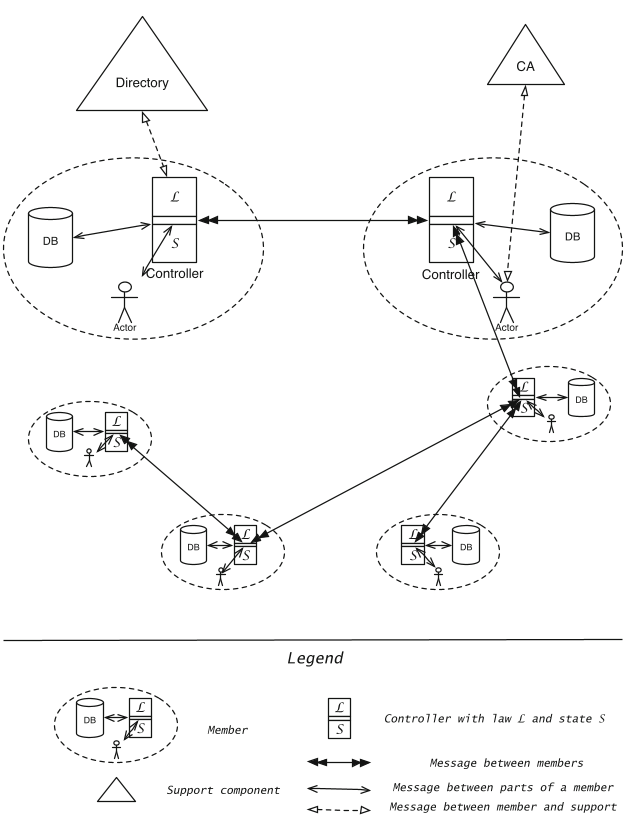
How it works: When User A sends a message to User B, it must pass through A's controller and B's controller. Both controllers check the message against the "Law." If the law says "only managers can send this," and A isn't a manager, the controller simply blocks the message.
Key Implementation Features
1. Membership & Revocation
The system uses rules (R1-R7) to verify employees via certificates. Crucially, it enables Decentralized Revocation. If a manager sends a #revoke# message, the target's controller receives it and immediately terminates all further interactions for that user. The user cannot bypass this because the controller is a trusted middleware.
2. Privacy-Preserving Search (The Gossip Improvement)
In a standard gossip protocol, if I search for "oncology specialists," every node carrying my message knows what I'm looking for. In OSC, the Law (Rule R13) ensures that:
- Only members who satisfy the search criteria can "Deliver" (read) the message.
- Intermediate carriers only "Forward" the message without accessing the content.
(Note: Rule R13 in the paper governs the logic of conditional delivery during gossip, preventing carriers from snooping.)
Experimental Validation
The authors implemented a case study for an enterprise OSN with 200 users. They successfully demonstrated:
- Role-based access: Different groups (e.g., HR, Engineering) had overlapping but distinct access rights.
- Scalable Search: Using gossip instead of a central index, while maintaining the privacy of the search query.
- Automated Enforcement: Proving that even in a distributed environment, the law is "absolute" as long as the controllers are trusted.
Critical Insight & Conclusion
This paper is a significant "theoretical fix" for decentralization. It proves that governance is a middleware problem, not a centralization problem.
Limitations: The model relies heavily on the "Trustworthiness of Controllers." If a user can hack their own LGI-controller, the whole legal structure of the community collapses. The authors suggest using a Trusted Controller Service (CoS), but this reintroduces a slight element of centralization.
Future Outlook: As we move toward Web3 and decentralized identity, the principles of LGI-governed interactions could provide the necessary "rules of engagement" for decentralized autonomous organizations (DAOs) and private enterprise social layers.