
Navigating the Digital Crowd: How Culture and Social Circles Shape Our Online Privacy
How to regulate individuals’ privacy boundaries on social network sites: A cross-cultural comparison
2018-05-04
Summary
Problem
Method
Results
Takeaways
Abstract
This study investigates how social networking site (SNS) users regulate privacy boundaries amidst diverse social circles using Communication Privacy Management (CPM) theory. It specifically compares the mechanisms of boundary coordination and turbulence across the United States and China, identifying how cultural dimensions like individualism and uncertainty avoidance moderate self-disclosure intentions.
## Executive Summary
**TL;DR**: In the age of "Context Collapse," we no longer post for a single audience but for a messy mix of bosses, parents, and friends. This study explores the "Communication Privacy Management" (CPM) framework to explain why we choose to share or hide. By comparing users in the US and China, the researchers reveal that while everyone seeks **Social Rewards**, our cultural DNA fundamentally changes whether we trust technical "Privacy Settings" or social "Group Norms" to protect us.
This paper serves as a critical bridge between sociological theory and UX design, mapping how the internal friction of playing multiple social roles (Role Conflict) creates the "turbulence" that makes us hit the delete button.
## The Friction of Multiple Personas: Problem & Motivation
Have you ever hesitated to post a party photo because your coach or manager might see it? This is the core of **Boundary Turbulence**.
Existing literature often views privacy as a solo calculation (Privacy Calculus). However, the authors argue that on SNS, privacy is a **collective game**. Once you share, your friends become "co-owners" of that data. The problem is that as our digital circles grow, we face:
* **Role Overload**: Too many expectations to manage.
* **Role Conflict**: Incompatible standards between different social groups.
The authors' insight is that culture acts as a filter for these stressors. A user in Shanghai might weigh a "shared group goal" differently than a user in New York when deciding if a post is "safe."
## Methodology: The CPM Framework in Action
The researchers broke down the privacy process into three distinct phases: **Rule Formation** (the cost-benefit check), **Coordination** (how we synchronize with others), and **Turbulence** (when things go wrong).
### 1. The Coordination Mechanisms
To prevent privacy leaks, users rely on two types of "fences":
* **Group Norms**: Soft fences. Shared values that "we don't leak each other's secrets."
* **Privacy Settings**: Hard fences. Technical tools provided by the platform (e.g., "Friends except...").
### 2. The Turbulence Factors
When these fences fail due to the sheer volume of social roles, users experience **Privacy Risk**, leading to a withdrawal from the platform.
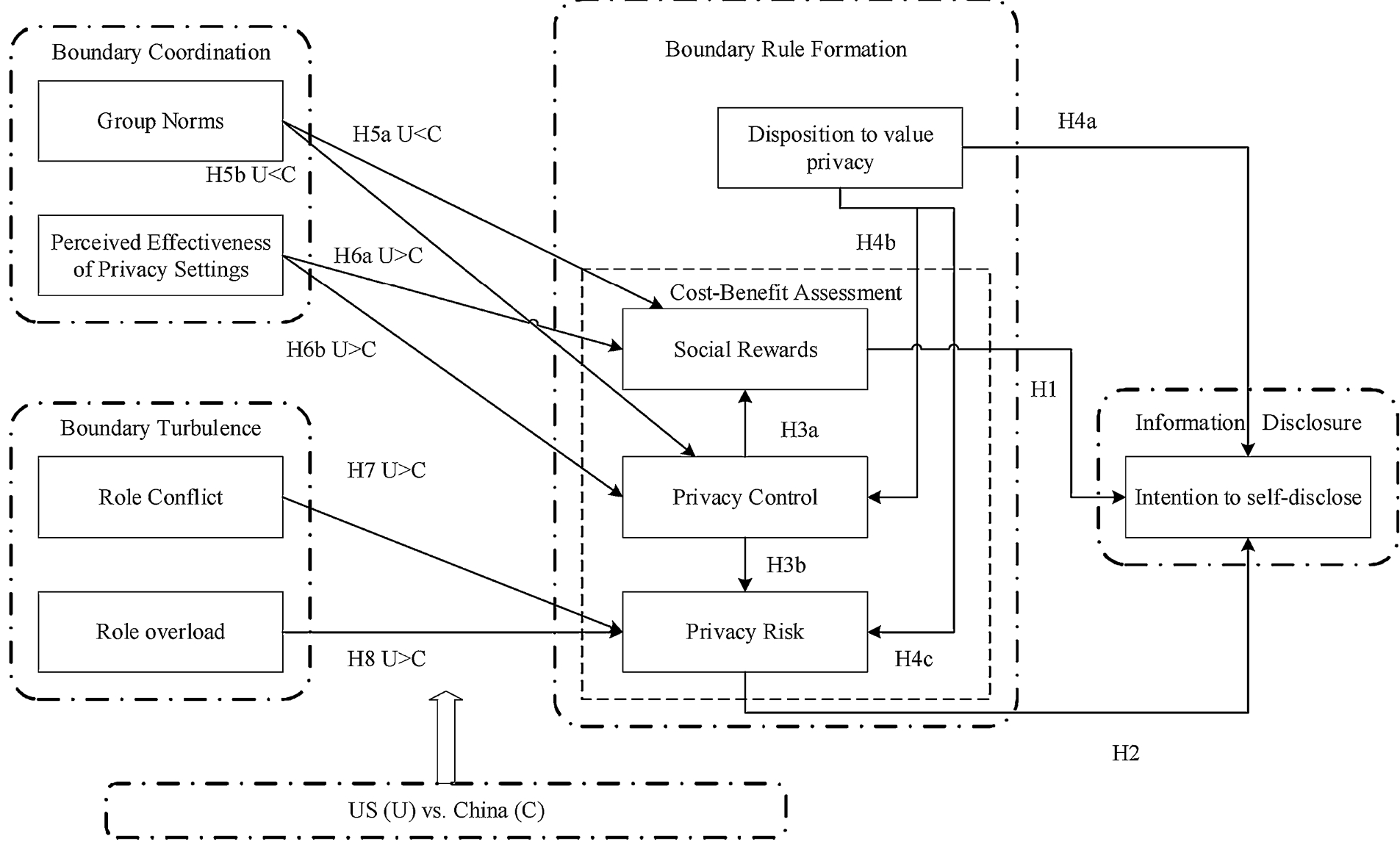
*The model illustrates how boundary coordination/turbulence feeds into the cost-benefit assessment of self-disclosure.*
## Experiments & Cultural Breakthroughs
The study surveyed 381 Americans and 450 Chinese users. Using Partial Least Squares (PLS), they uncovered several "clashes" in how cultures handle privacy.
### Key Findings:
* **Collectivism vs. Individualism**: For Chinese users (high collectivism), **Group Norms** were much more effective at providing a sense of "Privacy Control." In contrast, American users (high individualism) relied almost exclusively on the **Effectiveness of Privacy Settings**.
* **Uncertainty Avoidance**: For Americans, **Role Overload** (having too many roles to play) created a massive spike in perceived **Privacy Risk**. Chinese users were more tolerant of this ambiguity.
* **The Reward Driver**: Across both cultures, **Social Rewards** (acceptance, status, approval) remains the strongest predictor of why people disclose information, even when they know the risks.
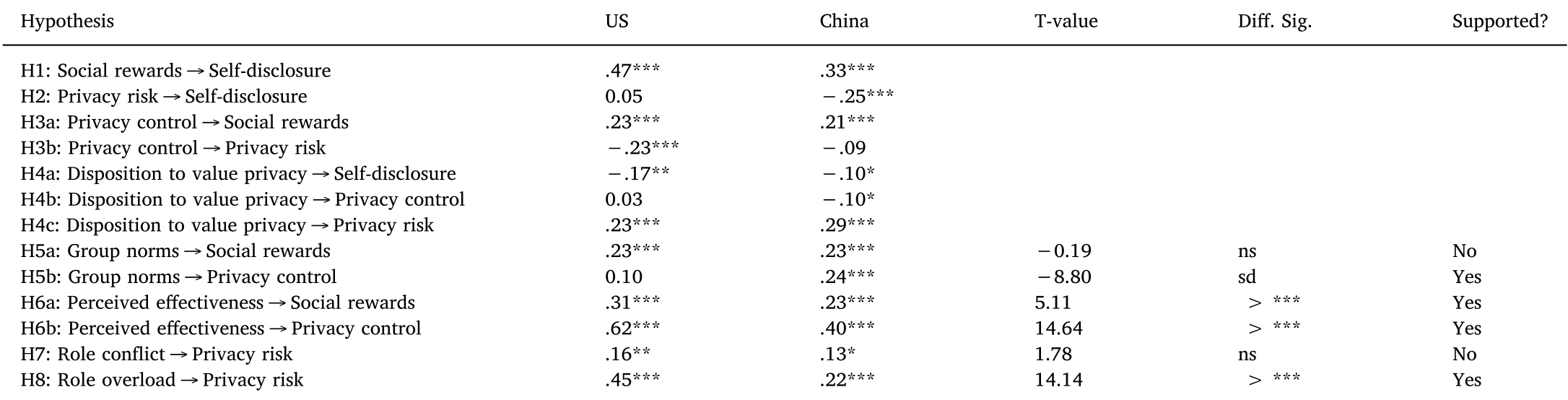
*The T-values highlight significant differences in how Group Norms and Role Overload impact users across the two nations.*
## Deep Insight: Beyond a "One-Size-Fits-All" UI
The most profound takeaway from Liu and Wang's work is for the architects of social platforms.
1. **For Western Markets**: Privacy tools must be "hard" and "explicit." Users need to feel the "knobs and levers" of their privacy settings to feel safe.
2. **For Eastern Markets**: Features that reinforce "community trust" and shared responsibility are more effective.
3. **The "Millennial" Factor**: The paper hints that younger "Digital Natives" might be evolving past these traditional cultural boundaries, suggesting a future "Cultural Convergence" in digital behavior.
### Conclusion
Privacy is not just a setting in a menu; it is a social performance. This study proves that our willingness to share is a delicate balance between the **pleasure of being seen** and the **fear of being misunderstood** by the wrong audience. As we move toward more immersive social environments (like the Metaverse), understanding these cultural scripts of "boundary coordination" will be the difference between a thriving community and a digital ghost town.