
Rehumanized Crowdsourcing: Why the "Who" Behind the Label Matters for AI Ethics
9275_Rehumanized Crowdsourcing A Labeling Framework Addressing Bias and Ethics in Machine Learning.
The paper introduces "Rehumanized Crowdsourcing," a novel labeling framework designed to mitigate demographic bias and ethical issues in machine learning datasets. By employing a multi-objective optimization algorithm, the system dynamically routes microtasks to crowd workers based on human factors such as demographics and local minimum wage.
TL;DR
As AI becomes ubiquitous, we often forget that the "ground truth" labels it learns from are generated by thousands of human crowd workers. This paper argues that ignoring the human context of these workers—their gender, age, and economic reality—leads to biased AI and unethical labor practices. The authors propose a "Rehumanized Crowdsourcing" framework that uses multi-objective optimization to ensure diverse, fairly-paid workers provide the data that fuels our algorithms.
The "Dehumanization" of the Data Pipeline
In the race to build SOTA models, data scientists often treat crowdsourcing platforms like black-box APIs: they input raw data and expect labels to come out. This "process-centric" approach overlooks critical human factors:
- Demographic Skew: Most platforms are dominated by specific subgroups (e.g., young males from specific countries like Venezuela).
- Ethical Neglect: Workers are often paid far below their local minimum wage, leading to "digital sweatshop" conditions.
- Bias Amplification: If 70% of your content moderators are male, the resulting "clean" dataset will inherently reflect a male perspective on toxicity and offense.
Methodology: Task Assignment as Optimization
The core of this work is a feedback-loop framework implemented on the Figure Eight platform. Instead of a first-come, first-served model, the system periodically evaluates the current "pool" of labels and adjusts who can see the task next.
The Pareto-Optimal Approach
The system attempts to maximize three often-conflicting objectives:
- Diversity (Entropy): Reaching for a uniform distribution of age, gender, and country.
- Ethics (Fair Pay): Maximizing the ratio of task pay to the worker's local minimum wage.
- Trust (Quality): Maintaining high historical accuracy on "Gold Standard" test questions.
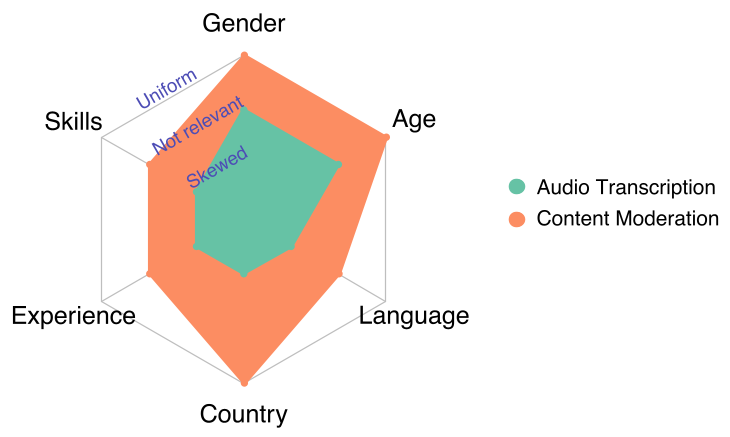 Figure: The framework allows requesters to define specific "Goals" for different use cases, such as prioritizing gender diversity for content moderation.
Experimental Insights
The authors tested the framework across three distinct use cases: Image Categorization, Content Moderation, and Audio Transcription.
1. Breaking the Demographic Monopoly
In the baseline (standard) condition, nearly 60% of workers for an image task came from a single country. With the framework, that concentration dropped to 18.5%, spreading the work across 74 unique countries.
2. Fairer Compensation
By routing tasks to users in regions where the pay was more competitive with local wages, the framework successfully increased the "Percentage of Minimum Wage" earned by workers. For audio tasks, it identified workers from countries where the task pay was significantly higher than local hourly rates, potentially reducing worker churn and boredom.
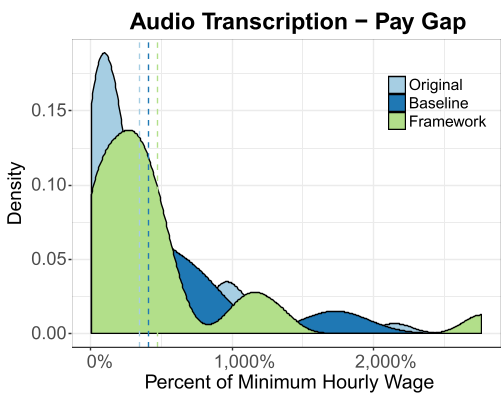 Figure: Density plots showing that the framework (vertical lines) successfully shifted the average compensation closer to or above national minimum wages.
Critical Analysis: The Cost of Fairness
The study reveals a few "hard truths" about rehumanizing the crowd:
- The Throughput Trade-off: Because the system is more selective about who can work, tasks take longer to finish. The framework task for image categorization was only 29% complete when the baseline had already finished.
- The Quality Paradox: There was a slight (3-5%) decrease in accuracy when using the framework. This suggests that the most "accurate" workers on these platforms are often a small, highly active, and demographically narrow group. Expanding the pool to be more "human" and "diverse" may require better training for newcomers.
Conclusion: Toward Transparent Labor
The ultimate takeaway is that accuracy is not a proxy for fairness. A dataset can be 99% accurate according to a specific demographic yet remain fundamentally biased against the rest of the world. By implementing "soft paternalistic nudges"—such as notifying requesters when their pay is too low for their target demographic—platforms can move toward a more sustainable and ethical future for the human labor that builds AI.