
De-Anonymizing the City: How Your Social Media Posts Can Unmask Your Cellular Records
Re-identification and information fusion between anonymized CDR and social network data
This research investigates user re-identification across heterogeneous datasets by fusing anonymized Call Detail Records (CDR) with geo-tagged social media data (Twitter and Flickr). The authors propose a probabilistic framework to quantify the likelihood that two separate digital traces belong to the same physical person based on spatio-temporal overlaps.
TL;DR
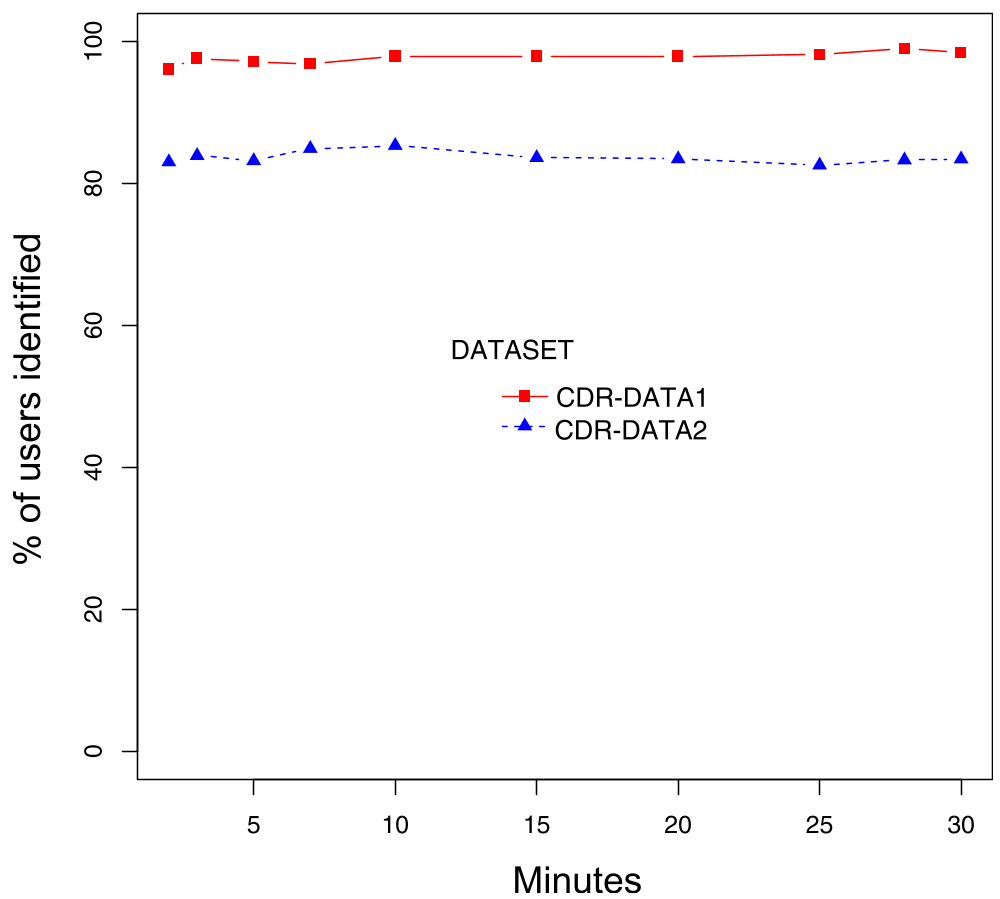
In a world of "anonymized" big data, your privacy might be thinner than you think. Researchers Alket Cecaj et al. demonstrate that by simply comparing the timestamps and GPS coordinates of your tweets/Flickr photos with anonymous cell tower logs (CDR), they can pinpoint your identity with alarming accuracy. By matching just 4 to 5 spatio-temporal "points," they could link social media handles to private mobile subscriber data with over 90% probability.
The Illusion of Anonymity
When telecommunication companies release data for research (like the D4D challenge), they "anonymize" it by hashing your phone number and perhaps adding noise to the location. However, this paper highlights a critical Symmetry of Mobility: the same physical person generates traces in multiple digital silos.
The problem isn't just that your mobility trace is unique (which it is—90% of us can be singled out by just 4 points); the problem is that this uniqueness acts as a join-key. If you tweet from a cafe and your phone simultaneously pings a nearby cell tower, those two independent data streams are now tethered by the laws of physics.
Methodology: Linking the Traces
The authors developed a two-step approach to bridge the gap between Telecom data (CDR) and Social Network data (FT).
1. Spatio-Temporal Matching
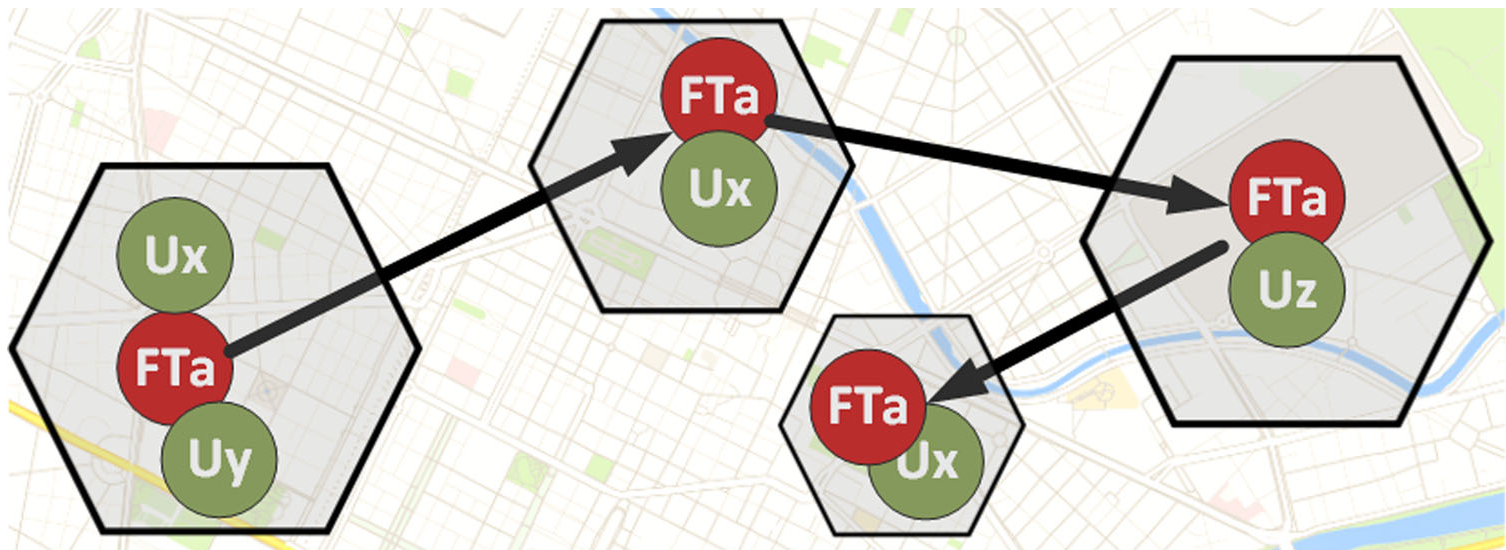
Matching isn't as simple as looking for identical GPS coordinates. CDR data is coarse—it only shows which cell tower you were connected to. The algorithm considers a match if a social media event falls within the coverage radius () of a cell tower and within a time threshold ().
2. The Exclusion Condition
To sharpen the results, the authors used an "exclusion" logic. If a CDR user is logged at Tower A while the Twitter user is posting from a location 20 miles away at the same time, that CDR user is permanently discarded as a candidate for that Twitter identity.
3. Probabilistic De-Anonymization
Unlike previous works that assumed every tweet has a corresponding CDR record, this paper acknowledges that data is sparse. They derived a probability: This calculates the likelihood that two users are the same person given matching points. If is low (e.g., 1 match), the probability is near zero because it could be a coincidental meeting. Once reaches 4 or 5, the probability spikes toward 1.0.
Experimental Evidence
The team tested their theories on massive datasets from Italy (CDR-DATA1 & CDR-DATA2).
- Uniqueness: They confirmed that mobility is incredibly sparse. It doesn't take much to find "who was at these locations at these times."
- The Convergence: For about 23% of social media users, the algorithm converged to exactly one unique CDR candidate.
- The Foreigner Test: In a clever validation, they matched the "Mobile Country Code" (MMC) of foreign SIM cards in the CDR data with the language of tweets (e.g., a German tourist tweeting in German). This ground-truth alignment confirmed the system's accuracy.
The Double-Edged Sword
The conclusion of the paper presents a fascinating dichotomy for the future of Tech:
- The Privacy Threat: Traditional k-anonymity is failing. As the authors quote, "even modest privacy gains require almost complete destruction of data-mining utility." If you make the data safe, you make it useless.
- The Information Fusion Opportunity: If we can safely perform this "joining" of data, we can create "Pervasive Anticipatory Computing." Imagine a city that knows not just where people are moving (CDR data), but why they are moving and how they feel about it (Social Media data).
Critical Analysis
While the study is a breakthrough in cross-dataset re-identification, it faces a Cold Start Problem: it requires a user to be active on both platforms simultaneously. However, as 5G and IoT integration deepen, the number of digital footprints we leave will only increase, making these "coincidental" overlaps a statistical certainty.
Final Takeaway: Your mobility is your fingerprint. In the era of information fusion, "anonymized" is a term that should be handled with extreme academic skepticism.