RLPA: Stabilizing Community Detection via Historical Reinforcement
Reinforcement Label Propagation Algorithm Based on History Record
The paper introduces the Reinforcement Label Propagation Algorithm (RLPA), a community detection method that stabilizes the classic Label Propagation Algorithm (LPA). By leveraging a similarity matrix derived from multiple classification "histories," RLPA significantly improves community detection accuracy—achieving up to a 17% NMI boost—and drastically reduces variance in results.
TL;DR
The Reinforcement Label Propagation Algorithm (RLPA) solves the notorious instability of traditional Label Propagation (LPA) by using a "wisdom of the crowd" approach. By running LPA multiple times to build a similarity matrix, it creates a deterministic tie-breaking mechanism that boosts accuracy by up to 17% and slashes performance variance by up to 97%.
The Chaos in the Network: Why LPA Fails
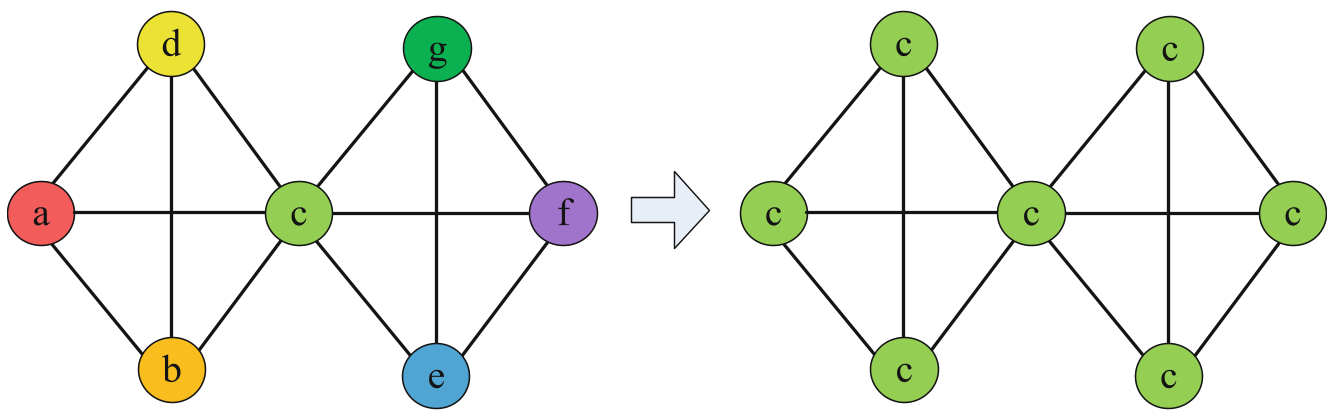
Label Propagation is beloved for its near-linear time complexity—it is one of the few algorithms that can handle massive social networks with millions of edges. However, it has a "gambler's flaw": when a node's neighbors have an equal distribution of different labels, the algorithm picks one at random.
This randomness isn't just a minor fluctuation. It often leads to a tipping point where a small community is accidentally "annexed" by a larger neighbor. Once these labels merge, they rarely separate, leading to unstable results where the same network can yield vastly different community structures across different runs.
The Core Insight: Harnessing the Similarity Matrix
The authors' primary contribution is the shift from "blind randomness" to "informed selection." Instead of relying on a single run, RLPA executes a two-stage process:
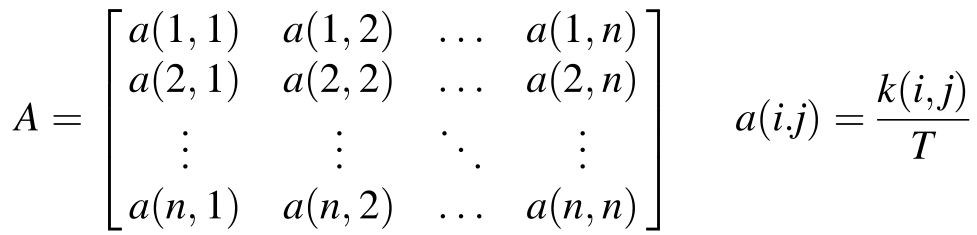
- History Accumulation: Run standard LPA times. If nodes and appear in the same community in runs, their similarity is defined as . This builds a global "Similarity Matrix" representing the statistical likelihood of nodes belonging together.
- Reinforced Propagation: In the final pass, when a node faces a tie between labels, it calculates a Label Influence Factor : where are neighbors of possessing label . The label with the highest cumulative "historical trust" wins.
Performance: Accuracy Meets Stability
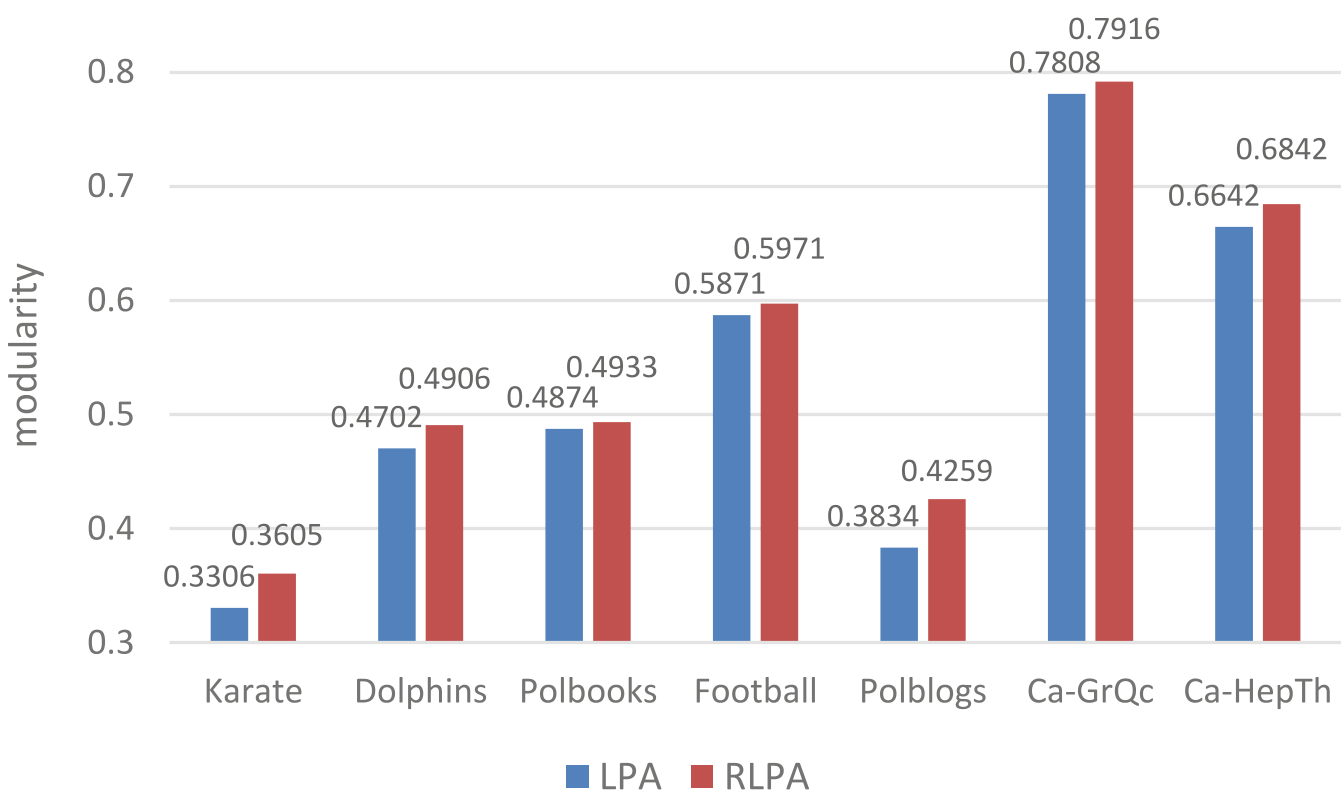
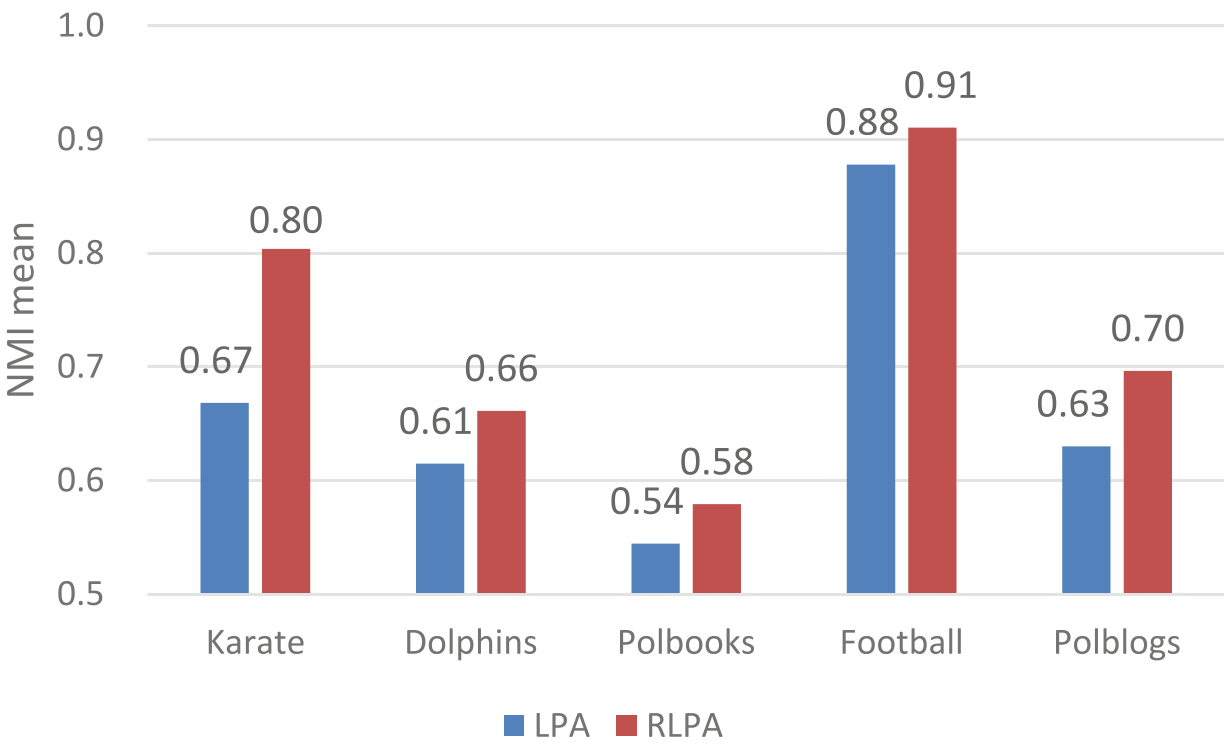
The RLPA was tested against several benchmarks, including the Karate Club, Dolphins, and US Politics blogs. The results demonstrate a "double-win":
- Accuracy (NMI): On the Karate Club dataset, the Normalized Mutual Information (NMI) jumped from roughly 0.68 to 0.80.
- Drastic Variance Reduction: This is the killer feature. For the
Polblogsdataset, the variance in results dropped by 97%. This means researchers can trust a single run of RLPA far more than a single run of standard LPA.
Complexity Analysis: Is it Worth the Overhead?
The time complexity of RLPA is , where is the number of history records and is the number of edges. While this is times slower than standard LPA, the authors show that even a small (e.g., ) yields significant gains. In the era of parallel computing, these runs can be executed concurrently, making the real-world latency overhead negligible compared to the massive stability gains.
Critical Analysis & Conclusion
RLPA is a elegant "plug-and-play" enhancement. It doesn't redefine the core mechanics of label propagation; rather, it provides a rigorous statistical framework for making the decisions that LPA previously left to chance.
Limitations: The algorithm still relies on being sufficiently large to capture the true network structure. In extremely sparse or noisy networks, the "initial" runs might all be equally biased, potentially reinforcing incorrect clusters.
Future Outlook: As noted by the authors, the next step is Parallelization. By implementing RLPA on frameworks like Spark or Pregel, one could potentially cluster billion-node graphs with the same stability currently reserved for small-scale datasets. This work paves the way for "Ensemble Graph Mining" as a standard for operationalizing stochastic algorithms.