
Reinforcement Learning in Healthcare: From Static Guidelines to Dynamic Intelligence
Reinforcement learning for intelligent healthcare applications: A survey
This survey comprehensively explores the integration of Reinforcement Learning (RL) into healthcare, categorizing over 150 papers into eight functional domains including Precision Medicine and Dynamic Treatment Regimes (DTR). It establishes a systematic framework for applying RL, Deep RL (DRL), and Inverse RL (IRL) to clinical decision-making, highlighting state-of-the-art achievements in sepsis treatment and personalized drug dosing.
Executive Summary
TL;DR: This survey provides a roadmap for transitioning healthcare from reactive treatments to proactive, personalized strategies using Reinforcement Learning (RL). By analyzing over 150 studies, the authors demonstrate how RL can optimize everything from sepsis intervention to robotic rehabilitation, offering a "closed-loop" approach to medicine.
Background Positioning: This is a comprehensive taxonomy and impact analysis. It identifies RL as the "logic engine" of precision medicine, moving beyond the pattern recognition of Supervised Learning into the realm of autonomous, sequential clinical reasoning.
The Core Motivation: Why RL is Vital for Medicine
In clinical practice, a doctor doesn't just make one "correct" diagnosis; they manage a patient over time. Each treatment changes the patient's state, which in turn dictates the next treatment.
- The Problem: Human clinicians are limited by the volume of data they can process in real-time.
- The Prior Work Failure: Standard Supervised Learning (SL) requires "labeled" gold standards. In many diseases, we don't know the "best" path—we only know the final outcome (survival or death).
- The RL Insight: By treating healthcare as a Markov Decision Process (MDP), we can use the "Reward Signal" (e.g., survival, reduced tumor size) to discover treatment sequences that humans might never have considered.
Methodology: Mapping the RL Topology
The researchers break down the RL problem into four constituent parts: Policies, Reward Signals, Value Functions, and Models. They distinguish between:
- Tabular Methods (Q-Learning/SARSA): Best for small, discrete state spaces like dosage adjustments.
- Deep RL (DQN): Essential for "Medical Imaging" where the input is a high-dimensional pixel grid.
- Inverse RL (IRL): Used when we don't know the reward function but want to "imitate" the decision-making logic of expert surgeons or top-tier clinicians.
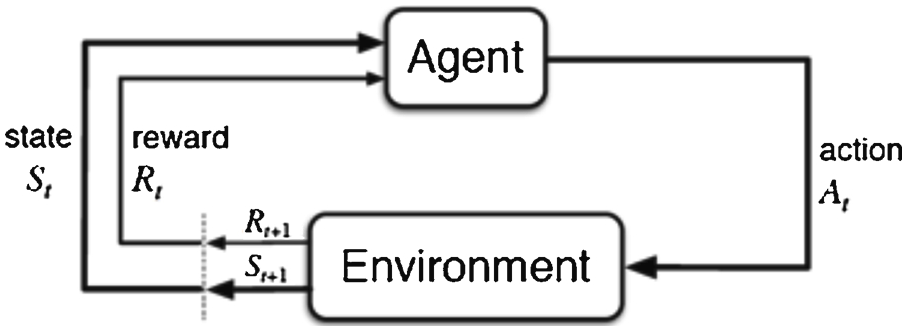 Figure 1: The fundamental interaction loop between the Clinical Agent and the Patient Environment.
A Strategic Pipeline for Developers
One of the paper's most valuable contributions is the Guideline for Application—a decision tree for technical architects.
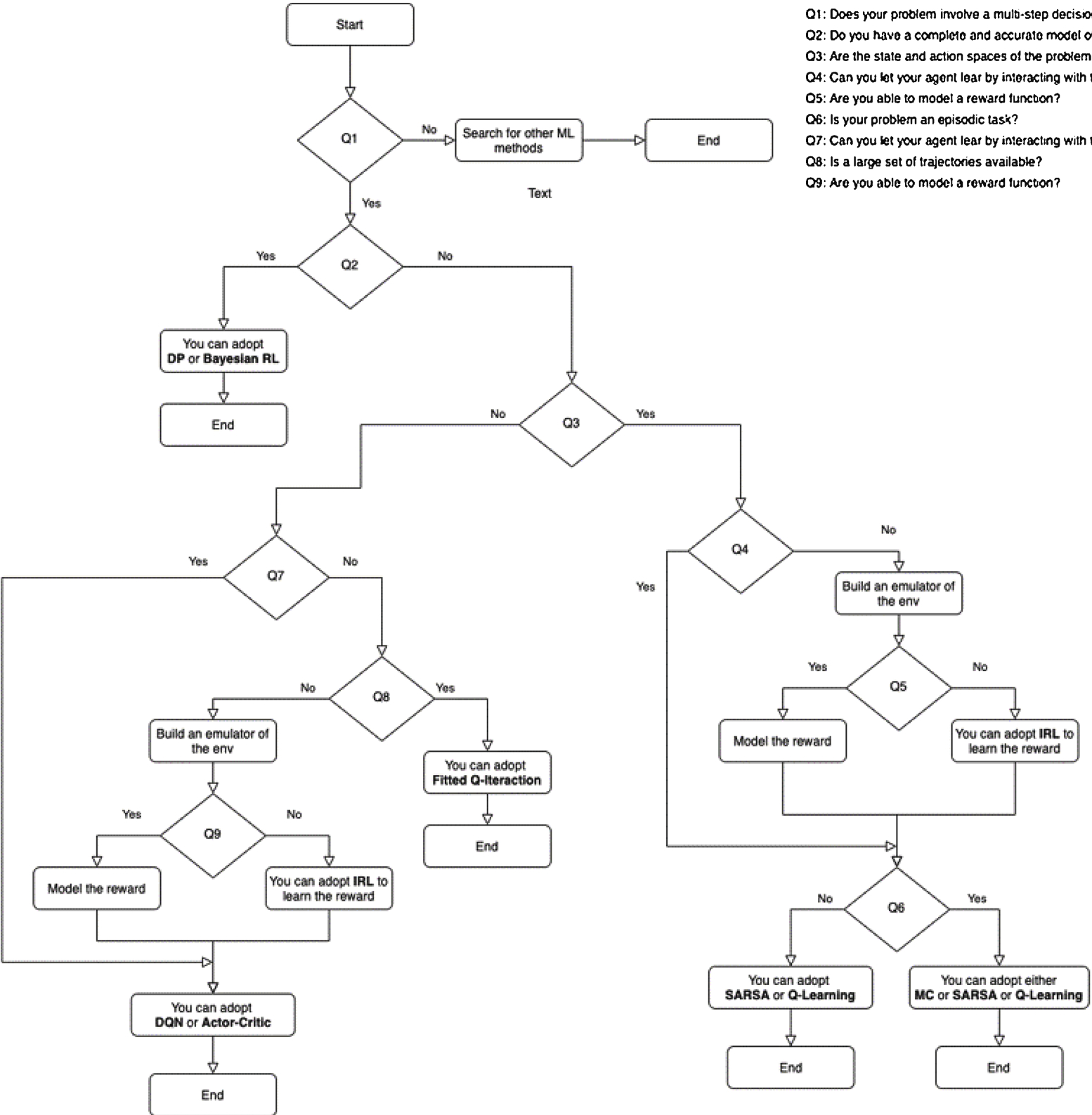 Figure 2: The logic flow for selecting RL algorithms based on problem characteristics (Episodic vs. Continuing, Model-based vs. Model-free).
Key Experimental Benchmarks
The survey highlights several "battleground" areas where RL is outperforming traditional methods:
- Sepsis Treatment: AI clinicians trained on the MIMIC-III database significantly outperformed human physicians in selecting vasopressor dosages, potentially reducing mortality.
- Anemia Management: Q-learning and Fitted Q-iteration have successfully personalized erythropoietin dosages, maintaining more patients within the "Goldilocks" range of hemoglobin levels compared to fixed hospital protocols.
- Medical Imaging: DQN agents are now used for "Active Landmark Detection," moving virtual "sensors" around 3D CT scans to find anatomical structures faster and more accurately than static sliding-window detectors.
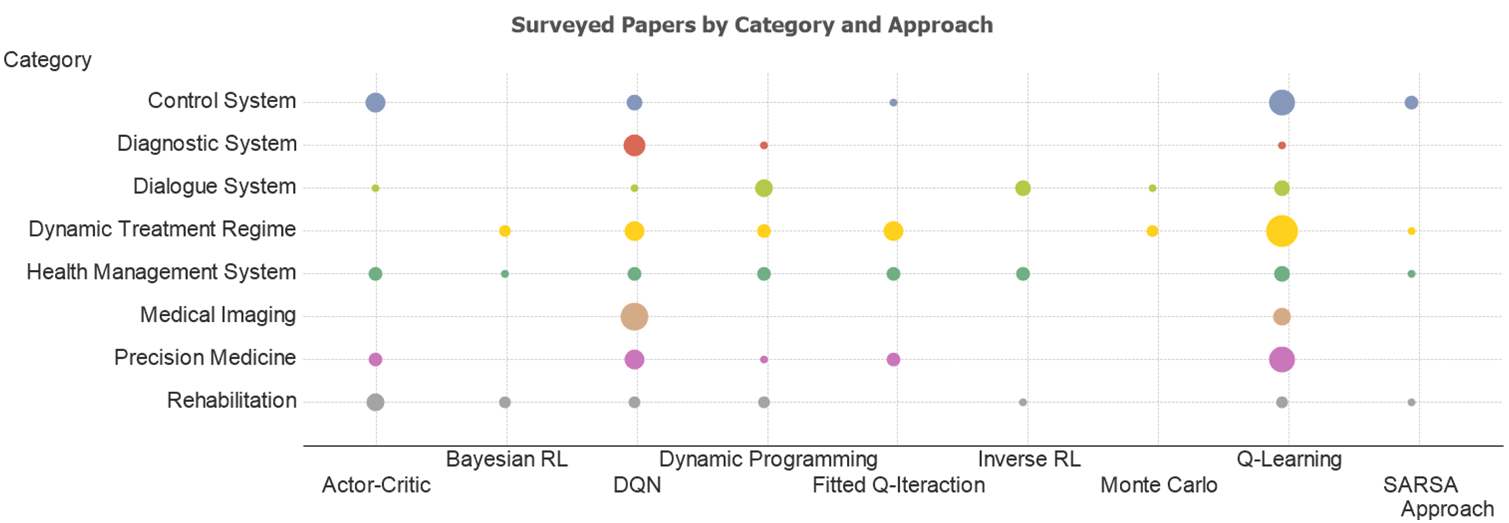 Figure 3: Statistics showing the dominance of Q-Learning and the rapid rise of Deep Q-Networks (DQN) in recent years.
Critical Insight: The "Safe Exploration" Challenge
The authors provide a sober analysis of the hurdles remaining:
- Reward Design: If you reward an AI solely for lowering blood pressure, it might over-prescribe vasopressors, causing long-term organ damage. Rewards must be "holistic."
- Exploration vs. Exploitation: In a video game, an agent can "die" a thousand times to learn. In a hospital, an agent cannot "explore" a lethal drug dose to see what happens. This necessitates Offline RL and high-fidelity simulators.
- Non-Stationarity: Diseases evolve, and hospital equipment changes. An RL policy must be robust enough to handle "distribution shift."
Conclusion
RL is no longer a theoretical curiosity in healthcare; it is the backbone of the next generation of Digital Therapeutics. While SL tells us what is in an image, RL tells us what to do next. The next frontier will be the certification of "Software as a Medical Device" (SaMD) for these black-box controllers, requiring the interpretability and safety guarantees highlighted in this survey.