
Beyond the Feed: Why Relatedness is the Secret Metric for Social Media Success
Relatedness need and users' satisfaction with social network sites: A self-determinant perspective
This study investigates the drivers of user satisfaction on Social Network Sites (SNSs) through the lens of Self-Determination Theory (SDT). By focusing on the "need for relatedness," the authors demonstrate that both the satisfaction of this need and the individual's baseline level of the need significantly dictate overall user satisfaction on platforms like Facebook.
TL;DR
Why do some people find Facebook fulfilling while others find it draining? This study identifies Relatedness—the psychological need to feel cared for and connected—as the core driver. It reveals that while satisfying this need boosts user happiness, individuals with naturally higher "social hunger" (ambivalent attachment) are actually much harder to satisfy in a digital environment.
The "Why" Behind the Scroll: Moving Past Privacy
For years, academic interest in Social Network Sites (SNSs) was obsessed with privacy. Researchers asked: How much data do users share? and Are they worried about leaks? However, this tech-centric view ignored the human element. The authors of this paper argue that people don't use SNSs for "momentary rewards" but to fulfill deep-seated psychological needs.
Using Self-Determination Theory (SDT), the study shifts the focus from what the software does to what the user feels. Specifically, it targets the Need for Relatedness—our innate desire to establish mutual care with others.
Methodology: Measuring the Unseen
The researchers surveyed 263 Facebook users, focusing on two distinct dimensions:
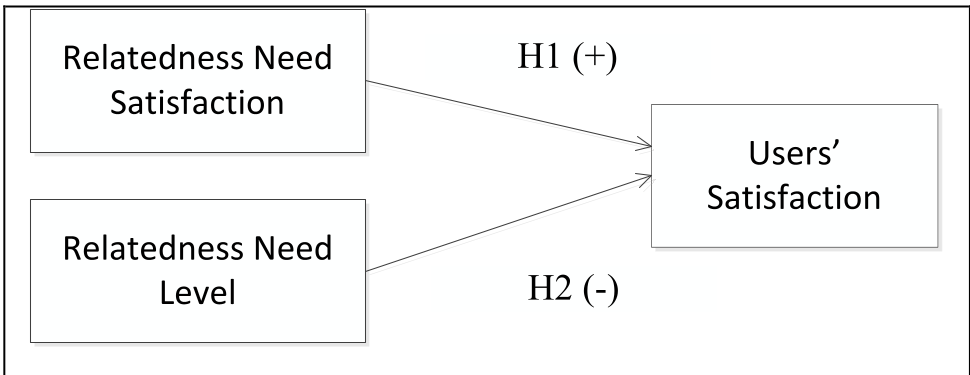
- Relatedness Need Satisfaction: Does the platform actually make you feel connected?
- Relatedness Need Level: How much social validation do you inherently require? (often linked to an "Ambivalent Attachment Style").
Since no scale existed for "relatedness satisfaction" in an SNS context, the authors developed a new psychometric model following the Rigorous MacKenzie et al. (2011) procedure.
Key Insights: The "Social Hunger" Paradox
The results from the path analysis (conducted in Mplus) yielded a fascinating dichotomy:
1. The Satisfaction Effect (H1)
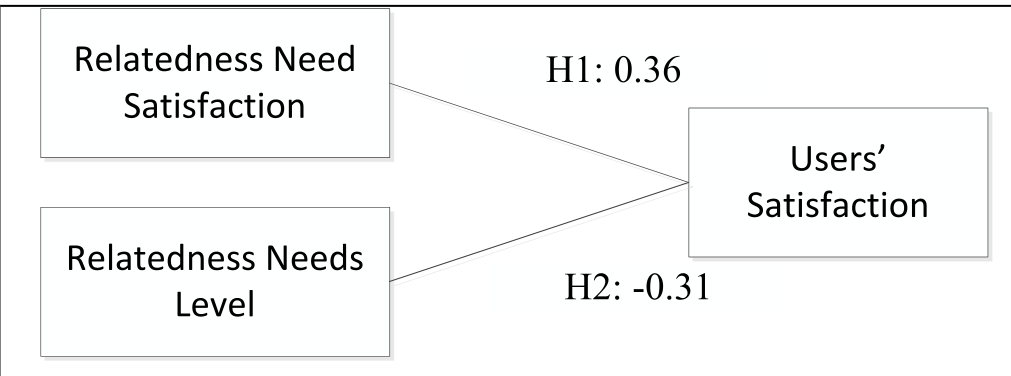
When users feel that others care about their posts or interact with them actively (the "Like" effect), their satisfaction with the platform skyrockets. Every standard unit of satisfaction in relatedness led to a 0.36 increase in general platform satisfaction.
2. The Dependency Trap (H2)
This is the study’s most intriguing finding. Users who have a high "Relatedness Need Level"—meaning they are constantly anxious about social abandonment—are less likely to be satisfied with Facebook.
- The Intuition: These users are "bottomless pits" for social validation. A simple "Like" might satisfy a secure user, but for an ambivalent user, it is never enough. This results in a negative correlation (-0.31) between their need level and their actual satisfaction.
Critical Analysis & Conclusion
Theoretical Implication: This work successfully debunks Hierarchical Needs Theory in the digital age. We don't satisfy needs in a "ladder"; we pursue relatedness, autonomy, and competence simultaneously. The study proves that SDT is a robust framework for the "Attention Economy."
Practical Takeaway for Product Managers: If you run a social platform, "engagement" (clicks/time spent) is a hollow metric. To ensure long-term user health:
- Facilitate meaningful interactions: Use notifications to highlight responses to personal posts rather than just generic "trending" content.
- Contextual Awareness: Recognize that users with high social anxiety might need different interaction cues to feel "connected."
Limitations: The study focused on a 2011-2016 era student sample on Facebook. In today's landscape of "anonymous" interaction (Reddit) or "performance-based" interaction (TikTok), the dynamics of relatedness may have shifted toward Competence (the other pillars of SDT).
Final Word
Satisfaction isn't about how many friends you have; it's about how much those connections make you feel cared for. For platforms, the goal shouldn't be to connect the world, but to make the world feel connected.