
RBIR: Why Your Friends' Comments Matter More Than Keywords in Image Search
Relation based image retrival in online social network
The paper introduces Relation-Based Image Retrieval (RBIR), a framework for social media photo search that prioritizes results based on the strength of user relationships. By analyzing activities like comments and likes, the system achieves a significant improvement in retrieval precision compared to traditional keyword-based methods.
TL;DR
Researchers from UiT The Arctic University of Norway have developed Relation-Based Image Retrieval (RBIR), a system that ranks social media photos not just by tags, but by the "warmth" of your social connections. By weighting likes and comments from close friends more heavily, the system achieved a 71% precision rate, crushing traditional keyword-only search which lingered at 38%.
Problem: The Context Vacuum in Image Search
In 2014, when this paper was published, social networks were exploding. However, searching for photos remained a cold, mechanical process.
- Text-Based Retrieval (TBIR) relies on tags, which are often missing or subjective.
- Content-Based Retrieval (CBIR) struggles with the "semantic gap"—the difference between pixels and the emotional value of a photo.
The authors realized that in a social network, a photo's value isn't just in its pixels; it's in the social artifact it creates. A blurry photo of your cousin's wedding is infinitely more relevant to you than a professional stock photo of a random wedding.
Methodology: Engineering Social Relevance
The RBIR architecture (see below) shifts the focus from "what is in the image" to "who is talking about the image."
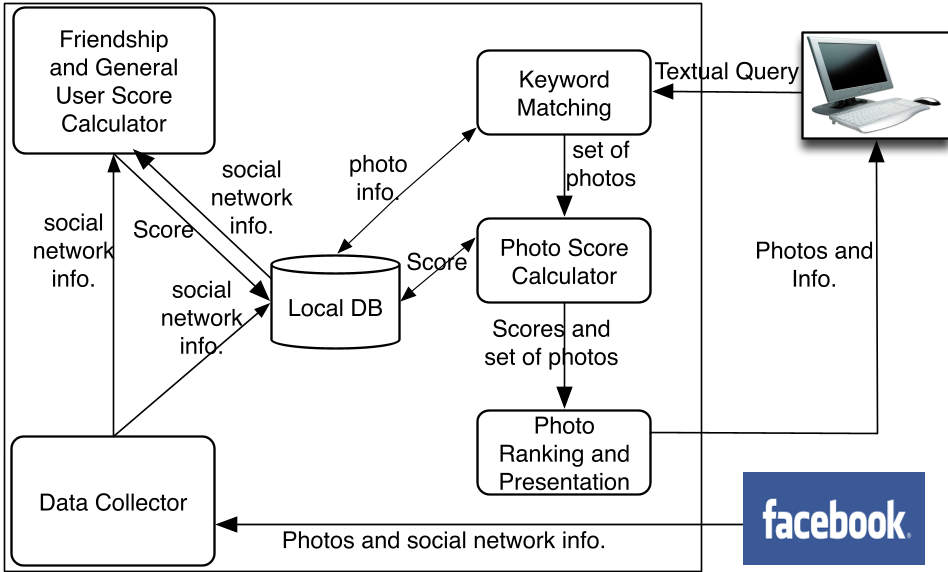
The authors implemented a sophisticated scoring engine based on three pillars:
1. The Relationship Score ()
This measures the "strength of the bond" between two users. It takes into account the mutual interactions (likes and comments) normalized by the total number of photos. If you comment on every photo your friend posts, your relationship score is high.
2. General User Score ()
This represents a user's global "reputation" or popularity within the network. It uses a logarithmic scale to account for the number of friends, preventing "social butterflies" from unfairly dominating the results.
3. The Photo Score ()
The final rank of a photo is a weighted sum:
- Direct relationship between the searcher and the owner.
- Weighted activity: A like from a "Best Friend" (high relationship score) contributes more to the ranking than a like from a "loose acquaintance."
- Time Decay: Newer photos receive a slight boost to keep results fresh.
Experiments: Real-World Combat on Facebook
The team tested the system on a massive dataset: 193,869 photos and nearly 300,000 likes collected via the Facebook API.
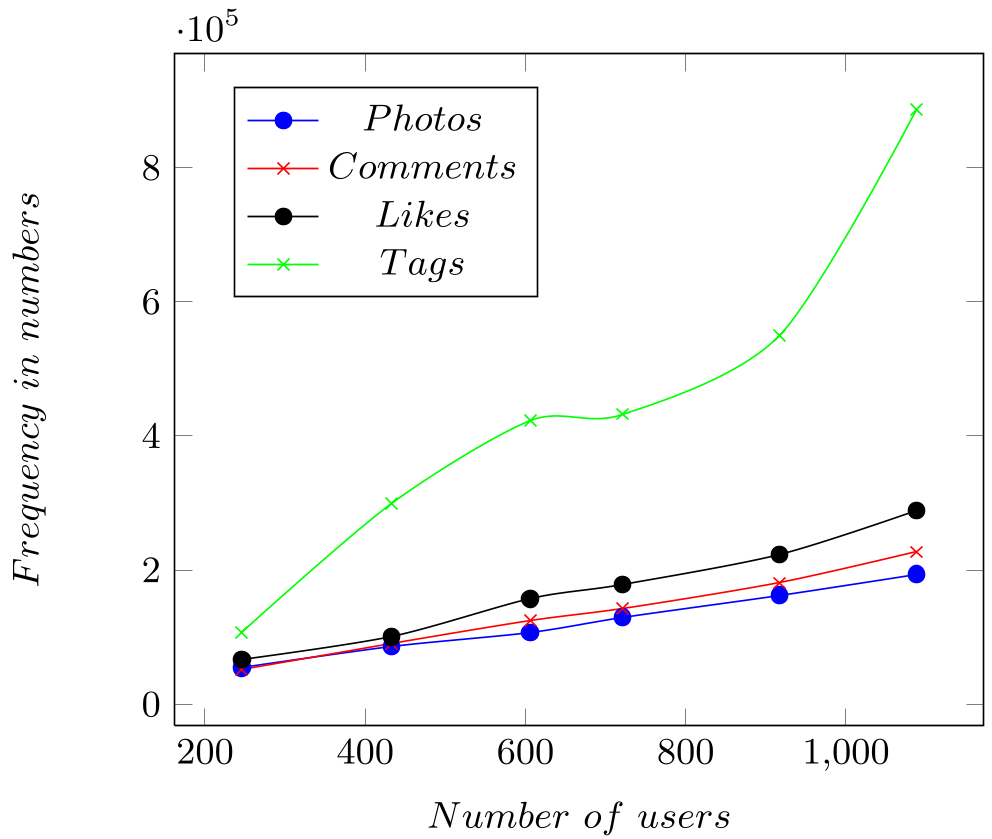
Key Findings:
- Superior Precision: In top-5 results (P@5), RBIR hit 0.71 precision, while traditional SQL-based keyword matching managed only 0.37.
- Events vs. Places: The system was particularly effective at finding "Places" (0.84 precision). Why? Because when searching for "Oslo," users prefer seeing their friends' travel photos over generic cityscapes.
Depth Insight: The "Wedding" Test
Consider the query "wedding." A traditional search might show the most popular public wedding photos from across the globe. RBIR, however, surfaces a photo of the user's cousin. Even if that photo has fewer "total" likes than a celebrity wedding, it ranks #1 because the quality and connection of those likes (family members) carry massive weight in the RBIR formula.
Critical Analysis & Future Outlook
Takeaway: This paper was a pioneer in moving from "Global Popularity" to "Personalized Social Relevance." It proved that the social graph is the ultimate filter for information overload.
Limitations:
- Cold Start: For a first-time user, the system has no interaction history, making it temporarily reliant on basic keywords.
- Computation: In 2014, API limits made downloading this data slow (8 seconds per query). In today's era of real-time data streaming and GNNs, these calculations could happen in milliseconds.
Conclusion: As we move toward more decentralized or niche social networks, the logic of RBIR—valuing the "who" over the "how many"—remains the gold standard for creating search experiences that actually feel human.