
Relation Grid: Bridging Real-World Social Bonds and Distributed Computing
Relation Grid: A Social Relationship Network Model
The paper introduces Relation Grid, a distributed social network model isomorphic to real-world social structures. It leverages a graph-based architecture with weighted, directed edges to represent interpersonal correlations and proposes RGML (Relation Grid Manipulation Language) for complex social queries.
TL;DR
Relation Grid is a pioneer model that seeks to map the "messy" reality of human relationships into a structured, distributed technical framework. By treating social ties as weighted, directed edges in a graph, it allows for complex operations like recursive messaging and community building, all while maintaining scalability through smart mathematical constraints on search depth.
Background & Motivation: The Gap in Digital Socializing
While Social Network Analysis (SNA) has existed for decades, most digital implementations are either centralized silos (like Facebook) or abstract virtual environments where identities are blurred. The authors identify a critical missing link: a mechanism that supports the representation and acquisition of actual social relationships in a decentralized manner.
The core insight is that human networks are "Small-World" networks. If we can mathematically model the "closeness" of a bond, we can navigate the entire global population in just a few hops without crashing the system.
Methodology: The Anatomy of a Relation Grid
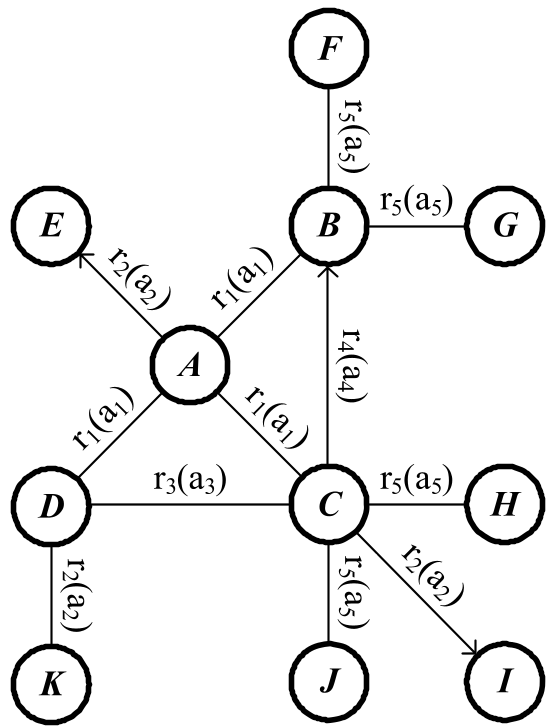
The model is structured as a weighted, directed graph .
- Nodes (): Represent people, containing rich metadata.
- Relations (): Can be Symmetrical (friendship) or Asymmetrical (following).
- Correlation Factor (): A value in representing how close a relationship is.
The Magic of PCF (Path Correlation Factor)
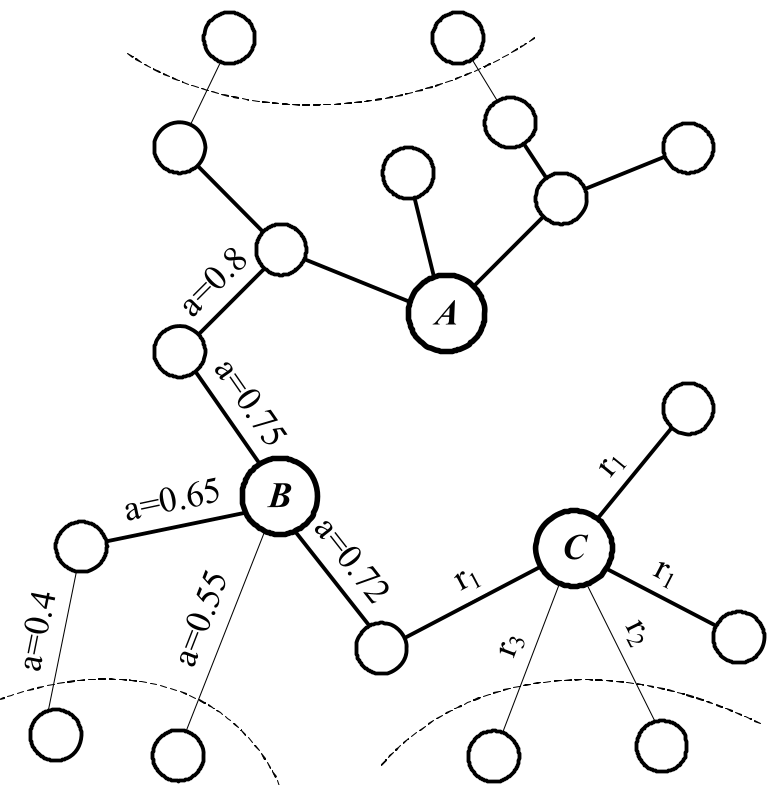
One of the paper's strongest contributions is the definition of Path Correlation Factor (PCF). If you are looking for a friend through a chain of intermediaries, your "relationship strength" with the target is the product of all correlation factors along that path: This metric allows the system to prioritize "strong" paths even in a decentralized environment.
Scalability: Solving the Flooding Problem
In a distributed system, "flooding" (sending a message to everyone) leads to an exponential explosion of traffic (). To prevent a network meltdown, Relation Grid employs three primary restrictions:
- TTL (Time to Live): Limiting the number of "hops" based on the logarithmic properties of Small-World networks.
- PCF Restriction: Only propagating messages through "close" acquaintances.
- Path Restriction: Limiting searches to specific types of relationships (e.g., only "colleagues").
By combining these, the authors prove that complexity remains polynomial (), making the grid viable for millions of nodes.
Real-World Applications
The paper envisions a transformed digital landscape:
- Relationship Discovery: Instead of simple keyword searches, users can run complex RGML queries like: "Find a friend of a friend who knows C++ and lives in Beijing."
- Authentic Communities: Unlike random IRC or Discord channels, Relation Grid communities are formed based on actual social ties (TTL/PCF based selection), ensuring higher trust and cohesion.
Critical Insight & Conclusion
The Relation Grid was ahead of its time in advocating for a decentralized, self-organized social graph. While modern platforms have leanings toward these ideas (think Decentralized Identifiers or the Fediverse), this paper provides the formal graph-theoretical foundation needed to quantify "relationship value."
Its primary limitation is the assumption of honest node participation—metadata and correlation factors are provided by users, which invites issues of trust and reputation. However, as an underlying architecture for a "Social Grid," it remains a mathematically robust reference for anyone building distributed social systems.