
Relational vs. Masspersonal: The Strategic Logic of Love on SNS
Relational and Masspersonal Maintenance: Romantic Partners' Use of Social Network Websites
This research investigates how romantic partners use Social Network Websites (SNSs) for relational maintenance, introducing the concept of "masspersonal" communication. Through a survey and content analysis, the study demonstrates how public and private SNS features distinctively impact social presence, satisfaction, and partner uncertainty.
TL;DR
In the digital age, romantic maintenance is no longer just between two people—it's a "masspersonal" performance. This research reveals that while public posts (likes, tags) boost relationship satisfaction and reduce uncertainty, private messaging can actually correlate with higher partner uncertainty. We choose our channels strategically: private for the messy, intimate reality; public for the curated, positive "relational image."
Background: Beyond the Binary of Private and Public
Historically, communication was either interpersonal (one-to-one) or mass (one-to-many). Social Network Sites (SNSs) like Facebook have collapsed this wall. When you post "I love you" on a partner’s wall, you aren't just talking to them; you are signaling to your entire social network. This creates a unique tension between Relational Maintenance (keeping the bond strong) and Self-Presentation (looking like a "good" couple to others).
The "Uncertainty" Paradox
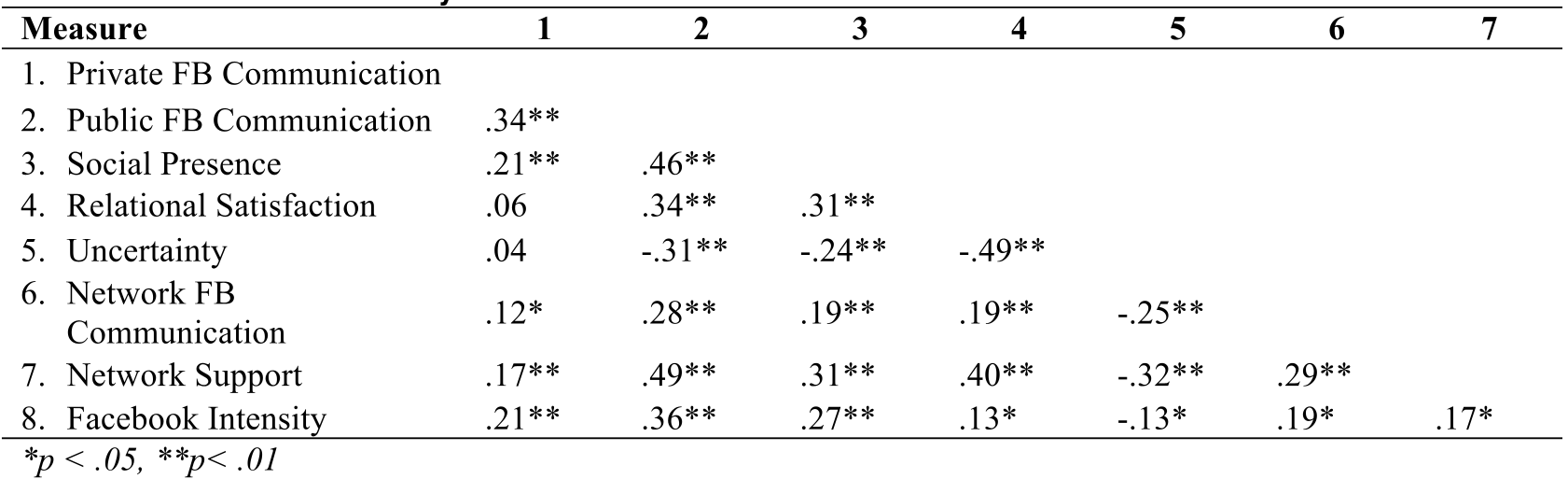
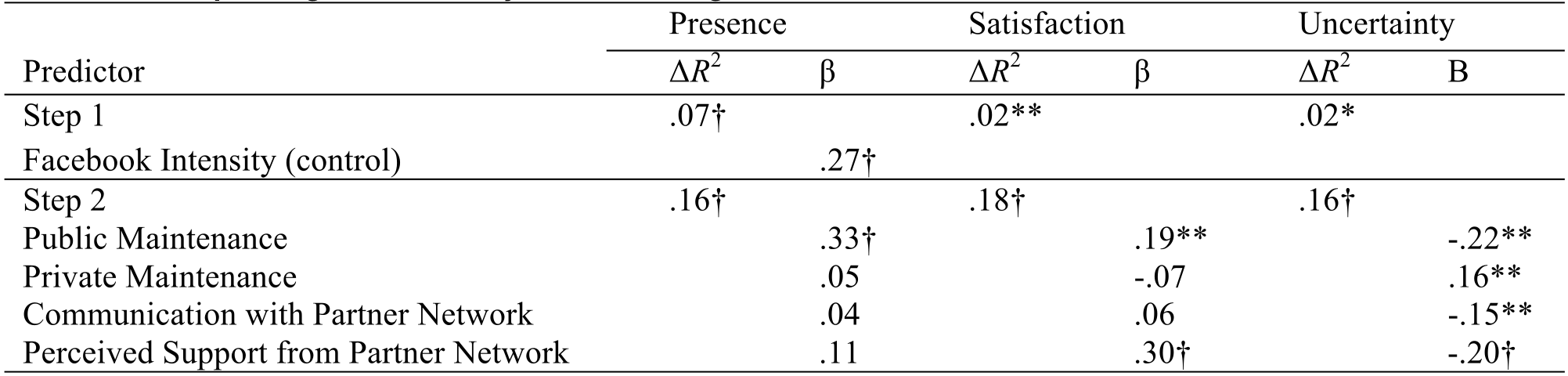
The most striking finding of this research (Study 1) is the divergence of public and private channels regarding Partner Uncertainty.
- Public Maintenance: Acts as a "virtual tie sign" (like a digital wedding ring). High levels of public communication reduce uncertainty. Seeing your partner post about you publicly provides social proof of their commitment.
- Private Maintenance: Surprisingly, higher rates of private SNS communication were associated with increased uncertainty.
- The Insight: This isn't necessarily because private messages cause doubt, but likely because partners who already feel uncertain "retreat" to private channels to hash out conflicts or seek excessive reassurance.
Methodology: Coding the Content of Modern Love
To solve the "Why," the authors moved to Study 2: a content analysis of actual messages. They categorized messages into "Mundane," "Assurances," "Conflict," and others.
The "Grooming" Effect
Nearly 20% of messages were classified as Mundane Maintenance—inside jokes, shared links, and "social grooming." These "phatic posts" serve as digital pulses, maintaining the connection with minimal effort but high consistency.
Implicit Norms: The Social Guardrails
The study found a strict hierarchy of channel selection based on the Valence (positive/negative) and Intimacy of the message:
- Positive & Mundane: These are "safe" for public walls. They contribute to a positive relational image.
- Negative & Intimate: These are sequestered in private messages. Partners are acutely aware of social judgment; "airing dirty laundry" publicly is a violation of SNS norms.
The Role of the "Digital Tribe"
One of the paper's most salient contributions is proving that Network Support matters even more online. Communication with a partner's social circle on SNS leads to:
- Higher Relational Satisfaction
- Lower Partner Uncertainty
- Stronger feelings of "Presence"
Even if your partner is physically away, seeing their friends interact with them (or you) on social media provides a "virtual reminder" of those social ties, keeping the relationship anchored.
Critical Insight: The Cost of the "Positivity Bias"
The researchers highlight a Positivity Bias in public SNS spaces. Because we only see the "highlight reel" of other couples, and because we ourselves only post the positive, SNSs create a sanitized version of romance. While this benefits satisfaction in the short term, it leaves no room for the necessary "Direct Relational Conflict" to be resolved anywhere but in the dark of private DMs.
Conclusion & Future Outlook
This research moves us beyond seeing SNS as a "distraction" and positions it as a sophisticated tool for Relational Engineering.
- Takeaway: Public behaviors serve the "Relational Image" and satisfy the network; private behaviors handle the "Relational Reality."
- Future Work: As platforms shift toward more "close friends" features and ephemeral stories, how the distinction between public and masspersonal maintenance changes will be the next frontier of interpersonal research.