
RAIMA: Redefining Social Connectivity through Adaptive Egocentric Networks
Relational Attribute Integrated Matching Analysis (RAIMA): A Framework for the Design of Self-Adaptive Egocentric Social Networks
This paper introduces RAIMA (Relational Attribute Integrated Matching Analysis), a generic framework for designing self-adaptive egocentric social networks in pervasive computing environments. It features a linear, multicriteria matching algorithm and a visualization engine that represents social similarity spatially through egocentric graphs.
TL;DR
The Relational Attribute Integrated Matching Analysis (RAIMA) framework addresses the rigidity of current mobile social networks. By introducing a multicriteria matching algorithm that calculates "Conceptual Distance" rather than just looking for exact matches, it allows for nuanced, context-aware social discovery. Coupled with a spatial visualization engine, RAIMA enables users to navigate their social surroundings intuitively while moving between different environments—like transitioning from a casual hobby club to a formal professional conference—without reconfiguring their software.
The "Rigidity" Trap in Social Matching
Most computer-mediated social networks are static. If you use a dating app, it is only good for dating. If you use a professional networking tool, it stays professional. This "one-app-one-context" model fails in the mobile world where human needs change as frequently as their physical location.
The researchers identified three technical bottlenecks in existing SOTA (State Of The Art) systems:
- Algorithmic Rigidity: Heavy reliance on "Stable Marriage" algorithms that fail if an exact match isn't found.
- Context Blindness: The inability to re-prioritize attributes (e.g., prioritizing "Research Interests" over "Age" at a symposium).
- Visual Overload: Representing social data textually on small mobile screens is inefficient and often compromises privacy by revealing too much raw data too early.
Methodology: The Conceptual Distance
RAIMA’s core innovation is the Conceptual Distance (CD) calculation. Instead of binary "match/no-match," it uses a linear scoring model that multiplies a Weight Matrix (W) by a Profile Matrix (P).
1. The Mathematical Intuition
The "distance" is calculated as: This allows for different attribute types (Numeric, Range, Lists) to be unified into a single similarity score. By adjusting the Weight Matrix at run-time, the system can instantly change its "logic" without a code recompile.
2. Architecture & Service Discovery
To work in "spontaneous" environments (crowded rooms with no Wi-Fi), RAIMA utilizes an optimized Bluetooth discovery process that replaces tedious manual pairing with hash-key verification, allowing trusted devices to exchange profiles seamlessly.
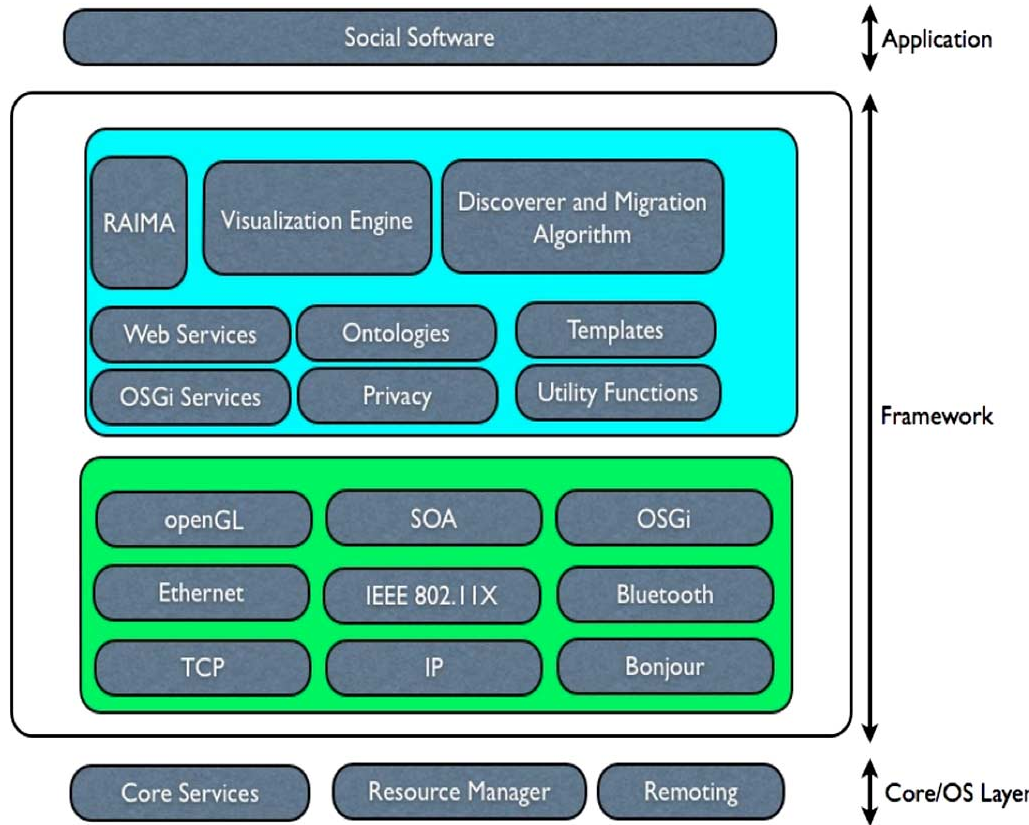 Fig 1: The multilayer structure of the RAIMA framework, highlighting the separation of templates from the core matching logic.
Visualizing Social Gravity
One of the most striking features of RAIMA is its Egocentric Social Graph. Instead of a list of names, the user sees themselves as a "Focus Node" in the center. Other people are represented as icons/nodes.
- Distance = Similarity: The closer a node is to the center, the higher the similarity score.
- Privacy: This spatial model conveys "how much you have in common" without immediately showing "what you have in common," protecting user data until mutual interest is established.
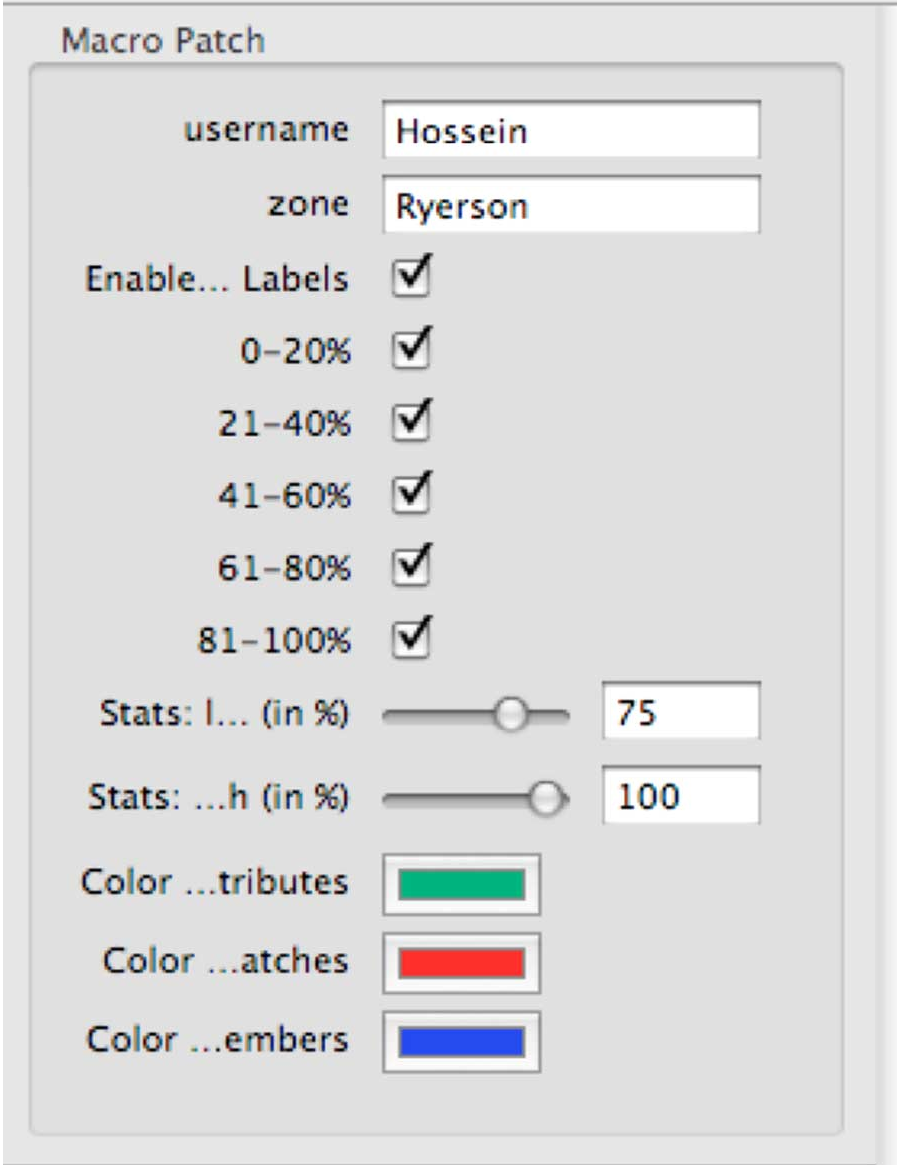 Fig 2: A real-time egocentric graph where vertices represent calibrated social scores.
Performance: RAIMA vs. SMA
The researchers compared RAIMA to the traditional Stable Marriage Algorithm (SMA). In scenarios with high attribute counts (100+ attributes), SMA’s probability of finding an ideal match drops significantly because the "perfect match" becomes statistically rare. RAIMA, however, maintains high performance by focusing on approximate similarity (Third Quartile matches).
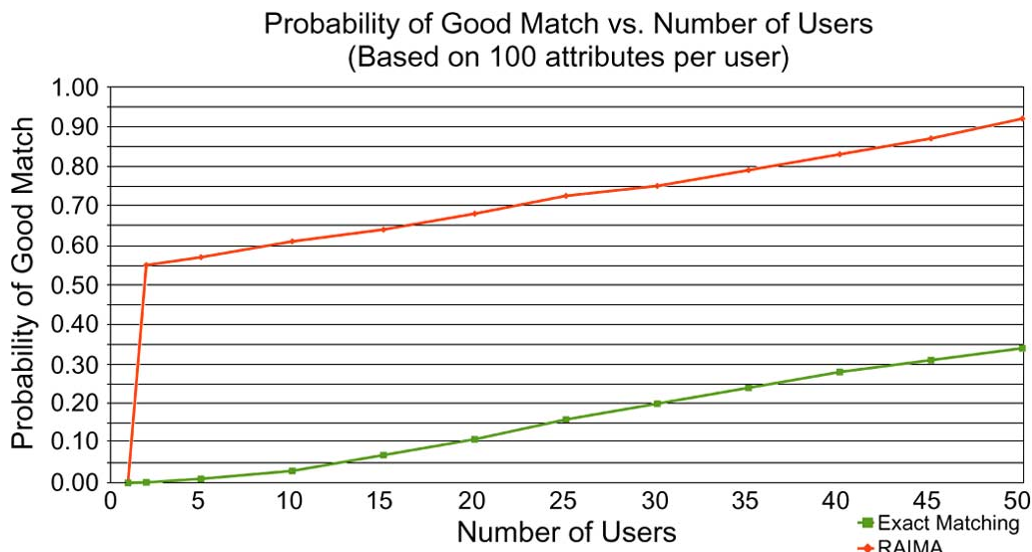 Fig 3: Scalability comparison. RAIMA (triangles) maintains match probability where traditional algorithms (circles) fail as social profiles become more complex.
Critical Insight & Future Outlook
RAIMA succeeds because it treats "Social Context" as a pluggable component. By separating the rules of engagement from the matching engine, the authors have created a blueprint for truly adaptive pervasive computing.
Limitations: The current model uses linear scoring. While efficient for mobile CPUs of the time, the authors admit that Fuzzy-Bayesian models would better handle "incomplete" social profiles where users haven't filled out every field.
Future Work: The next leap for RAIMA involves managing network latency in "mega-crowds" (50+ nodes) and integrating more complex inference models that can guess user preferences even when context templates are sparse.