
RFT Model: Discovering Relational Intelligence Through Fractal Neural Networks
Discovering Relational Intelligence in Online Social Networks
The paper introduces the Relational Flux Turbulence (RFT) model, a novel framework designed to identify "relational turbulence" within Online Social Networks (OSNs). By integrating Fractal Neural Networks (FNN) with social science-based Relational Turbulence Theory, the method achieves SOTA performance in profiling communication patterns and predicting social disruptions across Twitter, Google+, and Enron datasets.
TL;DR
Social networks are not just static graphs; they are living, "turbulent" ecosystems of evolving human emotions and status shifts. This paper introduces the Relational Flux Turbulence (RFT) model, which combines deep learning with social psychology to predict relationship breakdowns and social disruptions. By using a Fractal Neural Network (FNN) architecture, the model can adapt its own complexity to match the "chaos" of real-time social streams, outperforming traditional GCNs and ensemble methods.
Problem & Motivation: Beyond Shallow Graph Learning
Most modern AI approaches to social networks (like GCNs) treat relationships as mere edges in a graph, often defined by simple word co-occurrences or fixed adjacency matrices. However, human relationships are characterized by Relational Turbulence—the friction that occurs during transitions (e.g., from professional to personal).
The authors argue that existing models fail because:
- They are time-static, failing to capture the evolution of "flux."
- They ignore Information Geometry, missing the underlying physical/mathematical structure of social knowledge.
- They struggle with Social Shocks, treating outliers as noise rather than meaningful signals of relationship change.
Methodology: The Architecture of Chaos
The core of the RFT model is its ability to quantify "Relational Intelligence" through three specific dimensions:
- Relational Intensity (): The strength of exchange per context area.
- Relational Uncertainty (): The likelihood of encountering opposing sentiment.
- Relational Interference (): How much individuals hinder or disrupt each other's goals.
1. The Fractal Neural Network (FNN)
Unlike standard deep networks with fixed layers, the RFT uses an FNN architecture. Fractals are recursive, never-ending patterns. In this model, the network can "grow" new layers to learn deeper features or "collapse" them to maintain efficiency.
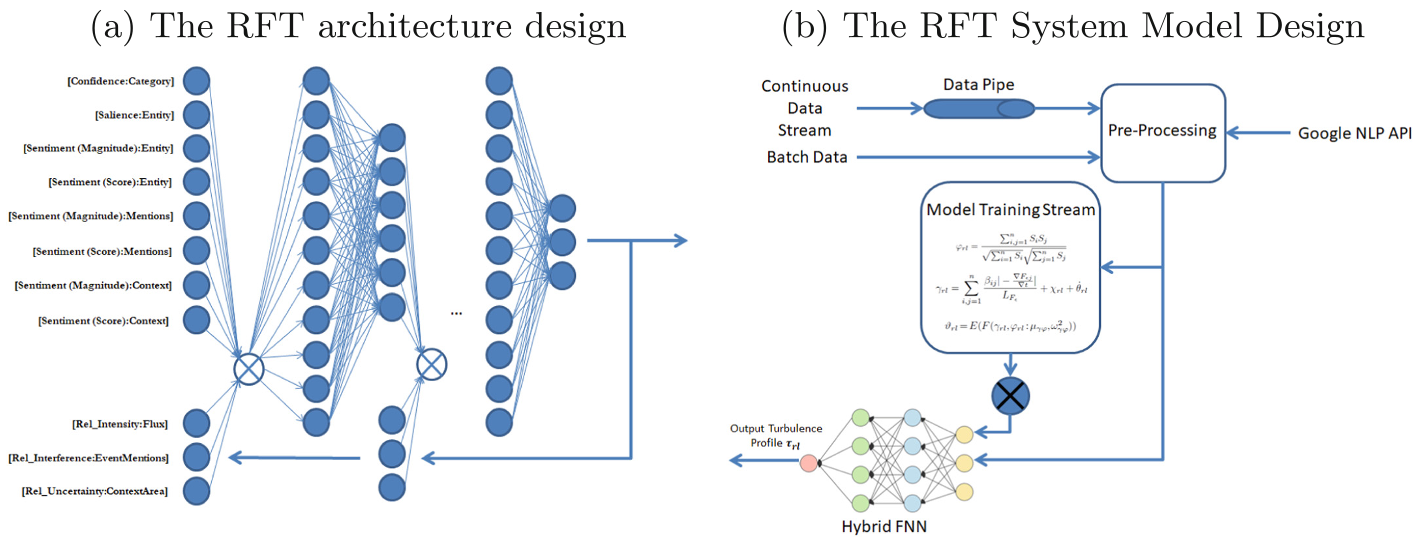 Figure 1: (a) Internal structure of the Fractal Neural Network; (b) The high-level RFT system workflow.
2. Hybrid Learning
The model employs a two-stage strategy:
- Generative Stage: Uses Restricted Boltzmann Machines (RBMs) to find good initialization points from unlabeled data.
- Discriminative Stage: Uses a Deep Stacking Network (DSN) to fine-tune the model for specific prediction tasks.
Experiments & Results: Proving Efficacy
The authors tested RFT against several baselines, including DCN (Deep Convolutional Networks) and IMPALA (Reinforcement Learning), across three major datasets: Enron emails, Google+, and Twitter.
Key Metrics:
- Correlation: RFT showed the highest Kendall Tau-B scores (0.810 on Twitter), indicating it most accurately ranks relationship states compared to ground truths.
- Error Reduction: Through K-fold validation, RFT achieved a significantly lower Mean Absolute Percentage Error (MAPE) at approximately 10.7%, whereas shallow networks stayed as high as 42%.
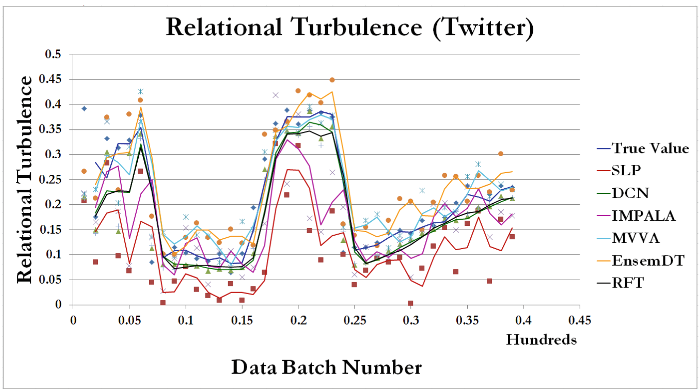 Figure 2: Performance comparison across Enron, Google, and Twitter datasets showing RFT's superior tracking of turbulence profiles.
Critical Insight: The "Social Influence" Factor
An interesting finding from the Spearman correlation analysis is that Entity Salience (social status/influence) often matters more than the Sentiment of a message during directed communications. This suggests that "who" is talking is often a more potent predictor of social turbulence than "what" is being said—a vital insight for AI models attempting to mimic human social cognition.
Conclusion
The RFT model represents a bridge between Social Theory and High-Performance AI. By moving away from rigid graph structures and toward dynamic, fractal architectures, the study provides a robust framework for detecting "Relational Intelligence."
Future Outlook: The authors suggest this methodology could be pivotal in Fintech (modeling market "shocks" like social shocks) and Robotics (allowing machines to understand the nuances of human conflict and transition).
Limitations: While powerful, the model relies on the Google NLP API for initial feature extraction. Future iterations might benefit from an end-to-end architecture that learns raw linguistic features alongside relational dynamics.