
Beyond Independent Labels: Boosting User Profiling with Relational LSVM
Relational User Attribute Inference in Social Media
2015-05-07
Summary
Problem
Method
Results
Takeaways
Abstract
The paper introduces Relational Latent SVM (Relational LSVM), a structured framework for inferring multi-modal user attributes (age, gender, occupation, etc.) from social media. It achieves state-of-the-art accuracy by jointly modeling multimodal features and the intrinsic dependency relations between different attributes.
## TL;DR
Social media profiles are often incomplete, but our attributes—age, gender, job, and interests—are not random; they are deeply interconnected. This paper introduces the **Relational Latent SVM (Relational LSVM)**, a model that doesn't just look at what you post, but how your attributes relate to each other. By mining these "dependency patterns," the authors achieve significant boosts in accuracy, particularly a **12.24% jump in age prediction**.
## The Problem: The "Silo" Inference Trap
Most AI models treat user profiling as a series of isolated tasks: one model for gender, one for age, one for interests. However, human identity is a cohesive structure. If an algorithm predicts a user is a "student" (Occupation) but also "60 years old" (Age), there is likely a conflict. Existing methods often miss this context, leading to inconsistent and inaccurate profiles. Furthermore, many models ignore the **multimodal** nature of social media—posts are more than just text; they are a mix of faces, scenes, and sociolinguistic cues.
## Methodology: The Power of Relational Chains
The core innovation is the **Relational LSVM**. Instead of a simple flat classifier, the authors build an undirected graph where vertices are attributes and edges represent the strength of their correlation (e.g., "Young" + "Student").
### 1. Multimodal Feature Extraction
The model processes three types of data:
* **Textual**: Unigrams, sociolinguistic signs, and LDA topics.
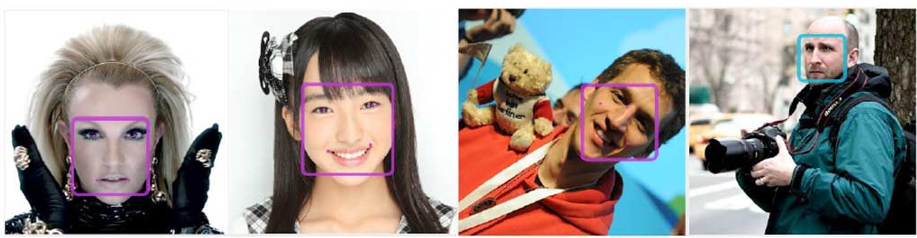
* **Visual (Profile)**: Color moments, edge histograms, and high-precision **face detection**.
* **Visual (Posts)**: Mapping images to a 81-category semantic concept list (e.g., "landscape," "electronic product").
### 2. The Relational LSVM Framework
The authors formulate the inference as a structured learning problem. In this setup, one attribute is the **Target**, and the others are **Auxiliary** latent variables.
The scoring function is a sum of four potentials:
1. **Feature vs. Target**: How well does the data support the target label?
2. **Feature vs. Auxiliary**: How well does the data support the "helper" labels?
3. **Target vs. Auxiliary**: Are the target and auxiliary labels compatible?
4. **Auxiliary vs. Auxiliary**: Is the whole set of predicted attributes logical?
## Experimental Evidence
The researchers crawled over **846,000 posts** from Google+ to test their theory.
### Accuracy Boosts
The results were clear: incorporating relations matters. While a standard "Stacked SVM" (which just combines features) performs reasonably well, the Relational LSVM consistently stays on top.
| Attribute | Stacked SVM Accuracy | Relational LSVM Accuracy | Improvement |
| :--- | :--- | :--- | :--- |
| **Age** | 60.54% | **72.78%** | **+12.24%** |
| **Gender** | 78.56% | **79.86%** | +1.30% |
| **Interest**| 59.80% | **61.72%** | +1.92% |
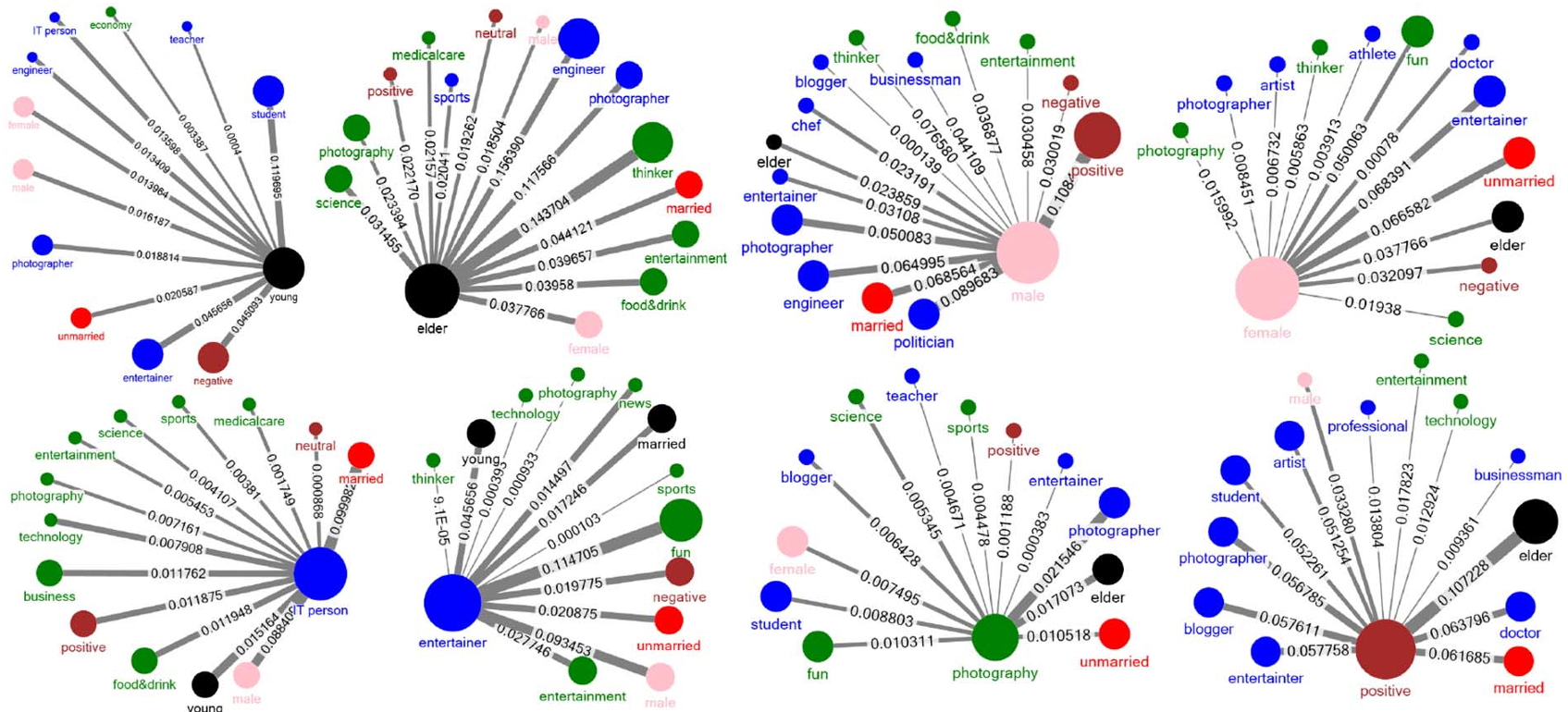
*Above: Visualization of learned attribute compatibilities. Note the thick links between "Young" and "Student," or "IT Person" and "Technology".*
### Application: Structured User Retrieval
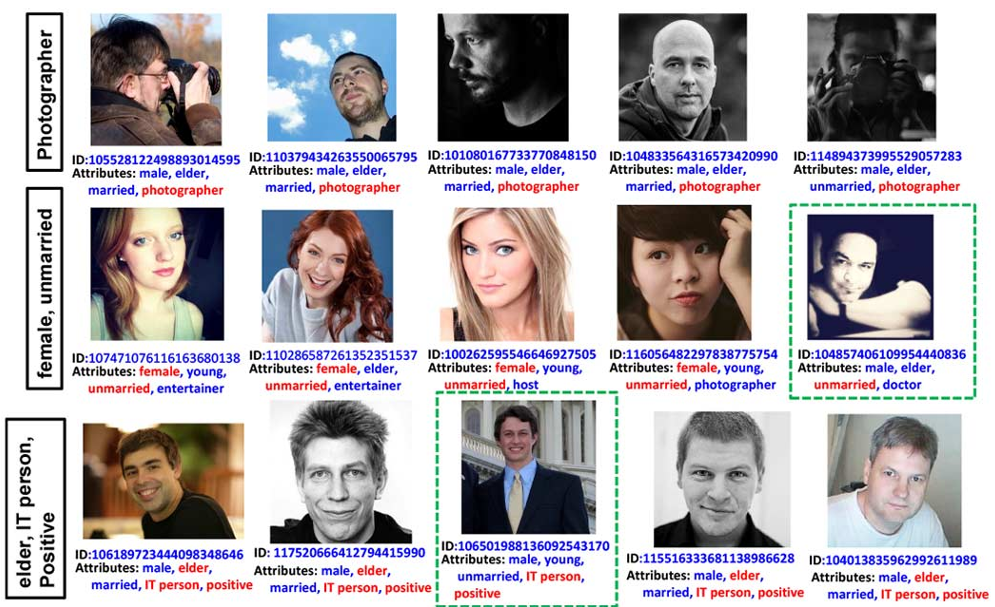
Beyond just labeling, the model enables "Graph Search" style queries. If you search for "Elderly + IT Person + Positive," the model uses its knowledge of attribute relations to find the best candidates even if some metadata is missing.
## Critical Insight & Future Outlook
The **Relational LSVM** succeeds because it treats "noise" in one attribute as a signal that can be corrected by another. If the visual face-detector is unsure about age, the linguistic model's detection of "student slang" can push the age prediction toward "Young."
**Limitations**: The primary bottleneck is computational complexity. The use of Loopy Belief Propagation for inference makes training significantly slower than standard SVMs (thousands of seconds vs. dozens).
**The Future**: As we move toward more complex social graphs, moving this relational logic into **Deep Graph Neural Networks** could allow for real-time, global-scale user personality and attribute mapping.