
Securing the Social Graph: Relationship-based Sharing in Decentralized Clouds
Relationship-based information sharing in cloud-based decentralized social networks
This paper proposes an extension for Decentralized Social Networks (DSNs) that secures user resources and relationships using public cloud storage. The core method utilizes polynomial-based encryption and a collaborative anonymization process to enforce relationship-based access control without exposing the social graph topology to the cloud provider.
TL;DR
This research addresses the "privacy parodox" of Social Networks: how to share data based on social ties (like "friends-of-friends") without letting the service provider see who your friends are. The authors propose a framework that encrypts resources and anonymizes social links using polynomials, allowing an untrusted cloud to verify relationships and grant access without ever "seeing" the social graph.
Background: The Problem with Centralized Trust
In standard Online Social Networks (OSNs) like Facebook, the provider has total visibility. Even in existing Decentralized Social Networks (DSNs) like Diaspora, the "social graph" (the map of who knows whom) is often exposed to the server to facilitate features like wallboards and messaging. This allows for unauthorized data mining and creates a single point of failure for privacy.
The authors argue that relationship data is just as sensitive as the content itself. Their goal is to move both resources and relationship structures into a public cloud while ensuring neither the cloud nor the management services can reconstruct the user’s social circle.
Methodology: The Algebra of Privacy
The technical heart of this paper is the Anonymized Contact List (ACL). Instead of storing a list of user IDs, the system stores the coefficients of a polynomial.
1. Polynomial Encoding
For a user and relationship type (e.g., friend), the system generates a polynomial where the roots are the hashed identifiers () of their contacts: By storing only the coefficients, the system makes it "hard" for an attacker to find the roots (the original contacts) due to the Abel-Ruffini Theorem and the ill-conditioned nature of high-degree polynomials (Wilkinson property).
2. Collaborative Path Finding
To verify if User A is a "friend of a friend" of User B, the cloud's Path Finder Service (PFS) performs polynomial multiplication. If User B's ID is a root of the resulting multi-hop polynomial, the relationship is verified.
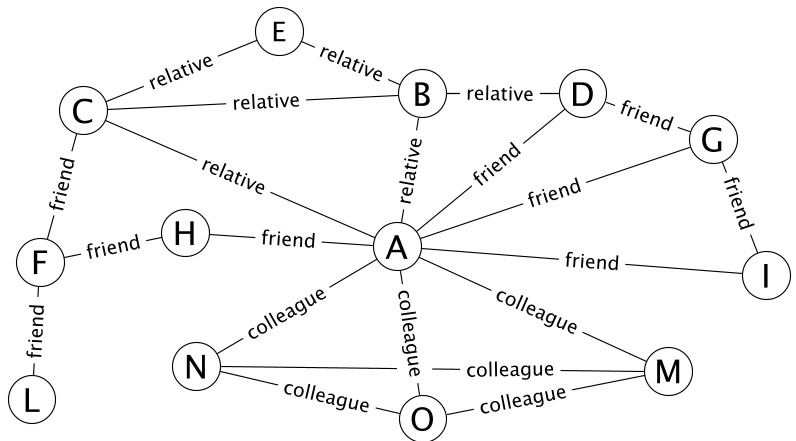 The protocol separates the Rule Manager (RMS) and Key Manager (KMS) to ensure that no single entity can both verify a relationship and decrypt the data.
Experiments and Performance
The authors tested their approach using real-world data from the Stanford SNAP Facebook dataset.
- Efficiency: Evaluating whether a user satisfies a rule (checking if an ID is a polynomial root) is extremely fast, taking only 10.7ms for depth-1 relationships and roughly 6 seconds for depth-5.
- Scalability: While the time to insert a new user into the anonymized graph grows quadratically , the authors note that in a cloud environment, this load can be distributed.
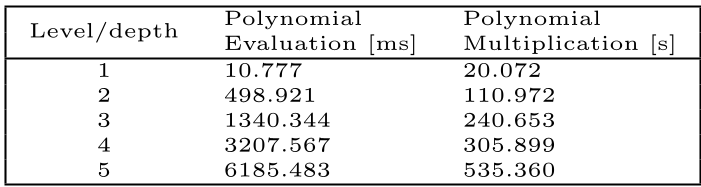 Table 3: Comparison of polynomial evaluation (fast for access) vs. multiplication (slower for graph building).
Security Analysis
The system is analyzed under a "honest-but-curious" model. Key findings include:
- Brute Force Resistance: To reconstruct the graph via brute force evaluation of the polynomials would take approximately 317 years given the search space.
- Collusion Resistance: As long as the Rule Manager (storing access rules) and Key Manager (storing resource keys) do not collude, user content remains private.
Critical Insight & Conclusion
This paper is a significant early attempt to treat social metadata with the same level of cryptographic rigor as the data itself. By moving the "logic" of social connections into the domain of algebra (polynomials), it successfully offloads computation to the cloud without sacrificing structural privacy.
Limitations: The primary bottleneck is the computation of high-degree polynomial multiplications for very large networks. Furthermore, while it resists simple re-identification, sophisticated structural steganography attacks on the preserved topology (even if IDs are anonymized) remain a theoretical risk.
Future Outlook: Transitioning this to modern Zero-Knowledge Proofs (ZKP) or Fully Homomorphic Encryption (FHE) could potentially offer even stronger guarantees, though likely at a higher computational cost than the polynomial method proposed here.