
Beyond Binary Ties: Decoding Multi-Dimensional Relationship Strength in Social Networks
Relationship strength estimation for online social networks with the study on Facebook
This paper proposes a general framework to estimate relationship strength in online social networks (OSNs) by moving beyond binary tie status. It introduces a field-specific measurement approach using Latent Dirichlet Allocation (LDA) and a graphical inference model to calculate closeness based on user profiles and interaction activities across domains like diet, sports, and work.
TL;DR
Online social networks treat your "best friend" and a "random acquaintance" the same way: a binary link. This paper breaks that mold by proposing a framework that calculates Relationship Strength across specific Activity Fields (e.g., Shopping, Work, Diet). By combining user profiles with LDA-based text clustering of interactions, the authors prove that context-aware tie estimation is far more accurate than global models.
The "Binary Blindness" Problem
Most social platforms today suffer from "Binary Blindness." They know that you are connected, but they don't know how close you are. Even worse, existing research often attempts to calculate a single "closeness" score.
The authors' core insight is that Tie Strength is context-dependent. You might have a high relationship strength with a colleague regarding "Work" but zero strength regarding "Sports." Mixing these interactions leads to noisy data and poor recommendations.
Methodology: The Two-Step Deep Dive
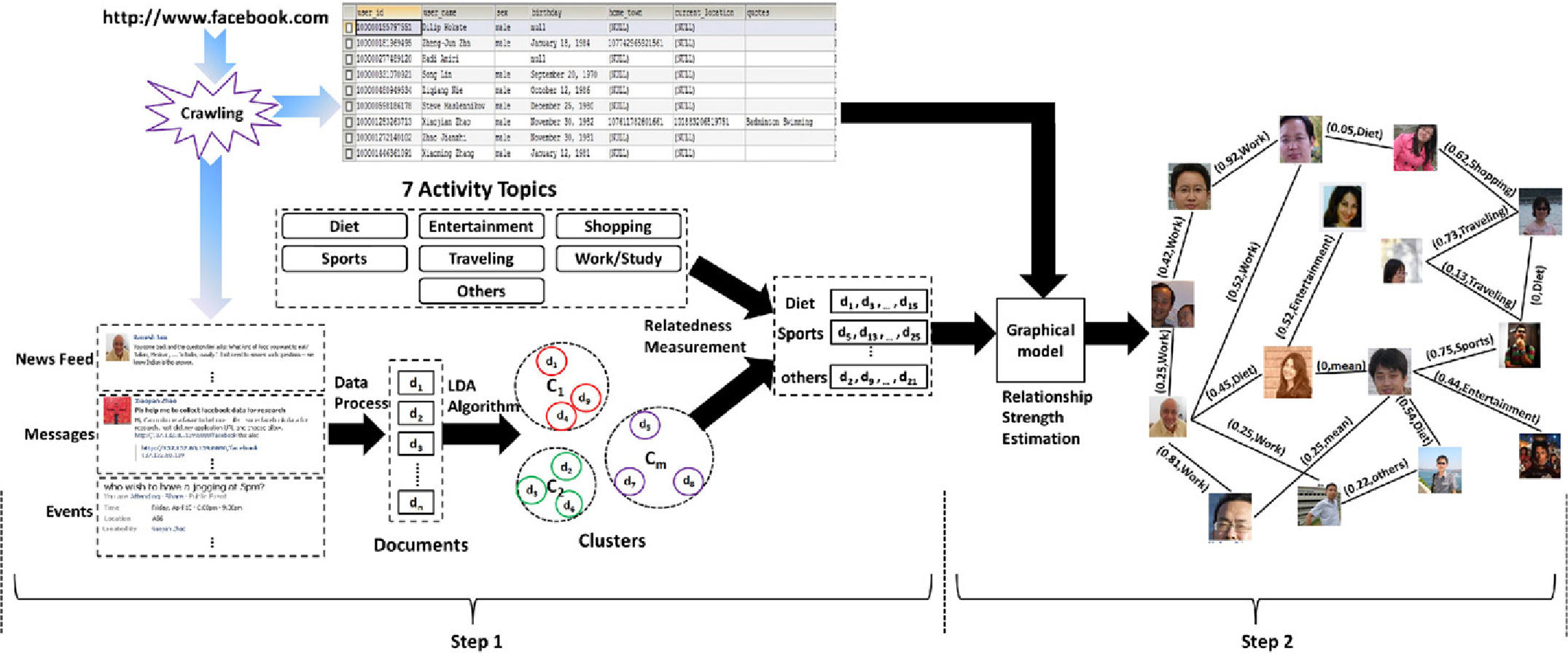
The proposed framework operates in two distinct phases:
1. Activity Field Assignment (The "What")
To understand the context of an interaction, the model doesn't just look at keywords. It uses Latent Dirichlet Allocation (LDA) to cluster 316,000 interaction documents from Facebook.
- Semantic Mapping: It uses Normalized Google Distance (NGD) to map these clusters to specific labels (Diet, Traveling, etc.).
- Granularity: The authors found that "Cluster-level" assignment (grouping similar conversations first) is much more robust than "Document-level" assignment, which often misinterprets single words (like mistaking a restaurant named "Sakura" for a "Traveling" topic).
2. Graphical Inference Model (The "How Close")
Once activities are categorized, the model estimates strength for users and in field . The model assumes:
- Profiles Drive Strength: Similarities in education, location, or hobbies () suggest a higher potential for strength.
- Strength Drives Interaction: High relationship strength leads to more localized interaction activities ().
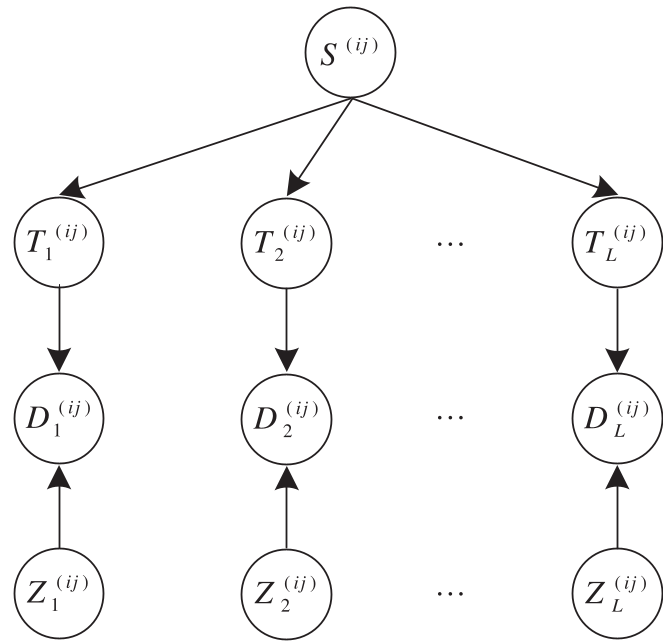
The authors solve this using Coordinate Ascent, updating weights () and strength variables iteratively until the joint probability is maximized.
Results: Why Context Matters
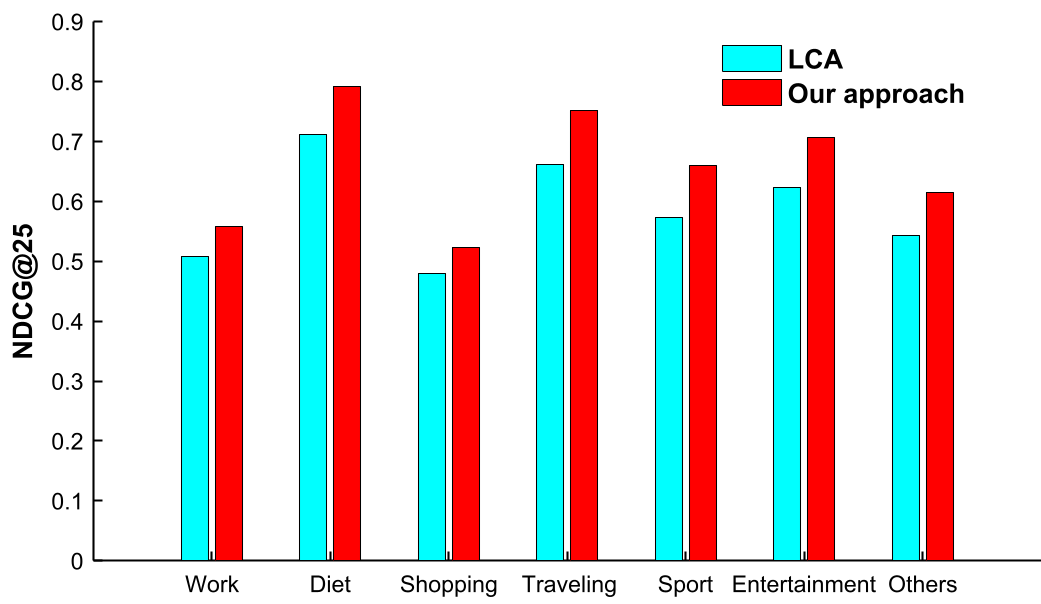
The experiment on Facebook data revealed a striking truth: General models (like LVA) fail because they dilute specific strengths.
- Field Accuracy: Fields like "Diet" and "Traveling" showed high classification accuracy because of distinct vocabularies (e.g., "dinner," "tourism").
- Performance Leap: The proposed model significantly outperformed the Latent Variable Model (LVA). By giving different weights to different activity fields when calculating "Overall Strength," the model reflects human reality: we value certain shared activities more than others when defining a "close friend."
Critical Insight & Innovation
The real value of this work is its Inductive Bias that social relationships are manifold, not monolithic. While modern Graph Neural Networks (GNNs) now handle edge weights more elegantly, this paper’s focus on the semantic context of the edge (the "Activity Field") remains a foundational concept for anyone building personalized social products.
Limitations & Future Work
- Temporal Decay: The study uses data from a specific two-month window. In reality, relationship strengths fade over time if interactions cease.
- Scale: While 632 persons provided a proof of concept, modern social graphs involve billions of nodes, requiring more distributed computing approaches for the LDA and Graphical Inference steps.
Conclusion
By treating relationship strength as a hidden variable manifested through specific social contexts, the authors provide a blueprint for more "human" social AI. It’s not just about who you know, but in what capacity you know them.