
Deciphering Social Strength: A Bayesian Approach to Folksonomy Link Analysis
Relationship strength estimation for social media using Folksonomy and network analysis
This paper introduces a robust method for estimating relationship strength between web pages in social bookmarking services using Folksonomy and network analysis. By leveraging a Bayesian framework to integrate individual user tag sets and manifold learning for link pruning, the method constructs a more accurate social network compared to traditional co-occurrence or collective tag-based approaches.
TL;DR
In the chaotic world of social bookmarking, tags are messy and relationships are often illusory. This paper presents a sophisticated framework that uses Bayes' Theorem to filter user-specific tag noise and Manifold Learning to prune unimportant network links. The result is a high-fidelity web page network that follows a natural power-law distribution and captures genuine topical relevance far better than standard co-occurrence models.
The Problem: The Chaos of "Folksonomy"
Social bookmarking services like Buzzurl or Delicious allow users to organize the web using their own tags. This creates a "Folksonomy"—a collaborative but unstructured vocabulary. While powerful, it introduces two major technical hurdles:
- Tag Ambiguity: A tag like "sf" could mean "San Francisco" or "Science Fiction," creating "pseudo-relationships" between unrelated pages.
- Network Noise: Simple co-occurrence (two pages bookmarked by the same user) creates billions of low-value links, making network analysis computationally expensive and semantically shallow.
Methodology: From Noisy Tags to Mathematical Intuition
Step 1: Bayesian Relationship Integration
Instead of just counting how many people used the same tag, the authors look at the consistency of tag usage per user. They calculate the Jaccard Coefficient for a pair of pages for each individual user.
The genius lies in the Bayesian Integration. They assume there is a "True Strength" () and that each user's tagging behavior is an observation with some error ():
By applying Bayes' Theorem, they calculate a posterior distribution that effectively "votes" on the true relationship strength, allowing them to discount "spammers" or inconsistent users by increasing their variance ().
Step 2: Manifold-Based Structural Pruning
Even with Bayesian filtering, the resulting network is often too dense. The authors treat link deletion as a Dimension Reduction problem. They seek a mapping that minimizes the distance between nodes that have high relationship strength:
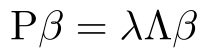
By solving the generalized eigenvalue problem , they extract the essential "manifold" of the data. Links that don't contribute to this underlying structure are discarded, effectively "denoising" the social graph.
Experimental Evidence
The authors compared their approach against the Co-occurrence approach and the All-tag approach.
Quantitative Breakthrough
| Method | Total Links Generated |
|---|---|
| Co-occurrence | ~2.3 Billion |
| All-tag | ~2.0 Billion |
| Bayes (Proposed) | ~0.28 Billion |
By reducing the link count by nearly 90%, the proposed method successfully eliminated the "pseudo-relationships" that plague social media data.
Qualitative Precision: The "Google" Test
When looking for pages related to google.co.jp, the Bayesian method identified high-quality search services like excite.co.jp and ask.jp. In contrast, the co-occurrence method was distracted by "famous" but unrelated sites like news portals and soft-indexing sites.
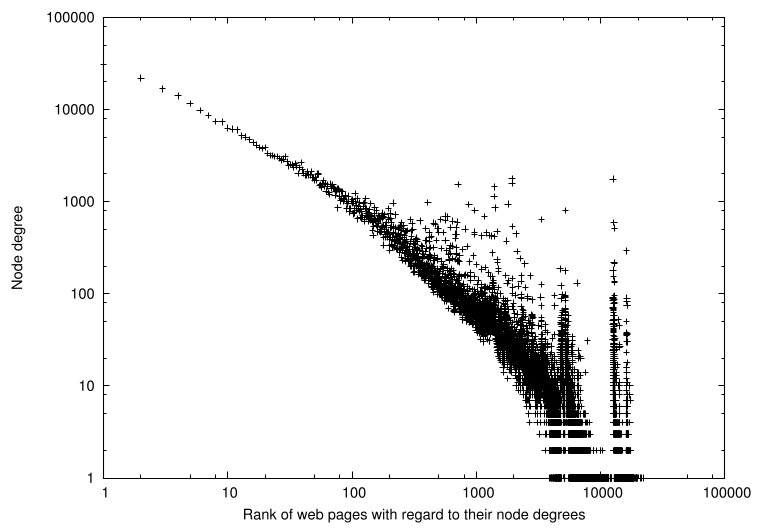 Figure: The proposed method naturally results in a Power-Law distribution (Fig 3), which is a hallmark of real-world social structures.
Critical Analysis & Conclusion
The core takeaway of this work is that local consistency is more reliable than global aggregation. By trusting individual user tag sets first and then mathematically integrating them, we can bypass the semantic confusion inherent in massive datasets.
Limitations:
- The manifold learning step, while effective, can be computationally heavy for massive graphs with millions of nodes.
- The Bayesian prior assumes a normal distribution for errors, which might not reflect more malicious "spamming" patterns in modern social media.
Future Outlook: This methodology is highly extensible to other domains. Imagine applying this "Manifold Pruning" to Multi-modal embeddings in AI, where different types of data (images, text) need to be aligned in a latent space without creating false semantic links.