
Understanding Weak Ties: Why Network Structure Dictates Resilience and Spreading
Influence of relationship strengths to network structures in social network
This paper investigates the influence of relationship strengths on network structure and information spreading using a mixture model and a binary dissemination algorithm. By comparing datasets like Arvix (academic cooperation) and Wiki (online collaboration), it reveals that the importance of "weak ties" varies significantly depending on the network's underlying topology.
TL;DR
Not all social networks are created equal. This research demonstrates a fundamental coupling between relationship strength and network topology. While "weak ties" are the glue holding traditional interpersonal networks (like academic collaborations) together, modern internet-based information networks (like Wiki) are significantly more resilient to their loss.
Background: The Power of the "Acquaintance"
Since Mark Granovetter's seminal work in 1973, "weak ties"—those casual acquaintances who bridge different social circles—have been recognized for their role in spreading non-redundant information. However, this paper goes deeper, asking a structural question: When does the removal of these weak ties actually cause a network to fall apart?
The Core Methodology: Quantifying the "Strength"
The author proposes a methodology to transition from raw interaction data to a nuanced understanding of tie strength.
- Similarity Inference: Utilizing factors like shared location, industry, and schools to calculate a clustering coefficient () between nodes.
- Newton-Raphson Optimization: A three-step learning algorithm is used to update the latent variables of user strength (), attributes (), and global weights ().
- Experimental Dissemination Model: An improved independent cascade model was built using two parameters:
- : Determines the route (e.g., targets weak ties).
- : Represents the inherent "interest" or strength of the information itself.

A Tale of Two Networks: Arvix vs. Wiki
The most striking insight comes from the comparison of different data sources.
1. Interpersonal "Relationship" Networks (Arvix)
In Arvix (academic collaborations), the network exhibits high aggregation and community features.
- The Collapse: When links are removed from weak to strong, the relative value of the maximum connected sub-graph () drops sharply.
- Phase Transition: As seen in the dynamic index , a distinct peak appears, indicating a phase transition (threshold ) where the network essentially crashes.
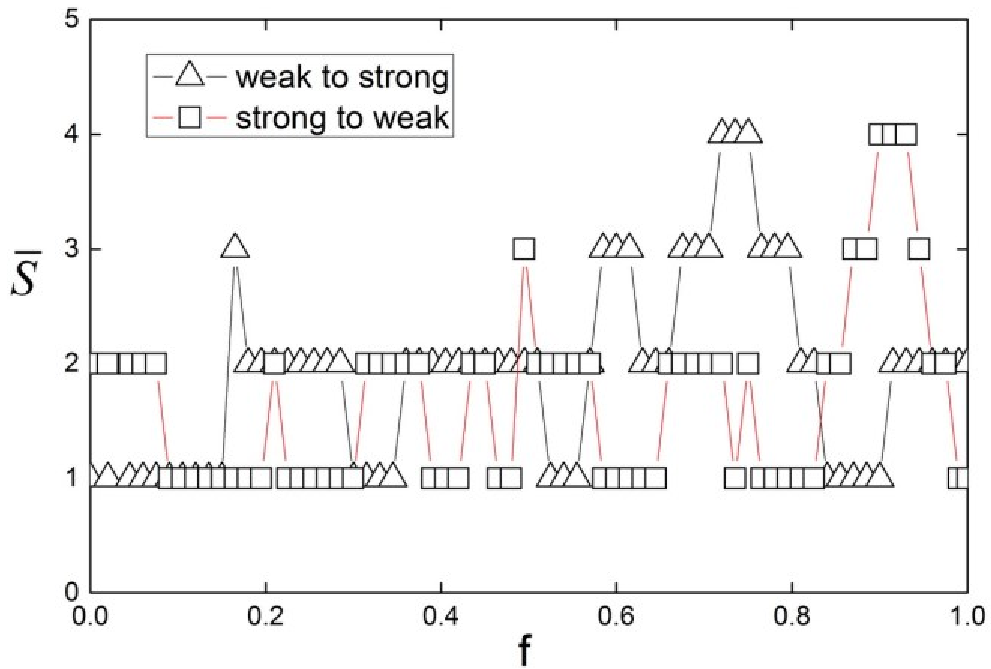
2. Information-Exchanged "Internet" Networks (Wiki)
In contrast, Wiki presents a reticular structure where information flow is the primary driver.
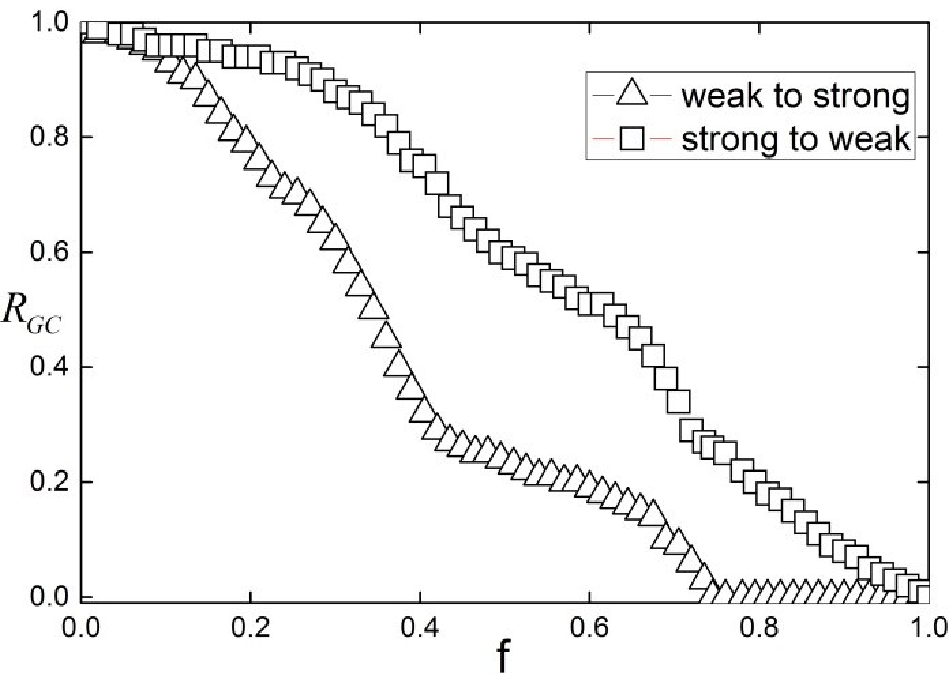
- Robustness: The curve for is stable and slopes downward gradually.
- No Transformation Point: There is no peak in the dynamic index . This suggests that in networks where interaction is widely distributed and less dependent on community "bridges," the removal of weak ties does not compromise the global structure.
Why the Difference? (Critical Insight)
The paper concludes that the impact of weak ties is tied to the topology of dissemination:
- Traditional Dissemination (Fig 5): High selectivity and community clustering make weak ties essential bridges. Without them, communities become isolated "islands."
- Internet Dissemination (Fig 6): These networks are more homogeneous in their degree distribution. The "birds of a feather" effect is less restrictive because the reticular structure provides multiple redundant pathways for information.
Conclusion & Future Outlook
This work provides a quantitative framework for understanding network vulnerability. For developers of social platforms or information systems, the takeaway is clear: if your network is highly community-based, protecting the "bridges" (weak ties) is vital for survival. If your network is decentralized and information-driven, focuses should shift from structural maintenance to the intrinsic "interest" () of the content to ensure spreading.
The study’s reliance on the Breadth-First Search (BFS) for max-connected sub-graphs provides a solid baseline, but future work could explore how these dynamics shift in dynamic/temporal networks where ties are constantly forming and dissolving.