
Beyond Rationality: How Emotion and Psychological Distance Drive Our Privacy Leaks
5738_Relative Importance of Determinants Towards Users' Privacy Disclosure on Social Network Sites by Privacy Invasion Experience Based on Construal Level
This study investigates the "Privacy Paradox" on Social Network Sites (SNS) by proposing a multi-dimensional decision-making model integrating rational, emotional, and situational factors. It uniquely applies Construal Level Theory (CLT) to demonstrate how the temporal distance of past privacy invasions moderates disclosure behavior, finding that affect and trust outweigh rational benefit-calculus.
TL;DR
Why do we keep sharing personal data on SNS even after hearing about massive leaks? This research proves that our "Privacy Calculus"—the rational weighing of risks vs. rewards—is often a myth. Instead, our disclosure is driven by Cognitive Absorption (getting lost in the fun) and Institutional Trust. Furthermore, how recently you've been "burned" by a privacy invasion completely changes how you make these decisions, a phenomenon explained by Construal Level Theory.
The "Privacy Paradox" and the Failure of Logic
For years, researchers assumed humans were "rational agents" who shared data only when the perceived benefit outweighed the risk. However, the Privacy Paradox persists: users claim to value privacy but behave recklessly.
The authors of this paper argue that existing models ignore the "unconscious" or "affective" state. They suggest that when you are scrolling through Facebook or Instagram, you aren't doing math; you are experiencing Cognitive Absorption—a state of deep involvement where time flies and your rational guard drops.
Methodology: The Three Pillars of Disclosure
The study proposes that disclosure is determined by three distinct paths:
- Rational (Perceived Value): Do the benefits of sharing outweigh the risks?
- Emotional (Cognitive Absorption): Are you so immersed in the "playfulness" of the app that you forget to be cautious?
- Situational (Institutional Trust): Do you believe the platform's privacy policies actually protect you?
Integrating Construal Level Theory (CLT)
The masterstroke of this paper is applying CLT. It suggests that if a privacy invasion happened to you years ago (distant), it is an "abstract" concept that doesn't affect your daily behavior. If it happened yesterday (near), it is "concrete" and shifts your decision-making process.
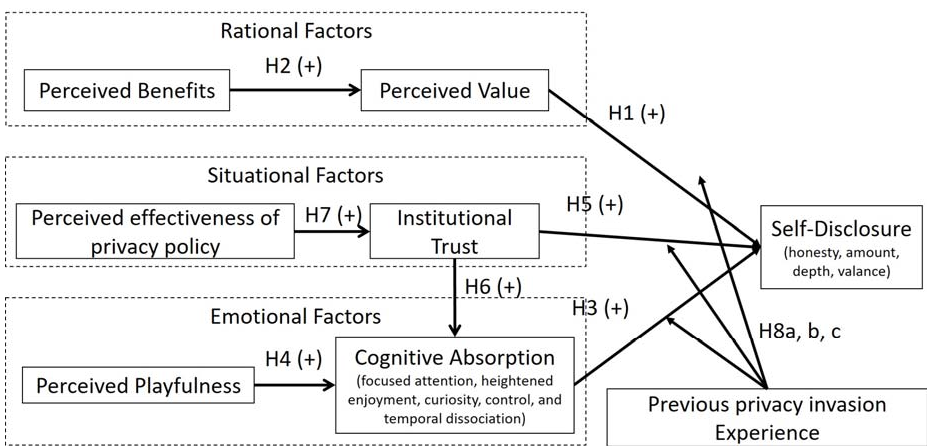 Figure 1: The hypothesized model connecting playfulness, absorption, trust, and disclosure behavior moderated by past experiences.
Key Findings: Logic is Out, Immersion is In
After analyzing 241 usable records via Structural Equation Modeling (SEM), the results were striking:
- Rationality is Silent: Perceived Value actually had an insignificant effect on disclosure. Users don't share because they've calculated it's "worth it"; they share because they aren't thinking about the cost at all.
- The Power of "Flow": Perceived playfulness leads to high Cognitive Absorption, which was the strongest predictor of how much and how deeply users disclosed information.
- Trust as a Safety Net: Institutional trust, bolstered by the perceived effectiveness of privacy policies, becomes the primary factor for users who have suffered a bad experience.
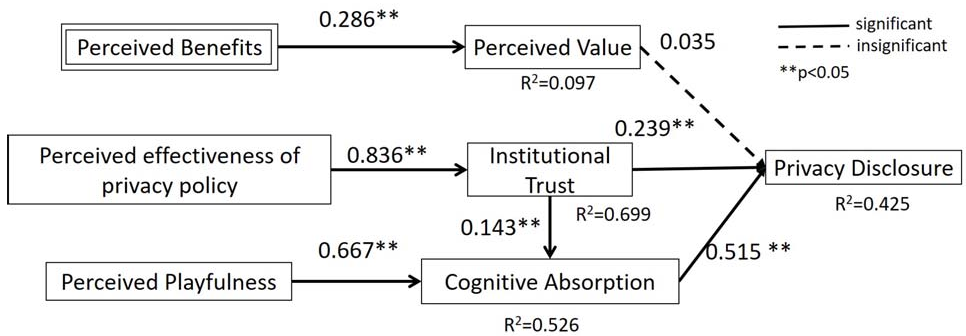 Figure 2: Empirical results showing the dominance of Cognitive Absorption (0.435) and Institutional Trust (0.334) over Perceived Value.
Deep Insight: The "Near-Miss" Effect
The study found that for users who had never experienced a privacy leak, trust didn't matter much—they disclosed mostly due to absorption. However, for those with a "Personal Bad Experience" (especially a recent one), Institutional Trust became the critical gatekeeper.
This suggests a "cooling-off" period: as the bad experience moves further into the past (increasing psychological distance), the concrete fear fades, and the user returns to an "absorbed" state of high disclosure.
Critical Analysis & Future Outlook
Takeaways for UX/Product Designers:
- Ethical Friction: If platforms want to protect users, they must find ways to "break" Cognitive Absorption. Reminders shouldn't just be static policies; they need to interrupt the "flow" to bring users back to a rational state.
- Trust is Fragile: For users who have been victims of leaks, the platform's survival depends entirely on visible, effective privacy mechanisms.
Limitations: While the study is robust, it relies on self-reported data which can be subject to bias. Future research could benefit from objective behavioral tracking to see if "intent" matches actual clicks in real-time.
Conclusion: Privacy on the modern web isn't a math problem—it's an emotional and situational tug-of-war. As we spend more time in immersive digital environments, understanding the "Cognitive Absorption" that leads us to overshare is more vital than ever.