
Good for Use, but Better for Choice: Decoding the Competitive Dynamics of SNS
Good for use, but better for choice: A relative model of competing social networking services
This study proposes a "Relative Model" to investigate user choices between competing Social Networking Services (SNS), specifically light-blogging versus micro-blogging. By integrating Media Richness Theory and Social Identity Theory, the authors identify "Relative We-Intention" as the key driver for collective platform usage, achieving a significant explained variance (R² = 41.8%).
TL;DR
In a world saturated with social platforms, the question isn't whether a service is "good," but whether it is "better" than the alternative. This paper shifts the academic focus from absolute satisfaction to Relative Value Modeling, proving that our decision to use a platform is a collective commitment ("We-intention") driven by how much more we identify with our social circle on one platform compared to its rivals.
Context: The Attention Economy and the Failure of Absolute Models
Most tech-adoption research asks: "Do you like this app?" However, in the Attention Economy, time is a zero-sum game. If you are spending an hour on Tumblr (light-blogging), you are likely spending less time on X/Twitter (micro-blogging).
The authors argue that previous SOTA (State-of-the-Art) models are flawed because they ignore the Comparison Level for Alternatives. To address this, they propose a model that doesn't just look at "I-intention" but "We-intention"—the perceived commitment of a group to perform a joint action.
Methodology: The Socio-Technical Bridge
The researchers combined two pillars of theory to explain this competitive choice:
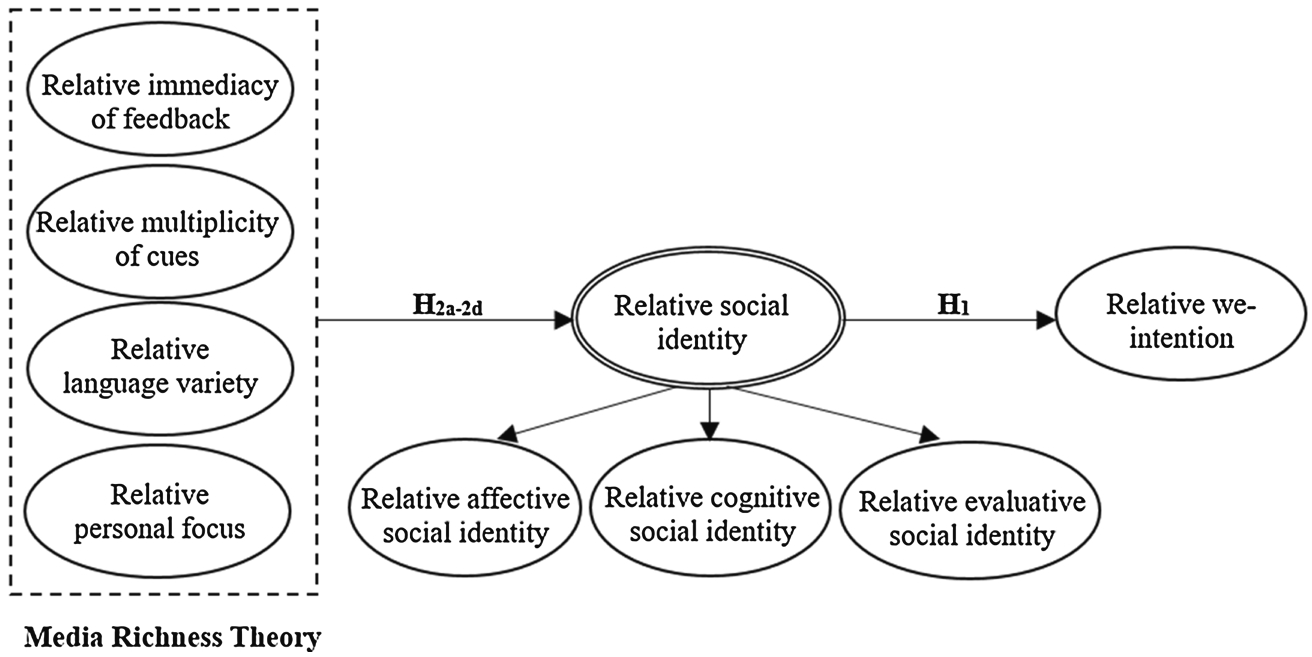
- Media Richness Theory (Technical): How well does the tech handle feedback, cues, and personalization?
- Social Identity Theory (Social): To what extent do you feel you "belong" to the group on Platform A vs. Platform B?
The Research Model
The authors hypothesized that technical "richness" leads to a stronger social identity, which in turn drives the intention to use the service. Crucially, every variable was measured as a relative difference (Score on Platform A minus Score on Platform B).
Key Insights from the Data
Using PLS-SEM (Partial Least Squares Structural Equation Modeling) on a dataset of 309 dual-users in China, the findings were revealing:
- The Power of Relative Social Identity: With a path coefficient of 0.647, social identity is the undisputed king of retention. If you feel more "at home" with your friends on one platform, you are far more likely to commit to it collectively.
- The "Richness" Paradox: Interestingly, only Immediate Feedback and Personal Focus mattered.
- The Failure of Cues and Symbols: Relative Multiplicity of Cues and Language Variety were statistically insignificant. Why? Because most modern SNS are "feature-complete." Both micro-blogs and light-blogs support text, video, and emoji; therefore, these features no longer provide a competitive edge.

Deep Dive: Why "We" Matters More Than "I"
In the context of SNS, "I-intention" is a myth. You don't use a social network alone. The study emphasizes that Relative We-intention captures the "we-perspective"—the subjective belief that "we, as a group, will act together." This is the first study to contextualize we-intention within a competitive, multi-platform environment.
Critical Analysis & Business Implications
1. Relative Advocacy
Product managers shouldn't just ask if their UI is clean. They must ask: "Is our feedback loop faster than our competitor's?" and "Does our AI provide a better 'personal focus' (persona) than the rival?"
2. The Limitation of Homogeneity
The study’s micro-blogging vs. light-blogging context suggests that when platforms become too similar (feature parity), technical superiority vanishes, and the battleground shifts entirely to Social Identity.
3. Future Outlook
While this paper uses self-reported survey data, the future of this research lies in objective digital traces. Combining this relative psychological model with actual app-usage logs would provide the "Holy Grail" of churn prediction.
Conclusion
Being "good" is no longer the baseline for success. In the era of the Attention Economy, your platform must be relatively better at fostering group identity. As the authors conclude: it’s good for use, but better for choice.