
RelGT-AC: Mastering the "Autocomplete" Challenge in Relational Databases
RelGT-AC: A Relational Graph Transformer for Autocomplete Tasks in Relational Databases
RelGT-AC is a specialized Relational Graph Transformer designed for autocomplete tasks in multi-table databases, extending the RelGT architecture to predict existing column values within a relational context. It achieves state-of-the-art results on RelBench v2, specifically outperforming GraphSAGE baselines on all regression tasks, such as a +0.436 R² improvement in enrollment prediction.
TL;DR
Predicting missing values in a database—"Autocomplete"—is more than just a search problem; it's a relational reasoning challenge. RelGT-AC introduces a Graph Transformer architecture that uses column masking and TF-IDF text encoding to outperform traditional GNNs and boosted trees. By focusing on why certain rows relate to others through global attention, it achieves massive gains in regression tasks and text-heavy classification.
The Problem: Identity Mapping and "Dead" Text
In a standard relational database, tables are connected by Primary-Foreign Key (PK-FK) relationships. Most machine learning attempts either flatten these tables (losing structural info) or use Graph Neural Networks (GNNs). However, when tasked with "Autocomplete" (predicting an existing column value like "payment terms" based on other row data), two issues arise:
- Leakage: If the model sees the target column during encoding, it simply learns the identity function rather than relational patterns.
- Lexical Loss: Databases are full of text (e.g., "Patient must be 18+ years old"). Standard models treat these as "Categorical" variables, effectively turning unique descriptions into "Unknown" tokens and throwing away the most important clues.
Methodology: The Three Pillars of RelGT-AC
1. Column Masking (The "Anti-Cheating" Layer)
To force the model to look at the relational context (joined tables) rather than the seed row itself, RelGT-AC implements an AutocompleteColumnMasker. This layer zeroes out the target column and any highly correlated features in the seed node before the data enters the Transformer.
2. TF-IDF Text Encoding
Instead of relying on heavy Pretrained Language Models (PLMs), the authors found that a simple, automatic TF-IDF encoder significantly recovers signal. If a column's average string length exceeds 20 characters, it's treated as text. This captured nuances in clinical trial criteria that categorical encoders missed entirely.
3. Global Transformer Attention
Unlike GraphSAGE, which averages a local neighborhood, the Transformer module allows the seed node to "pick and choose" which joined rows are relevant.
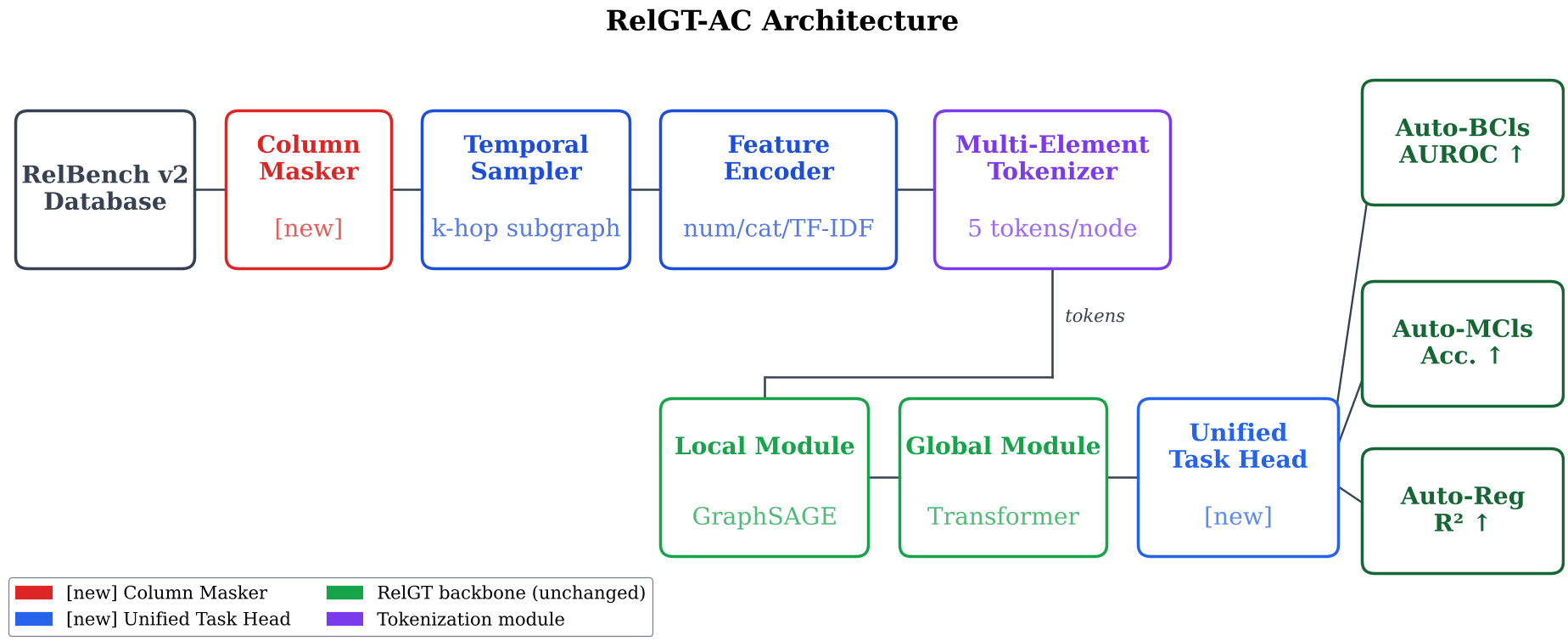 Figure 1: The RelGT-AC architecture featuring the Column Masker and Unified Task Head.
Experimental Showdown
The model was tested on RelBench v2, covering Formula 1 data, Stack Overflow, and Clinical Trials.
- Regression Superiority: In regression tasks (like predicting race results or enrollment numbers), RelGT-AC crushed the GraphSAGE baseline, improving R² by over 0.4 in some instances.
- The Text Factor: On the
eligibilities-adulttask, adding the TF-IDF encoder boosted the AUROC by exactly 10 points. - Attention Insight: Analysis showed that for clinical trials, the model learned to focus heavily on "Study Design" nodes—exactly how a human expert would determine eligibility.
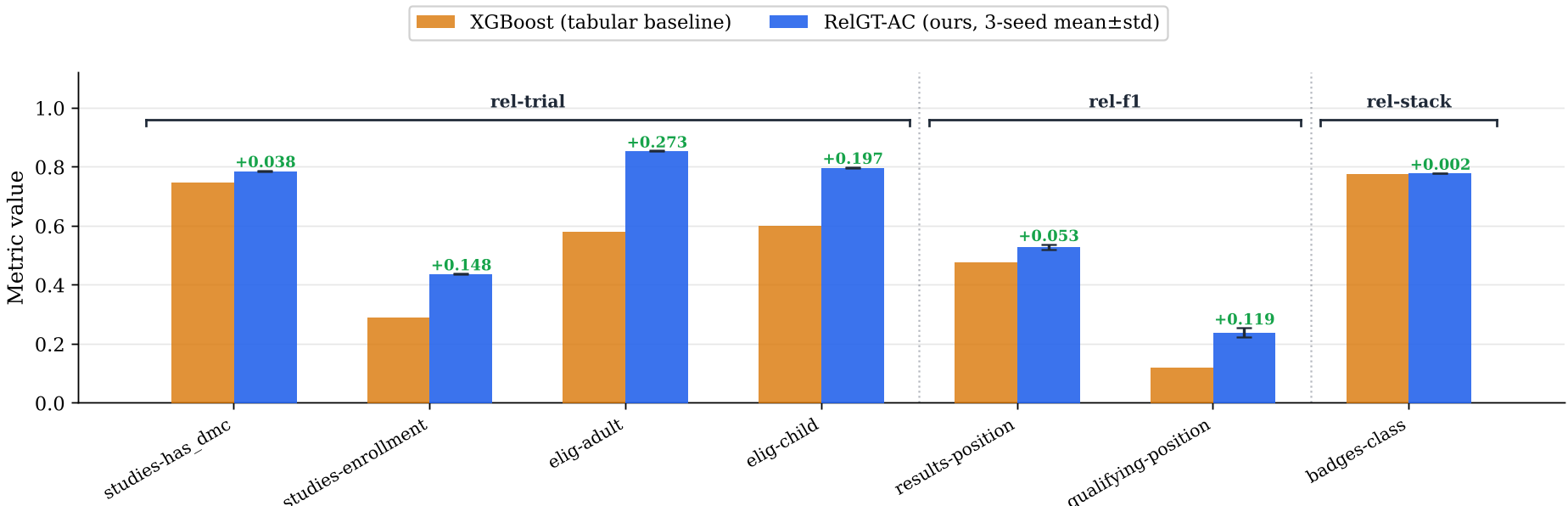 Figure 2: Performance gains of RelGT-AC over XGBoost across 7 diverse tasks.
Critical Insight: Why Context Matters
A key takeaway from the paper is the "Neighborhood Size" experiment. When the model was restricted to just 1 neighbor (), it performed worse than a basic XGBoost model. However, as the context size expanded to 32 neighbors, performance spiked. This proves that the secret sauce isn't just the Transformer—it's the ability to navigate the relational graph.
Conclusion & Future Work
RelGT-AC proves that Transformer-based "Global" reasoning is superior to "Local" GNN message passing for structured data. While it currently requires task-specific fine-tuning, its success with simple masking and TF-IDF encoding provides a blueprint for future Relational Foundation Models that could one day handle entire enterprise databases zero-shot.
Limitations: The model currently struggles with massive datasets (13M+ rows) due to GPU memory limits, suggesting a need for linear attention optimizations in the next iteration.