
Reliability-Driven Matching: Securing Vehicular Crowdsourcing Against Malicious Actors
Reliability-Driven Task Assignment in Vehicular Crowdsourcing: A Matching Game
This paper introduces a reliability-driven task assignment mechanism for vehicular crowdsourcing, combining a Beta reputation system for vehicle reliability assessment with a many-to-one matching game. The core contribution is a distributed Gale-Shapley-based algorithm that optimizes platform rewards while ensuring privacy and robustness against malicious data injection.
TL;DR
Vehicular crowdsourcing is a powerful paradigm for urban sensing, but it is vulnerable to malicious vehicles providing "garbage" data. This paper presents a novel mechanism that treats task assignment as a stable matching game. By integrating a Beta reputation system into the assignment logic, the platform can bypass unreliable participants, maintaining high service quality even in highly compromised environments, all while preserving vehicle privacy.
Academic Context: This work bridges the gap between Game Theory (Matching Theory) and Cyber-Physical System (CPS) Security, moving away from purely location-aware assignment toward a trust-aware scheduling framework.
The Core Challenge: The Cost of "Garbage In, Garbage Out"
Most existing vehicular crowdsensing (VCS) research assumes vehicles are either benign or merely selfish regarding energy consumption. In reality, malicious actors can launch:
- Data Falsification: Sending fake reports (e.g., false traffic jams).
- Discrimination: Selectively attacking specific sensing applications.
- Collusion: Multiple nodes coordinating to skew the platform's fused results.
The authors argue that verifying data after collection is too slow and resource-heavy. Instead, they ask: Can we build reliability directly into the selection process?
Methodology: The Two-Pillar Defense
1. The Beta Reputation System
Instead of a binary "trusted/untrusted" flag, the authors use a probabilistic model. Each vehicle's history for a specific task type is modeled using a Beta distribution: Where is successful outcomes and is failures. This allows the system to be fair to new users (starting at 0.5 reliability) while penalizing "white-washing" and rewarding consistent performance. A forgetting factor is included to allow formerly compromised vehicles to "rehabilitate" their status over time.
2. The Many-to-One Matching Game
The system models the platform and vehicles as two sets of players in a game.
- Platform Preference: Maximizes expected reward (), prioritizing vehicles with high reliability ().
- Vehicle Preference: Evaluates tasks based on internal costs (itinerary, fuel, sensor wear) without sharing this raw data with the platform.
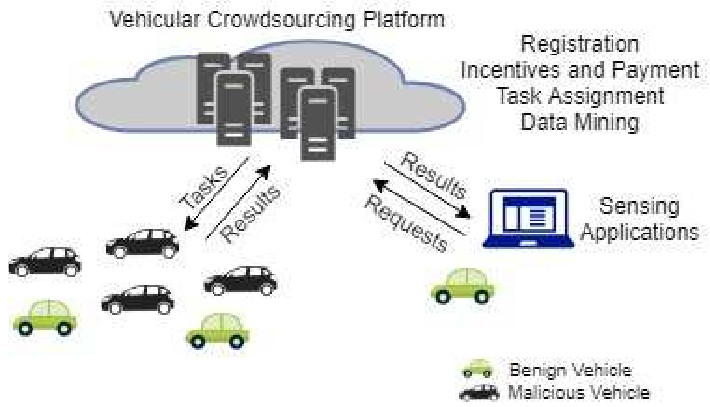 Fig 1: The vehicular crowdsourcing architecture involving requesters, the platform, and the mobile vehicle workers.
The Distributed Gale-Shapley Algorithm
To solve this NP-complete assignment problem efficiently, the authors adapt the Gale/Shapley algorithm. In this distributed version:
- Tasks "propose" to the most reliable vehicles.
- Vehicles "accept" tasks based on their own reward preferences, potentially bumping lower-reward tasks to remain within resource (sensing/computing/storage) capacities.
- The process iterates until a Stable Matching is reached—where no vehicle or task would prefer a different partner than their current one.
Experimental Validation
The paper's simulation results highlight two critical findings:
1. Robustness to Attackers: As shown in Fig. 2, as the percentage of unreliable vehicles increases to 80%, the proposed reliability-driven model (blue line) maintains significantly higher platform rewards compared to standard models.
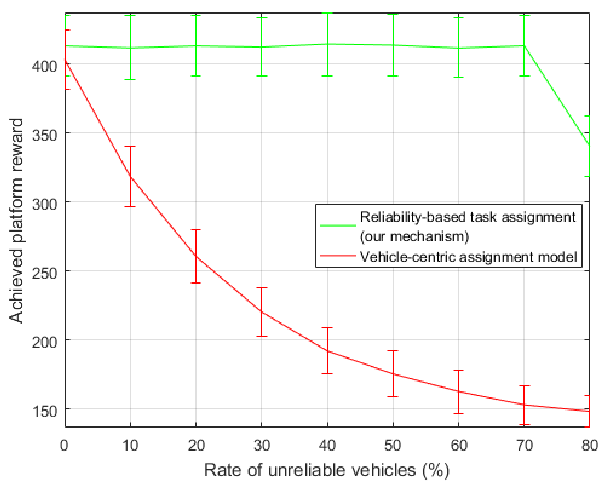 Fig 2: Platform reward stays stable under the proposed mechanism compared to vehicle-centric models.
2. Near-Optimal Efficiency: The distributed matching approach was compared against a Mixed Integer Linear Programming (MILP) solver. The results showed an average optimality gap of only 2.1%, proving that the distributed heuristic is nearly as effective as a centralized global optimum but with a fraction of the computational overhead.
Critical Insight & Future Outlook
The brilliance of this work lies in Decentralized Trust. By allowing vehicles to manage their own preference lists based on private itineraries, the platform avoids the "Big Brother" problem of tracking every car's path, yet still achieves a secure allocation.
Limitations: The current model assumes the platform can accurately judge a task's success to update the reputation. In sophisticated attacks (like collusion), the feedback itself might be tainted. Future work incorporating Peer-to-Peer Trust (where vehicles vet each other) will be essential to tackle large-scale coordinated cyberattacks.
Final Takeaway
For developers of smart city infrastructure, this paper provides a blueprint for a self-cleaning sensing ecosystem: don't just find the closest sensor; find the most reliable one through a competitive matching marketplace.