
Human Sensors: Turning Social Media Users into Security Assets
Evaluating the reliability of users as human sensors of social media security threats
This paper explores the "Human as a Sensor" (HaaS) paradigm for detecting social media security threats, such as phishing and QRishing. Utilizing a large-scale experiment with 4,457 participants and logistic regression modeling, the authors demonstrate that user reliability in threat detection can be predicted based on characteristics like platform familiarity and security awareness.
TL;DR
Cybersecurity has long treated the human user as the "weakest link." This paper flips the script, proposing a "Human as a Sensor" (HaaS) framework where users actively detect and report semantic attacks like phishing. By analyzing data from over 4,400 participants, the researchers proved that we can mathematically predict which users are "reliable sensors" based on practical metrics like platform familiarity, effectively turning a crowd of users into a distributed threat-detection network.
Background: Beyond the "Weakest Link"
Traditional cybersecurity focuses on firewalls and filters. However, semantic attacks—which target the human mind rather than software vulnerabilities—often slip through. The core insight of this research is that while humans are susceptible to deception, they are also highly capable of spotting "fishy" behavior if they are familiar with the environment. The challenge is: How do we know which user's report to trust?
Methodology: Modeling the Human Sensor
The authors developed a quantitative experiment using eight realistic scenarios (Exhibits), ranging from fake Instagram "QRishing" posts to legitimate Twitter ads.
The Predictive Framework
To make this practical for real-world platforms, the authors tested three deployment cases:
- Case A (Ideal): Access to all demographic and training data.
- Case B (Social Media): Only uses usage frequency, duration, and self-reported literacy (Ethical/Real-time).
- Case C (Enterprise): Includes internal training history but excludes protected traits like age/gender.
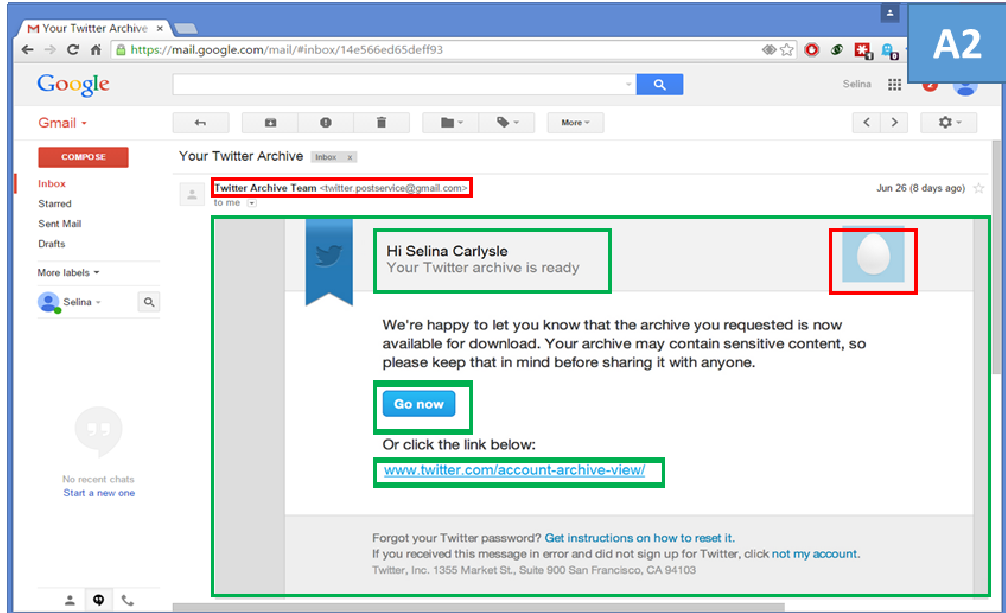 Figure: The success rate of participants across different attack (A) and non-attack (NA) scenarios.
The Mathematical Intuition
The researchers used Forward Stepwise Logistic Regression. Instead of just looking at who the user is, they looked at how they interact with the platform. They calculated Odds Ratios (OR)—for instance, if your familiarity with a platform increases by one unit, your odds of spotting a spear-phishing attack might increase by over 50%.
Key Results: What Makes a Good "Sensor"?
The results debunked the need for complex psychological profiles. The move from Case A to Case B (the most restrictive case) showed surprisingly little loss in predictive power.
- Familiarity is King: Knowledge of the specific platform (e.g., Steam or Facebook) was the strongest predictor of detection accuracy.
- The Power of Self-Study: Informal security learning (S3) was more effective than formal education in many scenarios.
- Efficiency: You don't need 20 variables to predict reliability; 2 to 5 specific indicators are enough to reach the point of diminishing returns in accuracy.
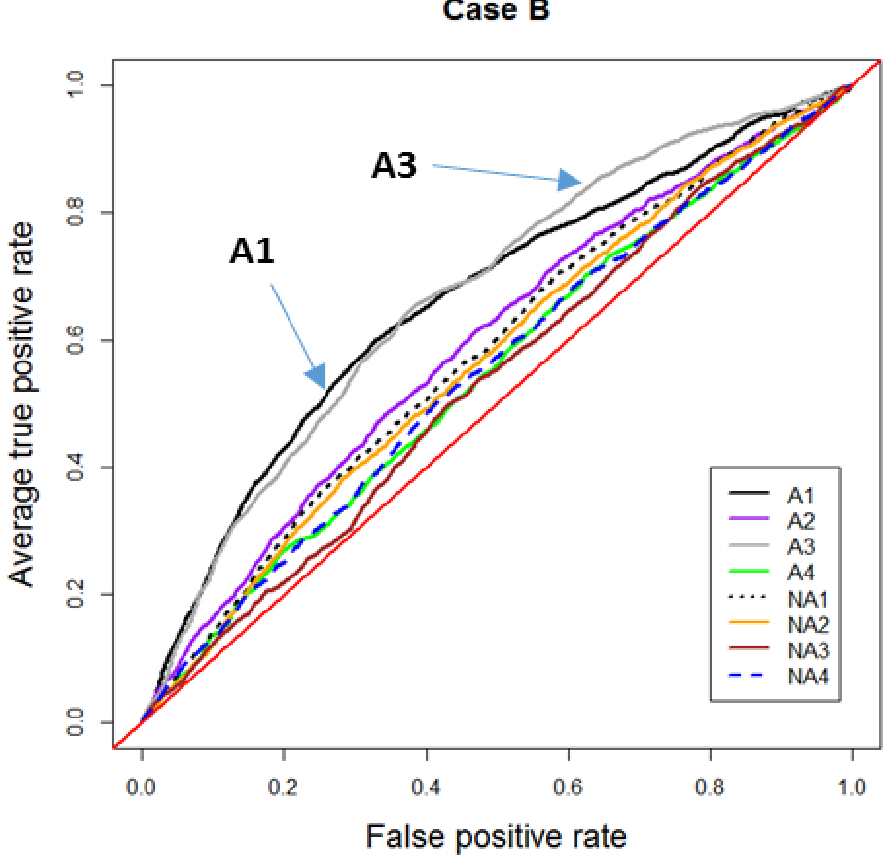 Figure: ROC curves showing the high predictive performance for various attack types in a monitored environment.
Critical Analysis & Conclusion
This work marks a significant shift in Cyber Situational Awareness. By treating user reports as "sensor data" with associated "reliability scores," platforms can filter out "noise" (false positives) and act on high-confidence "signals" of new, zero-day social engineering attacks.
Limitations & Future Work
While the study is robust, it relies on static screenshots (exhibits). Real-world attacks are dynamic and multi-stage. The authors suggest the next step is integrating this logic into live technical platforms (IDS/SIEM). Furthermore, this HaaS model could be extended to the Internet of Things (IoT) or Autonomous Vehicles, where human operators might sense physical anomalies before software monitors do.
Takeaway: Stop treating users only as targets; start treating them as distributed, intelligent sensors. The key isn't making every user perfect, but knowing exactly how much to trust each one.