
Reliable Face Analysis: Why Your Model Needs to Say "I Don't Know"
Reliable Age and Gender Estimation from Face Images: Stating the Confidence of Model Predictions
The paper introduces a multi-task deep learning model for age and gender estimation coupled with a novel reliability measure derived from stochastic dropout passes. By approximating Gaussian processes through multiple inference cycles, the method achieves state-of-the-art results on the Adience benchmark while providing a quantifiable confidence score for each prediction.
TL;DR
Deep learning models for age and gender estimation are notoriously over-confident, often guessing blindly on low-quality images. This paper introduces a framework that doesn't just predict attributes but also calculates a Reliability Score. Using stochastic dropout passes, the system identifies when it is "confused," allowing it to reach up to 98.5% accuracy by filtering out low-confidence samples.
The Problem: The "Silent Failure" of Softmax
In fields like forensics or access control, a wrong guess is worse than no guess at all. Most current CNNs provide a softmax output which many developers mistake for a confidence percentage. However, modern neural networks are often "miscalibrated"—they might give a 99% probability to a completely wrong class because they haven't seen similar data during training.
The authors identified that performance tanks on under-represented groups (like the 48-53 age bracket) or challenging environmental conditions. The missing link? A way to measure Epistemic Uncertainty—the model's own awareness of its limitations.
Methodology: Mining Intelligence from Randomness
The core innovation lies in the use of Stochastic Forward Passes. Unlike standard inference where dropout is turned off, the authors keep it active.
- Multiple Passes: The same image is fed through the network times. Because of dropout, different neurons are deactivated each time, creating a set of slightly different predictions.
- Centrality vs. Dispersion:
- Centrality: The average probability of the predicted class (is the "strength" high?).
- Dispersion: How much do the 100 predictions vary? If the model is certain, the results will be identical (low dispersion). If the model is guessing, the results will scatter (high dispersion).
The reliability formula balances these two factors, effectively penalizing predictions where the model's internal logic is inconsistent.
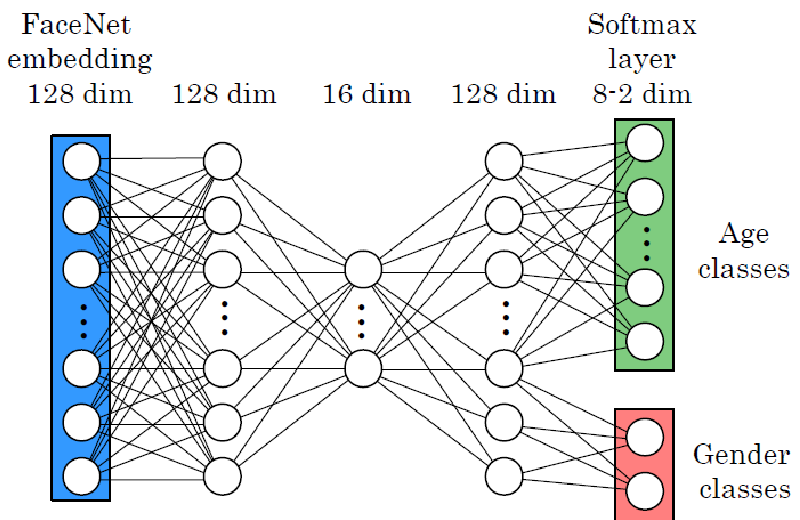 Figure 1: The multi-task architecture utilizing FaceNet embeddings followed by dropout-heavy dense layers.
Experimental Results: Precision Through Rejection
The model was tested on the Adience Benchmark, a dataset known for its "unfiltered" real-world face images. While the raw performance is state-of-the-art (64.3% Age, 89.8% Gender), the real power is shown in the Reliability-Threshold curves.
- Filtering works: By rejecting just the 20% of images with the lowest reliability scores, the error rate for gender classification was reduced by half.
- Visualizing Confusion: The authors show that images with near-zero reliability are often blurry, occluded, or have extreme lighting—images where even a human would struggle.
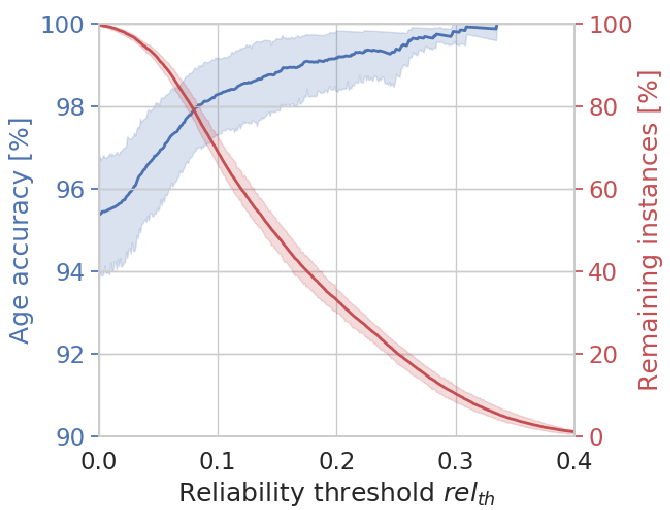 Figure 2: Accuracy vs. Reliability Threshold. As we increase the reliability requirement (blue line), the accuracy climbs significantly while the number of accepted samples (red line) decreases.
Critical Analysis & Insight
The brilliance of this approach is its plug-and-play nature. Most existing models trained with dropout can implement this reliability measure during deployment without retraining.
Limitations:
- Inference Latency: Running 100 forward passes for a single image increases computational cost by 100x. While negligible for forensics, this is a hurdle for real-time mobile apps.
- Data Bias: The model still reflects the biases of its training set (e.g., performing better on the 25-32 age group). While the reliability score flags the uncertainty caused by bias, it doesn't fix the underlying bias.
Conclusion
This paper shifts the focus from "how accurate can we get?" to "how trustworthy can we be?" By quantifying uncertainty, the authors provide a framework for AI that knows its own limits—a prerequisite for any AI system operating in the real, messy world of human faces.