
Reliable Data Analysis: Securing Mobile Ad-hoc Clouds via Blockchain
Reliable Data Analysis through Blockchain based Crowdsourcing in Mobile Ad-hoc Cloud
This paper introduces a blockchain-based rewarding and reputation framework for Mobile Ad-hoc Clouds (MAC) to enable reliable computational crowdsourcing. By integrating the lightweight Hyperledger Iroha blockchain, the authors propose a malicious node identification algorithm that ensures data integrity and incentivizes mobile device participation.
TL;DR
Mobile Ad-hoc Clouds (MAC) turn nearby smartphones into a powerful distributed computer. However, why would a user risk their battery for others? Incentives are needed, but incentives invite cheaters. This paper presents a reputation-aware blockchain framework using Hyperledger Iroha to detect malicious nodes in MACs, ensuring that only "honest" computation earns rewards while minimizing the cost of verifying results.
Background: The Rise of the Edge
We have transitioned from centralized mainframes to PCs, then to remote Clouds, and now back to the edge via Multi-Access Edge Computing (MEC). Despite mobile devices having massive latent power, average utilization remains below 25%. MACs exploit this by creating a "constellation" of devices. But trust is the missing link—participants might submit fake results to save battery while still claiming rewards.
The Core Problem: The Cost of Verification
In systems like BOINC (Berkeley Open Infrastructure for Network Computing), the standard way to ensure a result is correct is Task Replication—just run the same job on multiple devices and compare.
- The Pain Point: If you re-run every job, you waste 50%+ of your collective power.
- The Malicious Insight: Malicious nodes exploit rewarding systems by "pre-calculating" or guessing results to claim tokens, undermining the entire cloud’s reliability.
Methodology: Reputation Meets Blockchain
The authors propose a hybrid resource-sharing architecture where a local Cloudlet acts as a blockchain miner (Validating Node) while mobile devices act as workers (Non-validating Nodes).
1. Lightweight Blockchain (Iroha)
Unlike Bitcoin, which is too heavy for phones, Hyperledger Iroha is used for its mobile-first design. It stores:
- Credits: Tangible rewards for work.
- Reputation Score: A rank that determines how much the system "trusts" your output.
2. Malicious Node Identification Algorithm
The system doesn't treat every node equally. It employs a dynamic verification loop:
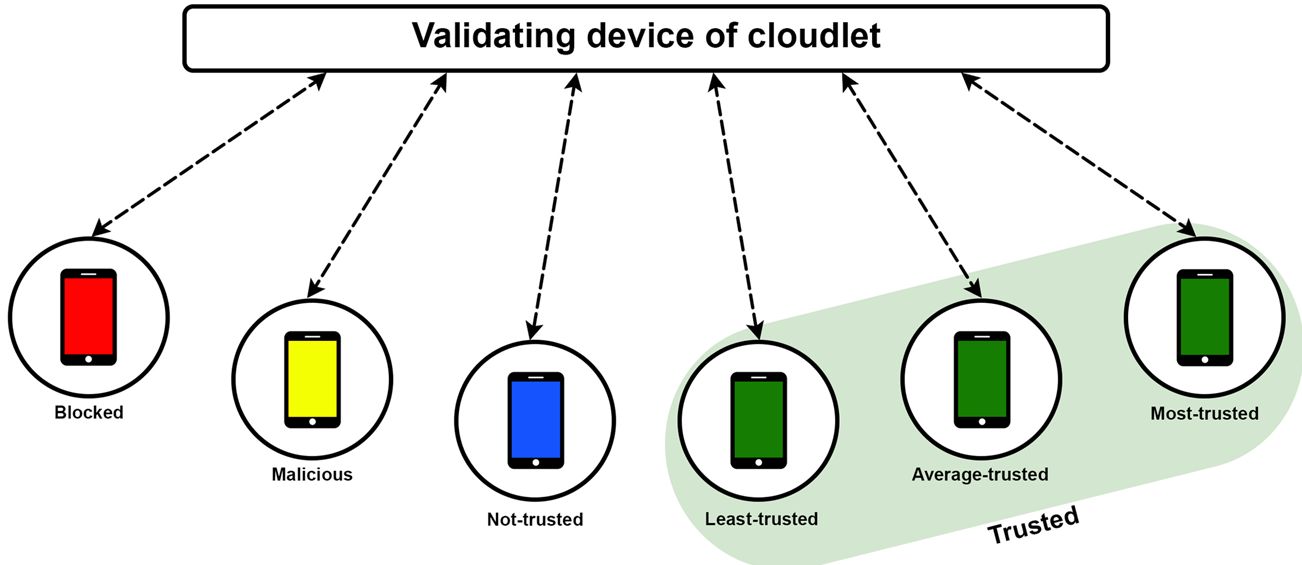
- New Nodes (Non-trusted): Every result is re-analyzed by a more trusted peer.
- Trusted Nodes: Once a node passes a reputation threshold, its results are accepted without immediate re-verification, saving vast amounts of energy.
- The Catch: If a trusted node ever fails a spot check, it is moved to the Blocked category immediately.
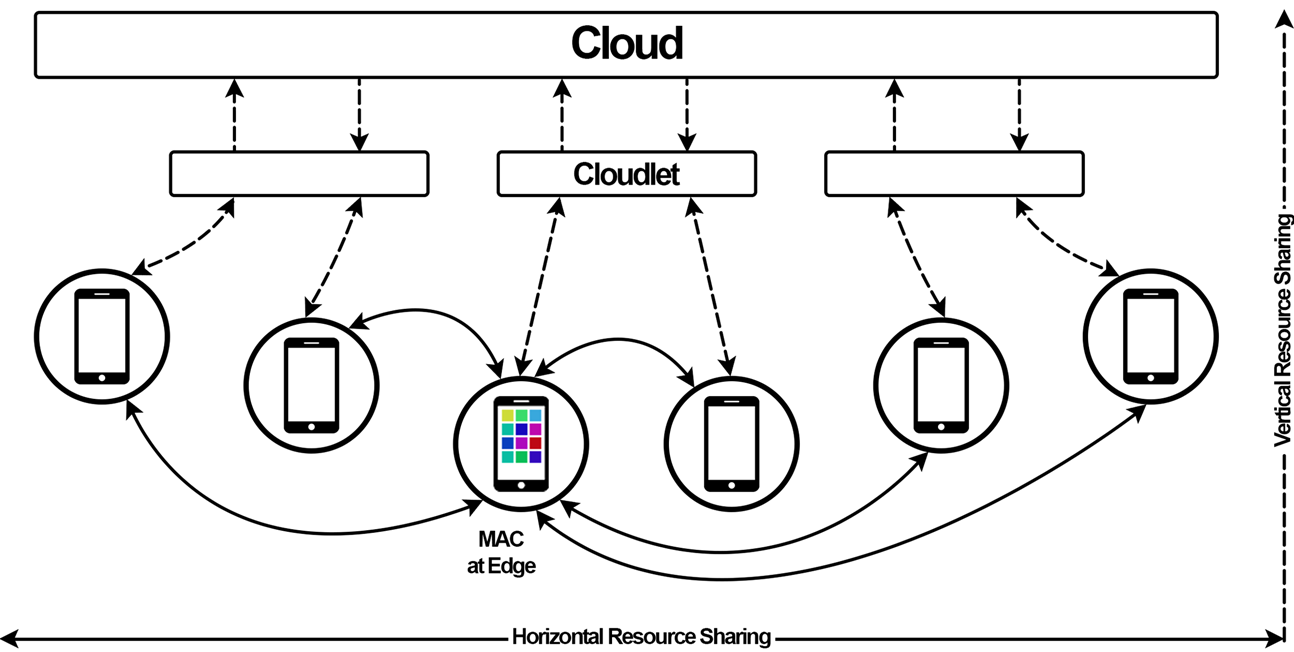 Note: The figure illustrates the interaction between the Blockchain plane (Validating nodes at the cloudlet) and the MAC plane (Mobile devices performing tasks).
Experimental Analysis: Catching the Cheaters
The authors tested the system using MapReduce operations—a common big data task. They simulated different types of malicious behavior, from "Active" cheaters (new nodes lying) to "Passive" high-reputation nodes that suddenly turn malicious.
Key Findings:
- Efficiency: For non-trusted nodes, identifying a fake result took only 2-3 re-analysis attempts.
- Robustness: Even when a "Most-Trusted" node (high reputation score) tried to submit fake data, the system eventually caught it within 5-7 attempts by cross-referencing with other trusted peers.
- Scalability: By reducing re-computations for high-reputation nodes, the system throughput increases as the network matures.
 The chart above shows that while more established 'Most-trusted' nodes require more checks to be flagged, the system maintains a 100% detection rate for malicious submissions.
Critical Insight & Conclusion
This work highlights a critical evolution in edge computing: Trust is a resource. By using blockchain as an immutable "ledger of behavior," we can move away from expensive, brute-force verification toward intelligent, reputation-based auditing.
Takeaway: The future of Mobile Ad-hoc Clouds isn't just about faster connections (5G/6G), but about decentralized governance. By making it "expensive" to lie (loss of reputation and access), we can finally unlock the 75% of underutilized mobile power sitting in our pockets.
Future Outlook: The next step is moving the "Validating Node" from the Cloudlet directly onto idle mobile devices, achieving a truly horizontal, peer-to-peer decentralized cloud.