
Is Your Marriage Machine-Learned? Decoding Divorce with NGBoost
Is Your Marriage Reliable?: Divorce Analysis with Machine Learning Algorithms
This paper evaluates the efficacy of machine learning in predicting marital outcomes using a specialized divorce prediction dataset. By benchmarking Support Vector Machines (SVM), Random Forests (RF), and Natural Gradient Boosting (NGBoost) on 54 psychological features, the study demonstrates that NGBoost achieves a superior SOTA accuracy of 98.33%.
TL;DR
Can an algorithm predict if a couple will stay together better than a marriage counselor? This paper explores the intersection of social science and AI, applying Natural Gradient Boosting (NGBoost) and Random Forests to a 54-feature psychological dataset. The results are startling: a predictive accuracy of 98.33%, revealing that the secret to a lasting marriage may lie in shared perceptions and communication "startup" styles.
The Social Stakes: Why Predict Divorce?
High divorce rates are more than just a personal tragedy; they are a systemic social issue linked to increased drug use and psychological distress in teenagers, as well as economic instability. The motivation behind this research is to move beyond "post-mortem" analysis and create a reliable predictive model that can identify at-risk couples based on their current emotional status.
Methodology: From Questionnaires to Feature Vectors
The researchers utilized a dataset of 170 samples (84 divorced, 86 married). Each sample consists of 54 features—essentially a 5-point scale response to questions regarding harmony, trust, and conflict styles.
The Model Arsenal
- Support Vector Machine (SVM): Uses a Radial Basis Function (RBF) kernel to find the optimal decision boundary.
- Random Forest (RF): An ensemble of 2,000 decision trees using bagging to reduce variance.
- NGBoost (Natural Gradient Boosting): The star of the show. Unlike standard gradient boosting, NGBoost treats parameters as a probability distribution and uses the Natural Gradient to find the steepest ascent in the parameter space, leading to more robust probabilistic forecasting.
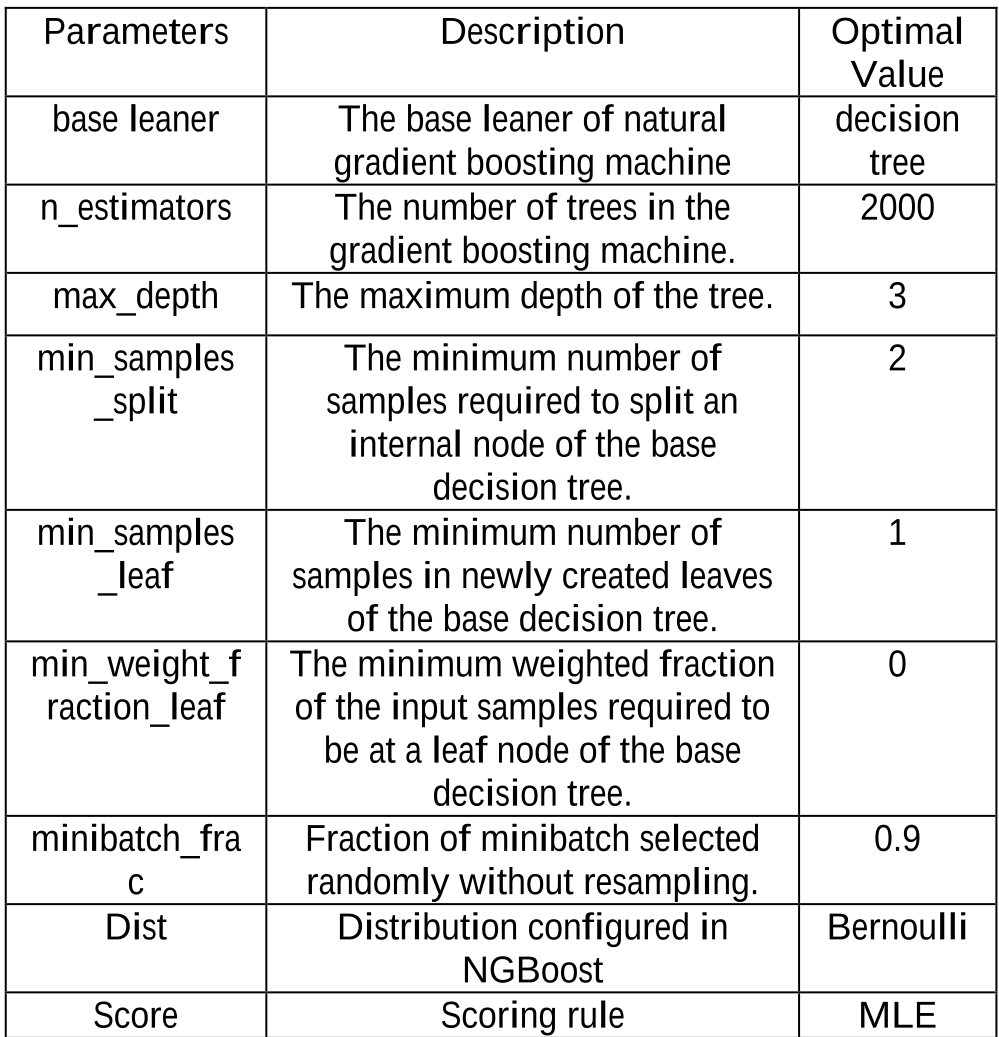 Table: Key parameters for the NGBoost implementation, utilizing a Bernoulli distribution for binary classification.
Experimental Showdown: NGBoost Takes the Crown
The authors employed 10-fold cross-validation to ensure the results weren't just a fluke of the data split. While all models performed exceptionally well (above 97%), NGBoost provided the edge.
- NGBoost Accuracy: 0.9833
- RF Accuracy: 0.9778
- SVM Accuracy: 0.9715
The high accuracy across all models suggests that the features themselves (the 54 questions) are highly discriminative, capturing the underlying "health" of a relationship with high fidelity.
Deep Insight: What Actually Causes Divorce?
Perhaps the most valuable contribution of this paper isn't just the prediction, but the Feature Importance analysis. By analyzing the trees in RF and NGBoost, the authors identified the "Top 10" traits that define a failing marriage.
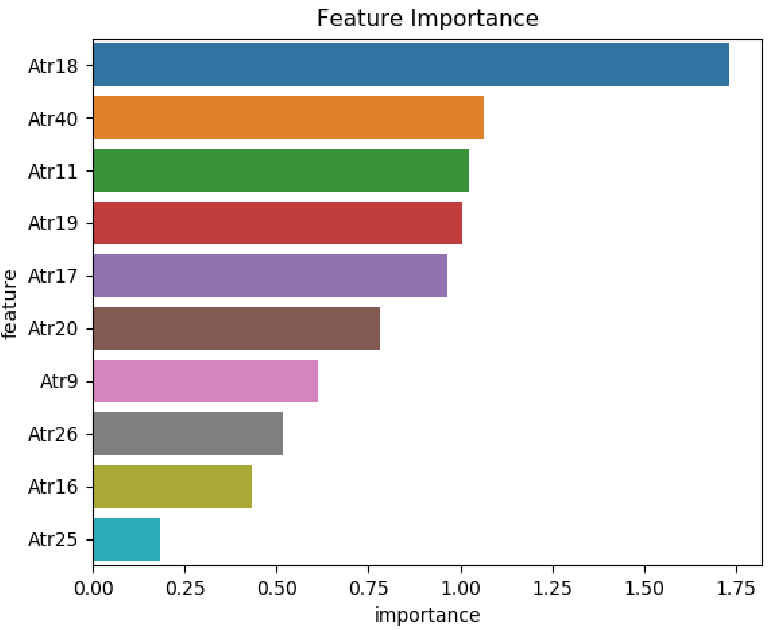 Figure: The feature importance ranking shows that ideological alignment (Q18) and communication patterns (Q40) are primary indicators.
Key Takeaways from the Features:
- Feature 18: "My spouse and I have similar ideas about how marriage should be." (Ranked #1 by both models).
- Feature 40: "We're just starting a discussion before I know what's going on." (Predicting a "harsh startup" in arguments).
- Feature 11: Long-term vision of harmony.
Critical Analysis & Conclusion
While the near-100% accuracy is impressive, it is worth noting the sample size (N=170) is relatively small for machine learning standards. In a real-world scenario, the "noise" of human behavior and external stressors (finances, health) might lower these scores.
However, the consistency between Random Forest and NGBoost in picking the same top features demonstrates high Internal Validity. This research proves that marital stability isn't just a mystery of the heart—it's a pattern that AI is increasingly capable of decoding. For future work, incorporating longitudinal data (tracking couples over 10-20 years) would be the "Holy Grail" of this research line.
The Takeaway? If you and your spouse see marriage through the same lens, you’ve already won half the battle.