
Beyond Labels: Injecting Semantic Intuition into Crowdsourced Medical Diagnosis
Reliable Medical Diagnosis from Crowdsourcing: Discover Trustworthy Answers from Non-Experts
The paper proposes a novel Truth Discovery framework for medical crowdsourcing that integrates semantic answer representation learning. By representing medical diagnoses as real-valued vectors and coupling their learning with user reliability estimation, the method achieves 74.39% accuracy on a large-scale Baidu dataset, significantly outperforming traditional categorical truth discovery methods.
TL;DR
In the high-stakes world of online medical Q&A, a "wrong" answer isn't always equally wrong. This paper introduces a framework that doesn't just count errors but measures their semantic distance. By combining Truth Discovery with Representation Learning, the authors achieve a new SOTA on medical diagnosis crowdsourcing, identifying trustworthy answers from non-experts with over 74% accuracy.
The Problem: The "Categorical Blindness" of Classical Truth Discovery
Traditional Truth Discovery (TD) operates on a simple principle: reliable users provide truths, and truths are answers backed by reliable users. However, most TD algorithms treat answers like "Common Cold" and "Influenza" as distinct, unrelated categories—the same way they would treat "Common Cold" and "Broken Leg."
In medicine, this is a fatal flaw. A user who misdiagnoses a cold as a mild respiratory infection is likely more knowledgeable (and thus more reliable) than someone who suggests a bone fracture for a runny nose. Without semantic awareness, we cannot accurately penalize users or aggregate "soft" consensus.
Methodology: Coupling Embeddings with Trustworthiness
The authors propose a unified optimization problem. Instead of treating an answer as a label, they map it to a vector in a semantic space.
1. The Core Insight
The model learns that if two diseases share similar context words (symptoms like "headache" or "fever" in the question text), their vectors should be close. However, because crowdsourced data is noisy, you can't trust every co-occurrence.
2. The Feedback Loop
The architecture (shown below) creates a mutual reinforcement cycle:
- Truth Computation: Identifies a "Semantic Truth Vector" for a question by taking a weighted average of user answer vectors.
- Reliability Estimation: Penalizes users based on the Euclidean distance between their answer vector and the Truth Vector.
- Vector Learning: Updates disease embeddings using question context, but weights these updates by the user's reliability to filter out "nonsense" pairings.
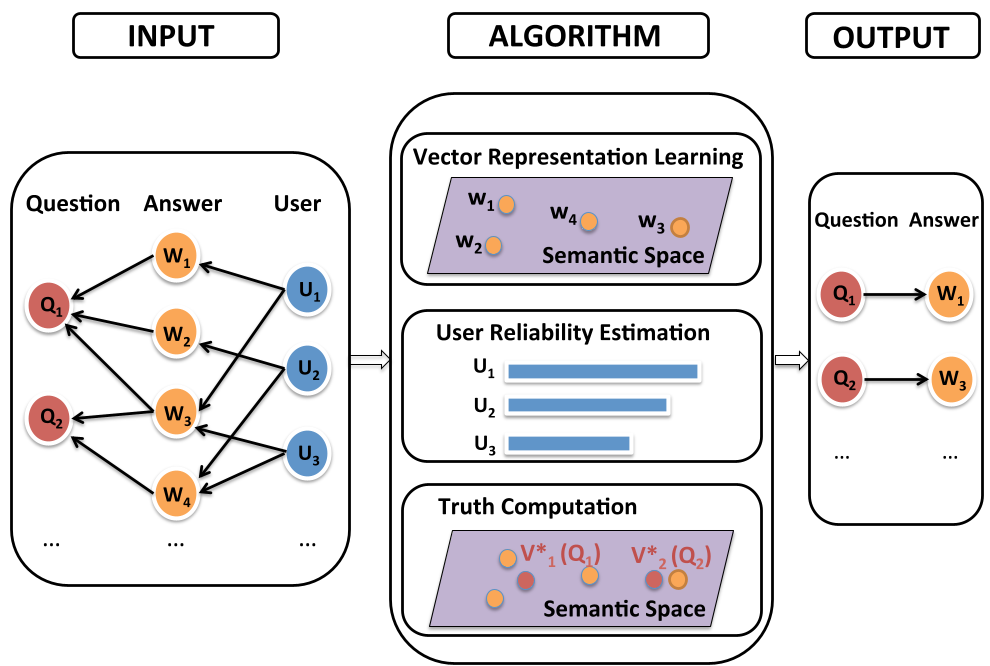 Figure 1: The synergy between Truth Discovery and Vector Learning.
Experimental Results: Precision in the Long Tail
The researchers tested their model on a massive dataset from Baidu Research, involving over 23,000 users.
Key Findings:
- Accuracy Boost: The proposed method reached 74.39%, leaving traditional models like TruthFinder and Investment behind (which hovered around 68-70%).
- Semantic Proximity: Even when the model was "wrong," the distance between its prediction and the doctor's gold standard was significantly smaller than baseline errors. It essentially "failed gracefully."
- Scalability: As seen in the performance charts, the running time scales linearly with the number of Q&A pairs, proving it can handle real-world web traffic.
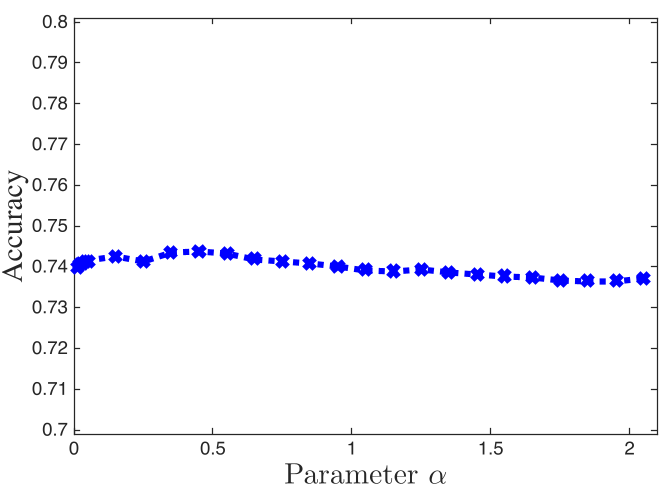 Figure 2: Accuracy remains stable across different parameter settings, showing high robustness.
Critical Insight: Why This Matters
This paper represents a shift from lexical matching to latent reasoning in data fusion. By allowing "Common Cold" and "Flu" to support one another through vector similarity, the model effectively "amplifies" the signal from reliable but slightly uncoordinated users.
Limitations: The model currently relies on a pre-defined medical entity dictionary for segmentation. In a world of evolving medical slang, moving toward an end-to-end Transformer-based context extractor would likely yield even higher gains.
Conclusion (Takeaway)
If you are building a system to aggregate human judgment—whether in medical AI, content moderation, or legal tech—don't treat your labels as islands. The semantic error distance is often a better teacher of user reliability than 0/1 accuracy.