
RMTF: Bridging the "Silence" in Social Media Sensing via Spatiotemporal Inference
Towards Reliable Missing Truth Discovery in Online Social Media Sensing Applications
The paper introduces Reliable Missing Truth Finder (RMTF), a spatiotemporal inference framework designed for social media sensing. It addresses the "missing truth" challenge where variables lack reports, achieving significant SOTA improvements in Kappa (2.88x) and MCC (2.49x) scores on real-world disaster recovery data.
TL;DR
In the chaos of a disaster, social media is a lifeline, but it is also a "sparse" and "noisy" sensor. Traditional Truth Discovery (TD) algorithms struggle when there are no reports at all for specific locations—a problem known as "Missing Truth." Reliable Missing Truth Finder (RMTF) solves this by using dynamic topic modeling to uncover latent correlations between events, allowing the system to "infer" what is happening in the silence.
The "Missing Truth" Crisis in Social Sensing
Social media sensing (using tweets or posts as sensors) is revolutionized but flawed. During Hurricane Sandy, research showed that 45% of gas stations in the affected area had zero Twitter reports on any given day.
Current state-of-the-art (SOTA) solutions suffer from two fatal assumptions:
- Data Density: They assume every variable (e.g., a gas station) is constantly being reported on.
- Independence: They ignore that the status of Station A is often a predictor for Station B (spatial correlation) or that today's status depends on yesterday's (temporal correlation).
Methodology: How RMTF "Sees" the Unseen
The core innovation of RMTF lies in its ability to handle Lagged and Latent Correlations.
1. Dynamic Correlation Inference (DCI)
Instead of assuming physical proximity is the only link, RMTF uses a dynamic mixture topic model. It treats a sequence of "truths" as documents generated by latent topics (e.g., supply chain links, brand, or local demand). By using Symmetric KL-Divergence, it calculates the similarity between two variables even if their correlation is delayed (lagged).
2. The Holistic Loss Function
RMTF aggregates three distinct types of "disagreements" into a single optimization problem:
- Claim Disagreement: How much does the estimated truth conflict with actual tweets? (Weighted by claim assertiveness).
- Spatial Disagreement: Does the estimate contradict the status of highly correlated nearby or similar variables?
- Temporal Disagreement: Does the estimate deviate wildly from the historical ARMA (AutoRegressive Moving Average) prediction?
Figure 1: The RMTF architecture showing the flow from raw claims to Dynamic Correlation Inference and final Binary Integer Programming.
Battle-Tested: Hurricane Sandy Evaluation
The authors tested RMTF against real Twitter data regarding gas availability in New York and New Jersey.
Quantitative Edge
While traditional models like EM (Expectation-Maximization) and TruthFinder were augmented with interpolation (KNN/ARMA) for a fair fight, RMTF still dominated:
- Kappa Score: 0.3345 (RMTF) vs. 0.1163 (Best Baseline).
- MCC: 0.3709 (RMTF) vs. 0.1491 (Best Baseline).
Parameter Sensitivity
The study highlights that Spatial Correlation () is a powerful but sensitive lever. As shown in the performance charts, if the spatial weight is too high, it overrides temporal logic and degrades performance. RMTF hit the "sweet spot" where spatial and temporal metrics balanced perfectly.
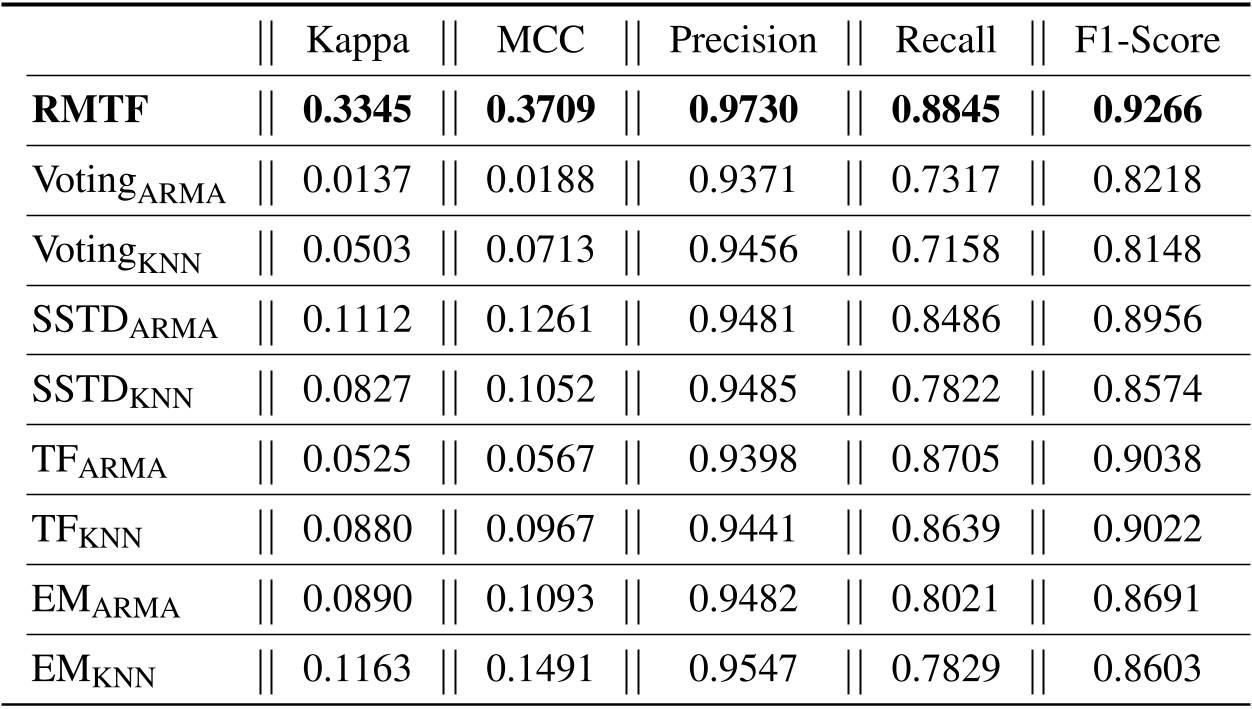 Table 1: Comparative performance metrics showing RMTF's clear lead in imbalanced data scenarios.
Critical Insight & Future Outlook
The brilliance of RMTF is its Inductive Bias: it assumes the world has structure even when the data doesn't.
Limitations:
- The model assumes a linear temporal relationship (ARMA). In real disaster scenarios, resource depletion is often non-linear (exponential "runs" on gas).
- It is vulnerable to collusion attacks where a coordinated group of users spreads a consistent lie.
The Takeaway: The next generation of Truth Discovery won't just be about identifying who is lying; it will be about using the "Physics of the World" (spatiotemporal trends) to fill the gaps where the "Human Sensor" is silent.