
Beyond Binary: Scaling Reliable Wisdom of Crowds with Iterative D-ary Algorithms
Reliable Multiple-choice Iterative Algorithm for Crowdsourcing Systems
The paper proposes a novel iterative algorithm for aggregating noisy responses in multiple-choice crowdsourcing systems. By utilizing message-passing techniques and low-rank matrix approximations, it extends the state-of-the-art Karger's binary algorithm to D-ary classification and short-answer tasks, achieving order-optimal error rates.
Crowdsourcing platforms like Amazon Mechanical Turk offer a scalable way to label data, but they face a fundamental "Trust vs. Cost" dilemma. Workers are often low-paid and lack accountability, leading to noisy, unreliable datasets. While Majority Voting is simple, it treats the professional expert and the random "spammer" as equals.
In this deep dive, we explore a sophisticated iterative approach from researchers at Seoul National University that moves beyond simple binary "Yes/No" tasks to solve complex multiple-choice and short-answer questions with mathematical precision.
The Core Challenge: The Multi-class Redundancy Trap
Prior breakthroughs in iterative algorithms (notably by Karger et al.) proved that we could achieve "order-optimal" results—meaning we get the highest possible reliability for the lowest number of queries. However, these were designed for binary tasks. To handle a 4-choice question, old methods had to split it into multiple binary questions, which "overexploited redundancy" and wasted budget.
The authors ask: Can we design an algorithm that handles D-ary choices natively while maintaining exponential error decay?
Methodology: Vectorized Consensus & Worker Reliability
The proposed algorithm treats task-worker interactions as a bipartite graph. It operates through two alternating messages:
- Task Message (): A likelihood vector for task . It is the weighted sum of responses from all workers except worker .
- Worker Message (): A scalar representing the reliability of worker . It is calculated by taking the inner product of the worker's response and the group’s consensus.
The Intuition of the Inner Product
If a worker's response vector aligns with the weighted consensus of their peers, the inner product is positive and large, increasing the worker's "weight" in the next iteration. If they provide a random or outlier answer, the value drops, effectively "muting" their influence on the final result.
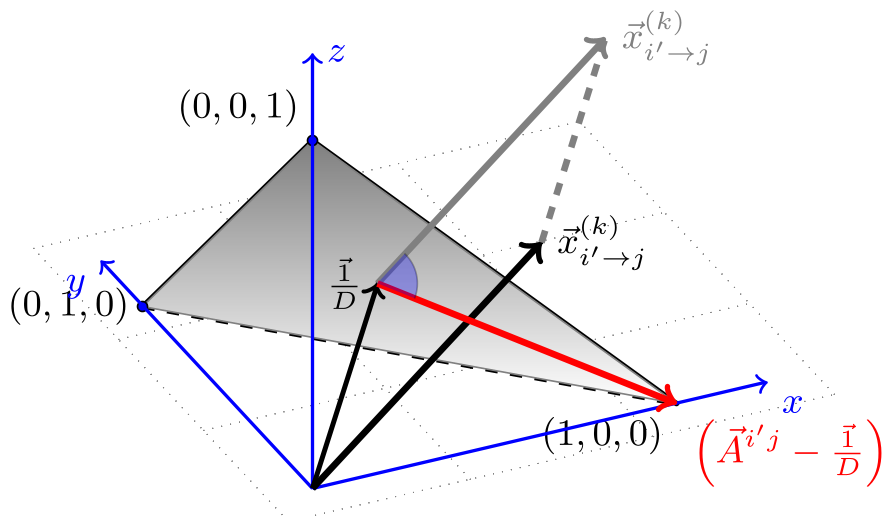 Figure 1: Visualization of the response vector and task consensus in the message vector space.
Mathematical Breakthrough: The Phase Transition ()
One of the paper's most significant contributions is the formal proof of Exponential Error Decay. The authors show that the reliability of the system depends on a quality factor , which relates to the negative entropy of worker responses.
The algorithm exhibits a Phase Transition:
- If : The error bound collapses exponentially as you add more tasks or workers.
- If : The variance diverges, and the algorithm fails to outperform simple Majority Voting.
This value is a function of the number of choices (), worker quality (), and the graph degree (how many tasks each worker does).
Experimental Results: Beating EM and Majority Voting
The researchers tested the algorithm against standard Expectation-Maximization (EM) and Majority Voting.
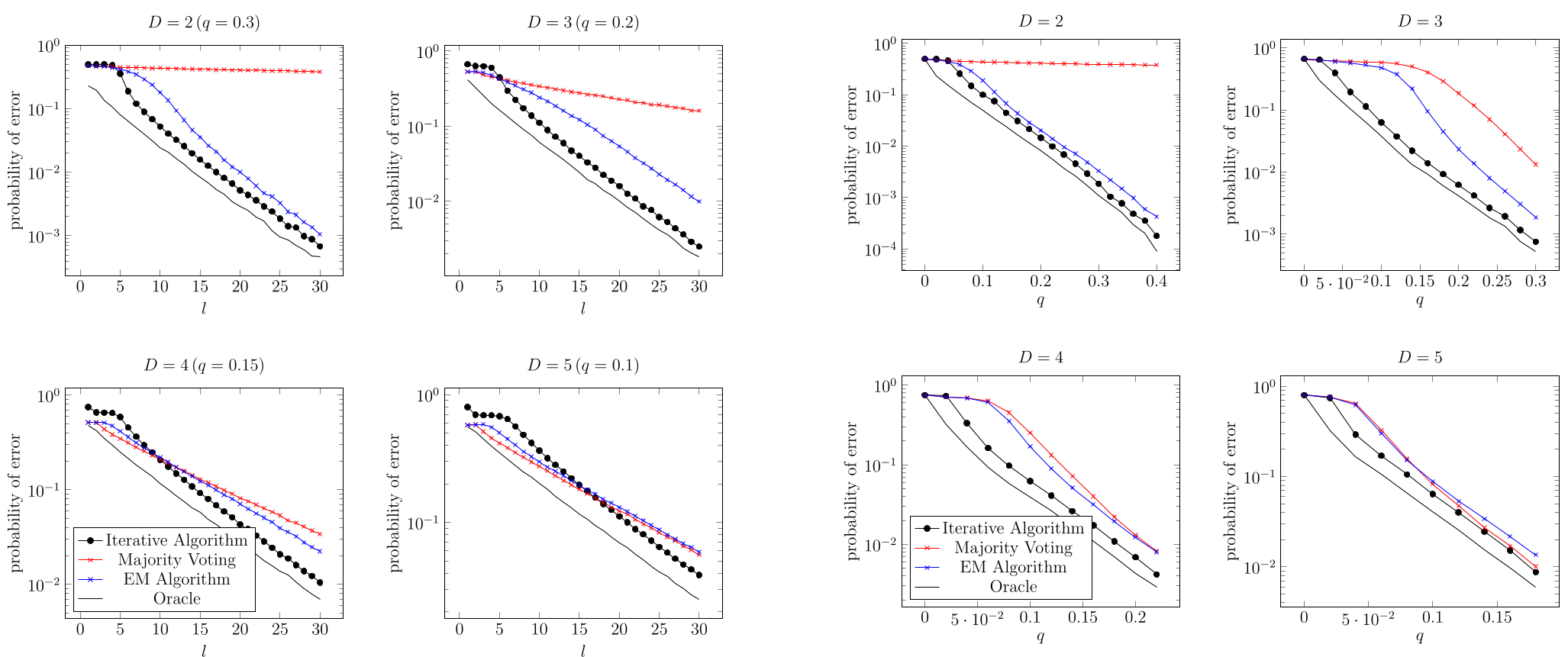 Figure 2: Performance comparison. Note how the Iterative Algorithm (green) achieves a significantly lower probability of error as worker quality (q) increases, staying close to the "Oracle" (optimal) line.
Key Findings:
- Accuracy: Superior to EM, which often gets stuck in local optima due to initialization issues.
- Adaptive Strategy: The algorithm can be used to identify "Expert" workers during a pilot phase. By assigning the remaining tasks to these high- workers, the error rate drops even further without increasing the total budget.
- Short-Answer Versatility: By decomposing short answers (like zip codes) into character-based microtasks, the algorithm successfully aggregates open-ended responses.
Critical Insight & Future Outlook
This work represents a bridge between information theory and practical crowdsourcing. By proving that worker reliability is essentially a manifestation of negative entropy, the authors provide a rigorous foundation for "Quality Control" in human-in-the-loop systems.
While the paper focuses on independent choices, future iterations could tackle ordered choices (like 1–5 star ratings) or tasks where multiple correct answers exist. For developers building data pipelines for AI training, this algorithm offers a robust, scalable alternative to the "brute force" of Majority Voting.
Conclusion
The "Reliable Multiple-choice Iterative Algorithm" proves that with the right mathematical framework, we can extract high-quality "Ground Truth" from a sea of noisy, low-cost labels. It is a vital read for anyone interested in the intersection of Message Passing, Spectral Methods, and Human Computation.