
RPTM: Bridging the Gap Between Reliability and Privacy in Blockchain Crowdsourcing
Reliable and Privacy-Preserving Task Matching in Blockchain-Based Crowdsourcing
The paper introduces RPTM (Reliable and Privacy-preserving Task Matching), a blockchain-based framework that uses smart contracts and a novel integer vector encryption scheme to match workers with tasks. It achieves multi-keyword fuzzy matching by integrating Locality Sensitive Hashing (LSH) and Bloom filters, ensuring both data confidentiality and operational integrity on the EOS blockchain.
TL;DR
Crowdsourcing platforms like Amazon Mechanical Turk face a fundamental paradox: users must share sensitive skills and interests to get matched, yet the centralized platforms doing the matching are often untrusted. RPTM (Reliable and Privacy-preserving Task Matching) resolves this by moving matching to the EOS blockchain. It uses a sophisticated Integer Vector Encryption scheme to hide data and Locality Sensitive Hashing (LSH) to allow for typos, ensuring that your task "Python" still matches a worker who typed "Pyton" without the blockchain ever knowing the actual word.
Problem & Motivation: The Trust Deficit in the Gig Economy
Current task-matching systems suffer from two main flaws:
- Centralized Malice: Servers can "lazy match" to save costs or leak private user data (health status, financial preferences) included in task descriptions.
- Brittle Matching: Existing encrypted search methods usually require 100% exact keyword matches. In the real world, human error (typos) or different naming conventions (e.g., "Graphic Design" vs. "Graphics Designer") cause these systems to fail.
The authors identify that while blockchain can fix the "trust" issue through transparency, that very transparency is a nightmare for privacy. RPTM was designed to provide the reliability of a public ledger without sacrificing the confidentiality of the data stored on it.
Methodology: The Core Mechanism
RPTM’s innovation lies in how it transforms linguistic keywords into secure, searchable mathematical vectors.
1. Multi-Keyword Fuzzy Logic
Instead of encrypting strings directly, RPTM processes keywords through two filters:
- Uni-gram Vectorization: Breaks words into character sets.
- LSH & Bloom Filter: LSH ensures that similar vectors hash to the same bucket. These are then stored in a Bloom filter. This allows the system to calculate "similarity" (via inner products) rather than "equality."
2. Secure Task Matching via Key-Switching
The technical heavy lifting is done using Integer Vector Homomorphic Encryption. To allow the blockchain to compute the similarity between Requester A and Worker B (who have different keys), a Key Distribution Center (KDC) provides a "Key-Switching Matrix." This matrix allows the smart contract to transform the ciphertext into a common format where the inner product can be calculated without ever revealing the underlying keywords.
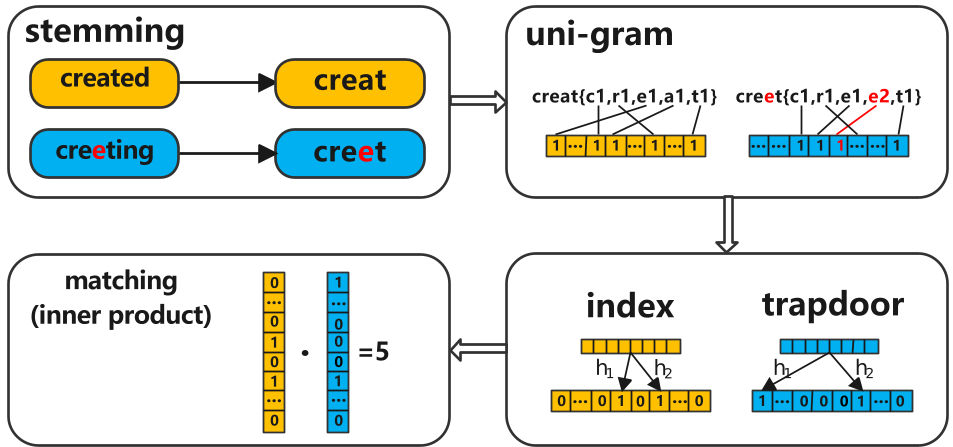 Figure: The RPTM system model showing the interaction between KDC, Requesters, Workers, and the EOS Blockchain.
Experiments & Results: Performance on a Global Scale
The authors tested RPTM on the EOS Jungle 2.0 Testnet. The results highlight that privacy doesn't have to be slow.
- Efficiency: Generating a secure "trapdoor" (search query) takes roughly 20ms, making it practical for mobile users.
- Reliability: By using smart contracts, the system guarantees that the top-k results are truly the best matches, preventing the platform from favoring specific workers.
- Accuracy: Even with spelling errors, the fuzzy matching algorithm maintains a precision of roughly 80-86%, which is a massive leap over "Exact Match" systems that would drop to 0% precision upon a single typo.
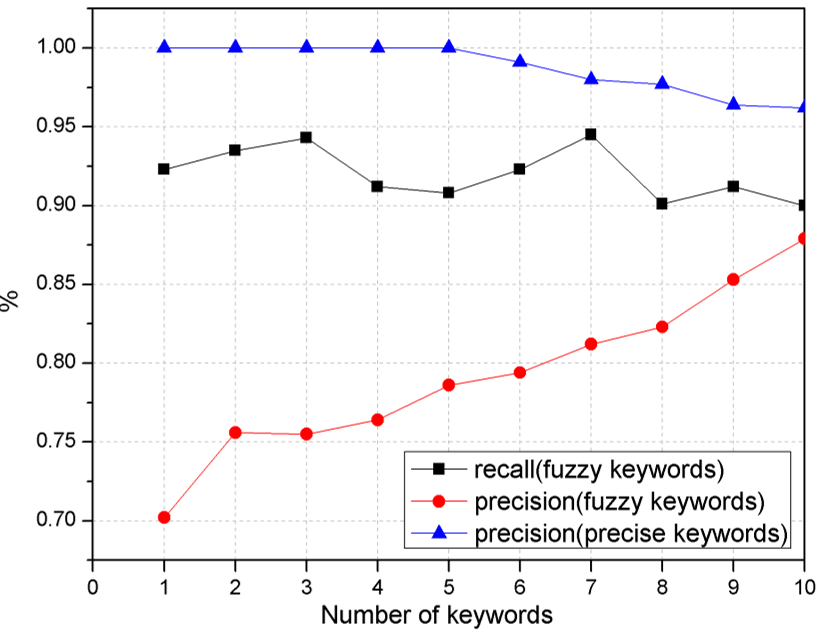 Figure: Accuracy and Recall metrics showing the system's resilience against spelling errors.
Critical Analysis & Conclusion
Takeaway
RPTM successfully moves beyond "theoretical" blockchain privacy by addressing the practical need for fuzzy searching. It proves that Learning With Errors (LWE) based encryption is suited for the high-throughput requirements of modern crowdsourcing.
Limitations
- KDC Dependence: While the KDC doesn't participate in the matching, it is still a centralized point of failure for initial key distribution.
- User Revocation: While the paper claims efficient revocation, the KDC must still manage the removal of key-switching matrices, which could become a bottleneck as the user base grows into the millions.
Future Outlook
The integration of Quantum-Resistant Encryption (LWE) makes RPTM a forward-looking architecture. Future research could explore removing the KDC entirely by using Decentralized Identifiers (DIDs) and Multi-Party Computation (MPC) for key management.