
RTCM: Securing Social Sensor Clouds via Fog Computing and Multisource Feedback
A Reliable Trust Computing Mechanism Based on Multisource Feedback and Fog Computing in Social Sensor Cloud
This paper introduces the Reliable Trust Computing Mechanism (RTCM), a decentralized trust evaluation framework for Social Sensor Clouds (SSC). It leverages fog computing and multisource feedback to provide low-latency, high-reliability trust assessment, achieving significant improvements in task success rates under malicious environments compared to traditional baselines like PSM and DRM.
Executive Summary
TL;DR: The Social Sensor Cloud (SSC) is an emerging IoT paradigm bridging physical sensors with social networks. However, its openness makes it a prime target for malicious data tampering. The Reliable Trust Computing Mechanism (RTCM) proposed by Liang et al. shifts trust evaluation from the centralized cloud to the fog edge. By fusing multisource feedback (direct interaction + fog recommendations) with a dynamic weighting algorithm, RTCM significantly reduces latency and enhances reliability, maintaining high task success rates even when 40% of nodes are malicious.
Background: This work represents a critical movement in IoT security—moving away from "Cloud-only" trust models toward edge-enabled, decentralized trust. It addresses the SOTA gap where existing models failed to handle the high overhead and subjective bias of social sensor data.
Motivation: The Trust Crisis in Social Sensors
Existing SSC architectures suffer from three fatal flaws:
- Centralization Bottleneck: Uploading every trust metric to the cloud causes massive overhead and delay.
- Social Complexity: Unlike static WSNs, social sensors are mobile and heterogeneous, making "one-size-fits-all" security rules useless.
- Malicious Feedback: Dishonest nodes can easily "game" the system by providing false feedback to lower the trust of honest nodes.
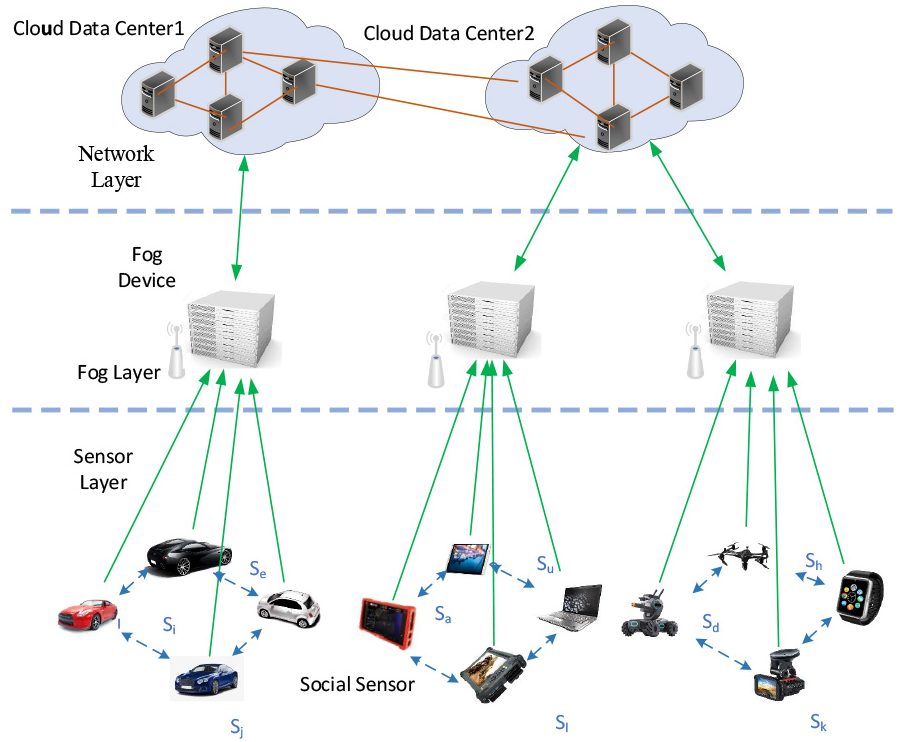
The authors' insight was simple yet powerful: Fog devices (FDs) are perfectly positioned to act as objective observers and localized trust aggregators, acting as a "middle-man" that filters noise before it reaches the network layer.
Methodology: The Three-Layer Trust Fusion
The RTCM framework operates across three distinct layers:
- Sensing Layer: Nodes collect direct interaction data (latency, packet success rate).
- Fog Layer: Fog devices monitor node behavior and aggregate feedback into a Recommendation Trust Matrix.
- Network Layer: The cloud acts as the final, globally trusted root.
Core Innovation: The Dynamic Fusion Algorithm
The global trust () is not a simple average. It is a weighted sum of S-to-S Direct Trust () and D-to-S Recommendation Trust ():
The breakthrough lies in the calculation of . Instead of human-defined weights, the system uses the interaction frequency and information entropy. If nodes interact frequently and successfully, the weight of "Direct Trust" increases, rewarding consistent honest behavior while isolating sudden malicious shifts.
Experiments & Results: Resilience Under Pressure
The researchers tested RTCM against two strong baselines: PSM (Similarity-based) and DRM (Distributed Management).
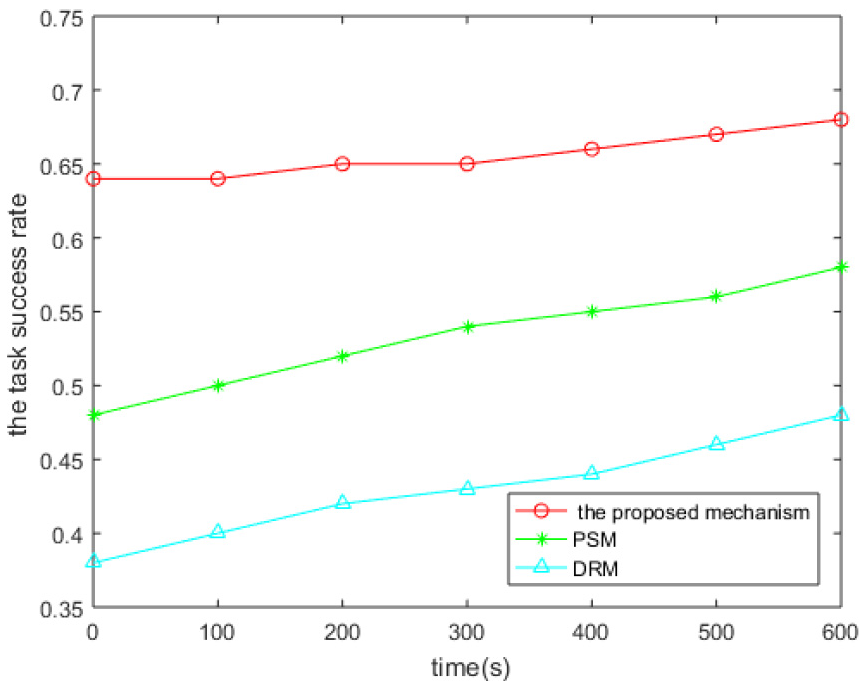
Key Finding 1: Superior Reliability
Even in Scene 3 (a "Highly Busy" network where 40% of nodes are malicious), RTCM achieved a 64% task success rate, while PSM and DRM plummeted to 48% and 38% respectively. This proves that RTCM’s multisource fusion is more robust against "Bad-mouthing" attacks.
Key Finding 2: Efficient Trust Evolution
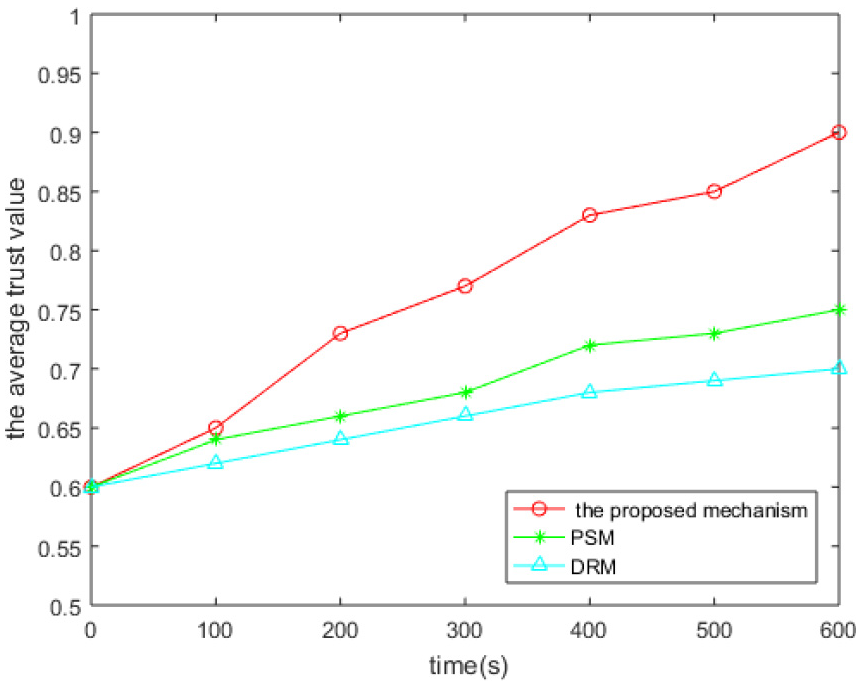
As shown in the "Trust Evolution" plots, RTCM allows honest nodes to recover their trust scores faster than competing models. The fog layer's ability to normalize feedback prevents a few malicious reports from permanently "killing" a node's reputation.
Critical Analysis & Conclusion
Takeaway
RTCM successfully proves that Fog Computing is not just for data processing, but for security logic. By localizing trust, the system gains "immunity" to global congestion and centralized failure points.
Limitations & Future Work
While robust, the current model assumes that Fog Devices themselves are always trustworthy. In a true zero-trust environment, we must consider "Fog compromises." The authors' next step—integrating even more flexible weight adjustments—is a step toward a truly autonomous, self-healing Social Sensor Cloud.
Final Prediction
We expect to see the RTCM's dynamic fusion logic incorporated into 6G edge intelligence, where the distinction between "Social" and "Technical" trust becomes increasingly blurred.