
Beyond Isolated Walls: Navigating Trust in Social Internetworking Systems
Finding reliable users and social networks in a social internetworking system
The paper introduces a novel multidimensional model for managing trust and reputation within "Social Internetworking Systems" (SIS)—complex environments where multiple social networks interoperate. It leverages a customized PageRank-based algorithm and a recursive reliability estimation mechanism to suggest trustworthy peer contacts and new social networks to users.
TL;DR
This research tackles the "silo" problem of social networks by proposing a Social Internetworking System (SIS). By using multidimensional trust matrices and "Representative Users" as cross-network bridges, the model helps users find reliable peers and relevant communities they’ve never interacted with before, achieving a Correctness score of 0.80 in real-world university trials.
Background: The Social Silo Problem
While social networks like LinkedIn or X (formerly Twitter) are powerful, they are often isolated. If you are looking for a reliable expert in "Blockchain Security" on one platform, you might miss the perfect candidate who is highly active on another. The authors identify three critical gaps in existing systems:
- Trust is Multidimensional: You might trust a professor’s opinion on Databases but not on Disco music.
- Lack of Interoperability: There is no "bridge" allowing users in Network A to gauge the reliability of users in Network B.
- Subjective vs. Objective Balance: Systems often fail to combine personal experience (Trust) with community-wide standing (Reputation).
Methodology: The Matrix and the Bridge
The core of the paper is the transition from simple numerical scores to Multidimensional Matrices.
1. The Trust Matrix ()
Instead of a single "star rating," trust is represented as a matrix where is the set of Dimensions (Honesty, Expertise, Precision) and is the set of Contexts (Technology, Sport, Economy).
2. Representative Users: The Social Interpreters
To solve the interoperability problem, the model introduces Representative Users. These are automated "delegates" for an entire social network. They aggregate the collective opinions of their network members and sit in all networks simultaneously, serving as the connective tissue for the SIS.
3. The Reliability Algorithm
The reliability of a user as perceived by user is calculated using a recursive decay formula:
- : A decay factor for transitive trust (trusting a friend of a friend).
- : The balance between subjective path-based trust and objective global reputation.
- : A PageRank-derived global reputation score.
 Figure 1: The overarching architecture showing the interaction between users and representative users across silos.
Experimental Insights
The authors tested the system with students from Computer Engineering and Economics departments. They measured two metrics:
- Correctness: Did the system suggest someone the user actually found reliable?
- Novelty: Did the system find reliable people the user didn't already know?
Key Findings:
- Optimal Depth: A "friend-of-a-friend" (Depth = 2) approach provided the best trade-off. Going deeper (Depth = 3) increased novelty but lowered correctness, as the "trust signal" became too diluted.
- The Value of Nuance: Moving from a single dimension (Case 1) to seven contexts and three dimensions (Case 5) significantly boosted the system's accuracy.
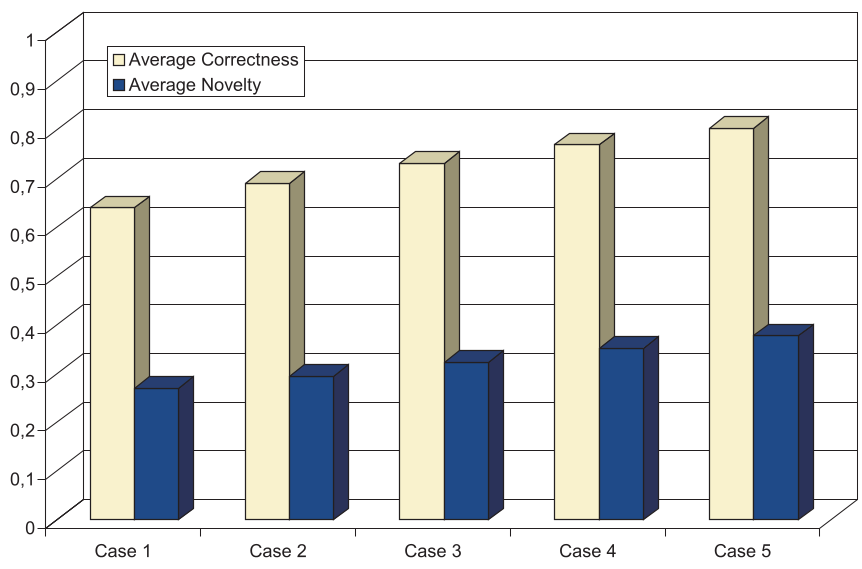 Figure 2: Average Correctness and Novelty gains as the complexity of dimensions and contexts increases.
Critical Analysis & Conclusion
Takeaway
This work pre-dates modern decentralized social movements (like the Fediverse) but provides the mathematical foundation they often lack. The use of Contextual Trust is a vital "Inductive Bias"—social reliability is not a global constant but a local variable dependent on the topic at hand.
Limitations
- Computational Complexity: Managing matrices for every pair of users in a system with millions of nodes would lead to significant scaling challenges (sparse matrix optimization would be required).
- Cold Start: The system relies heavily on initial ratings. New users or niche contexts might suffer from a lack of data.
Future Outlook
As we move toward a world of "Social Internetworking" (Inter-connected DAOs, Mastodon instances, etc.), the ability to derive trust across boundaries without sacrificing multidimensionality will be the "secret sauce" for the next generation of social discovery algorithms.