
Remarkable Advocates: Why Distance and Influence are the New Currency of Crowdfunding
Remarkable advocates: An investigation of geographic distance and social capital for crowdfunding
This study investigates how the characteristics of "advocates"—investors who promote projects within their social circles—influence crowdfunding success. Utilizing a large-scale longitudinal dataset from China (Demohour and Weibo), the researchers demonstrate that advocates with greater geographical distance and higher online social capital significantly enhance funding performance.
Executive Summary
TL;DR: In the digital age, being "close" to your investors might actually be costing you money. This research reveals that crowdfunding success is driven by advocates—investors who act as megaphones. By analyzing thousands of funding records, the study proves that advocates who are geographically distant and possess high social capital (followers) are the most effective at driving funding.
Academic Positioning: This work marks a paradigm shift from traditional "local bias" theories in finance to a "network reach" perspective in e-business, grounding social capital theory in objective secondary data rather than subjective surveys.
Problem & Motivation: The Death of Proximity?
In traditional venture capital, Geographical Distance (GD) is a villain. Proximity allows for face-to-face meetings, reduces information asymmetry, and lowers monitoring costs. This creates a "home bias" where entrepreneurs in rural or less-developed areas struggle to get noticed.
The authors hypothesized that online crowdfunding flips this script. In a digital ecosystem, the constraint is not monitoring, but attention. If your advocates are all in your backyard, you are fishing in a small, saturated pond. To scale, you need to reach "untapped potential."
Methodology: Mining the Synergy of Crowdfunding and Social Media
The researchers bypassed traditional surveys, opting for a computational social science approach. They merged two distinct datasets:
- Demohour.com: Project data, funding amounts, and timestamps.
- Weibo.com: Social network data of the actual investors (advocates).
They defined Social Capital (SC) as the number of followers an advocate has, and Geographical Distance (GD) as the physical distance between the project's registration and the advocate's city.
The Core Interaction: The Spillovers of Novelty
The study’s most profound insight isn't just that distance helps—it's how distance supercharges influence.
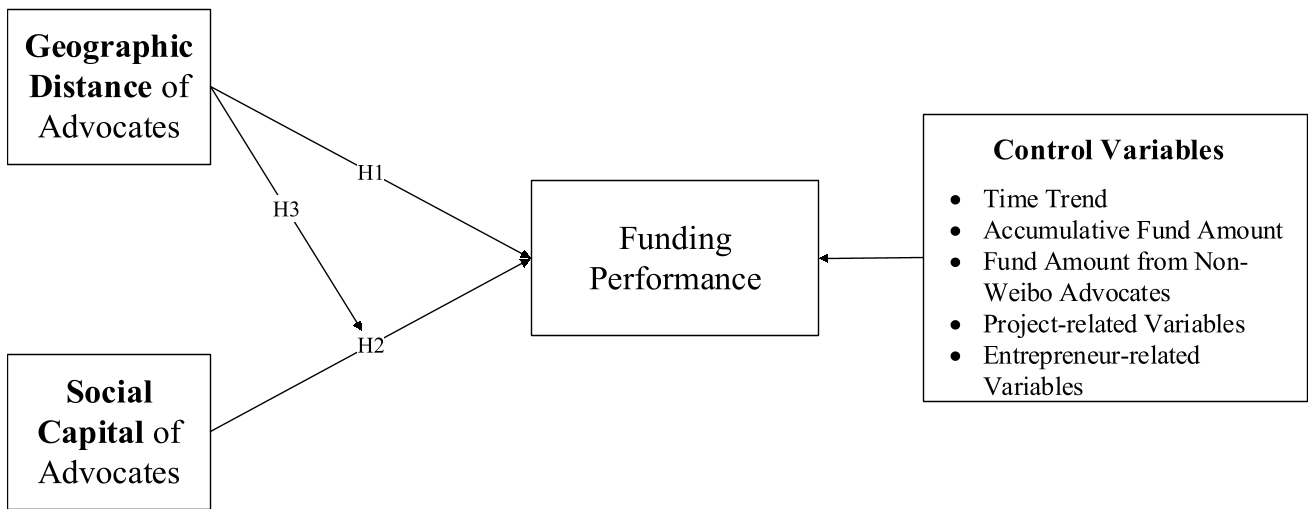
- Hypothesis 1 & 2: Both GD and SC independently boost funding.
- Hypothesis 3 (The Interaction): The impact of a high-follower advocate is significantly higher when they are far away.
The Intuition: Knowledge spillovers tend to be localized. If an influencer is in the same city as the entrepreneur, their followers likely already know about the project. A distant influencer brings the project to a new social circle, where the information is novel and perceived as higher quality because it has "traveled" successfully across boundaries.
Critical Analysis & Takeaways
Key Findings:
- Distance is a Signal: Support from distant advocates implies universal project appeal, reducing the "sympathy vote" perception typical of family-and-friend funding.
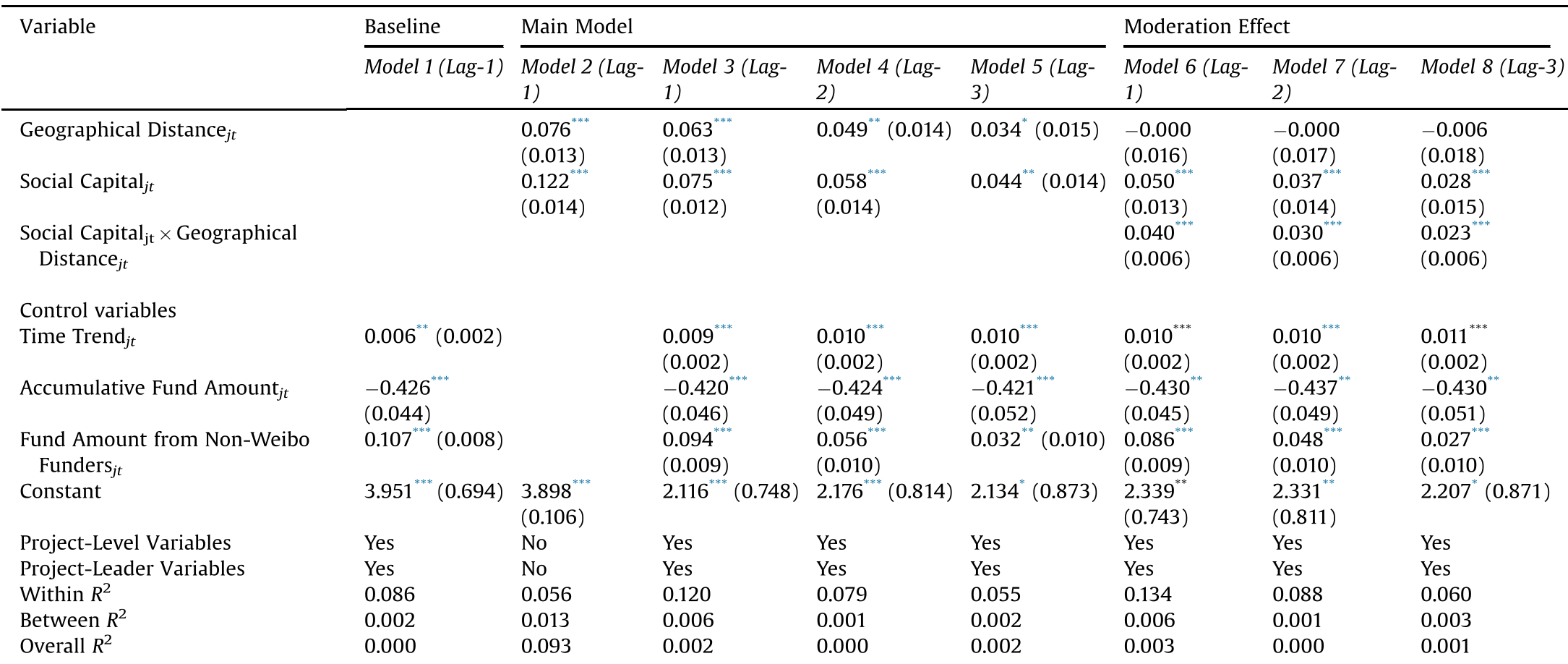
- Social Capital is Convertible: The study quantifies how digital "likes" and "followers" literally convert into CNY/USD through information diffusion.
Limitations:
While robust, the study focuses on reward-based crowdfunding (pre-ordering products). The dynamics might differ in equity crowdfunding, where financial risk is higher and the need for formal monitoring (and thus proximity) might return. Furthermore, the "Guanxi" culture in China might make these results specific to certain social contexts.
Future Outlook:
For entrepreneurs, the message is clear: Network broadly, not just locally. When choosing which advocates to engage with or which communities to seed, prioritize those that are geographically removed from your base. For platform designers, recommendation engines should stop suggesting "projects near you" and start suggesting "projects that provide novelty" based on geographical divergence.
Takeaway: In the "flat world" of the internet, your most valuable advocate is the one you’ve never met, living in a city you've never visited.