
Proactive Memory Agent: Solving Behavioral State Decay in Long-Horizon LLMs
Remember When It Matters: Proactive Memory Agent for Long-Horizon Agents
The paper introduces a "Proactive Memory Agent" that mitigates "behavioral state decay" in long-horizon LLM tasks. It employs a two-phase architecture—memory management and selective intervention—running alongside an action agent to inject memory-grounded reminders, achieving SOTA improvements of +8.3 pp on Terminal-Bench 2.0 and +6.8 pp on τ2-Bench.
TL;DR
As LLM agents tackle increasingly complex tasks—like debugging software or managing airline bookings—they often "forget" critical constraints even when the information is still in their context window. Meta AI researchers call this Behavioral State Decay. This paper introduces a Proactive Memory Agent that runs alongside the main agent, managing a structured memory bank and strategically deciding when to "intervene" with a reminder. The result? Significant performance boosts across major benchmarks and a new blueprint for building agents that don't repeat their own mistakes.
The Problem: When Having a Long Context Isn't Enough
Modern LLMs have massive context windows, but "availability" does not equal "influence." The authors identify a core failure mode: Behavioral State Decay. An agent might:
- Identify a strict requirement at Step 5.
- Get bogged down in a debugging loop at Step 50.
- Violate the original requirement at Step 55 because the "signal" from the early context has weakened.
Existing solutions like RAG (Retrieval-Augmented Generation) or summarization are too passive. They focus on what to store, but in a fast-moving execution loop, the real challenge is deciding when a piece of memory is important enough to interrupt the agent's current flow without causing "distraction" or token bloat.
Methodology: Memory as an Active Intervention
The authors propose a decoupled architecture where an unmodified Action Agent is supported by a specialized Memory Agent.
1. The Structured Memory Bank
Unlike a flat text file, the memory is organized into three distinct parts:
- Knowledge (K): Stable facts (e.g., file paths, domain rules).
- Procedural (P): History of attempts (e.g., "Command X failed with Error Y").
- Status (S): The memory agent's private "scratchpad" for tracking progress.
2. The Two-Phase Workflow
The Memory Agent doesn't just guess; it follows a rigorous two-step process at fixed intervals:
- Phase 1 (Update): Use tool calls to add, delete, or modify entries in the bank.
- Phase 2 (Intervene): Analyze the bank and the recent trajectory to decide: Should I say something? If yes, it generates a concise reminder. If no, it remains silent (the "Null Intervention").
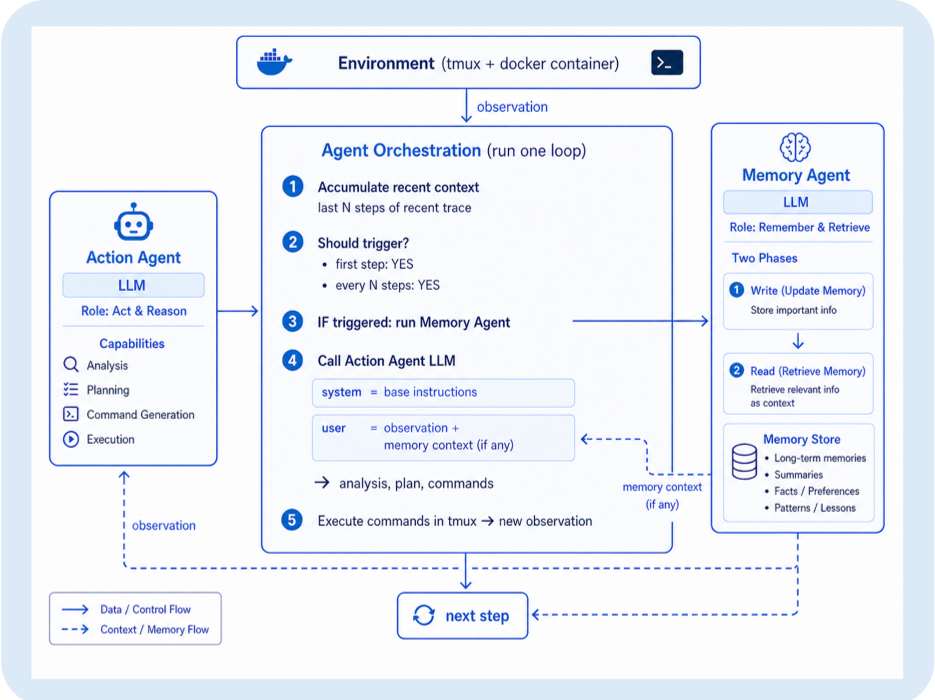 Figure 1: The dual-process system where the Memory Agent manages the bank and intervenes only when necessary.
Experiments: Proven Efficacy
The architecture was tested on Terminal-Bench 2.0 (coding/CLI tasks) and τ2-Bench (customer service interactions).
- Significant Gains: Adding the memory agent improved standard LLMs (like Claude Sonnet) by up to 8.3 percentage points.
- Ablation Insight: The team tested "Always Inject" (forcing a reminder every step) vs. "Selective Intervention." Selective intervention won, proving that knowing when to stay silent prevents the Action Agent from getting overwhelmed by redundant information.
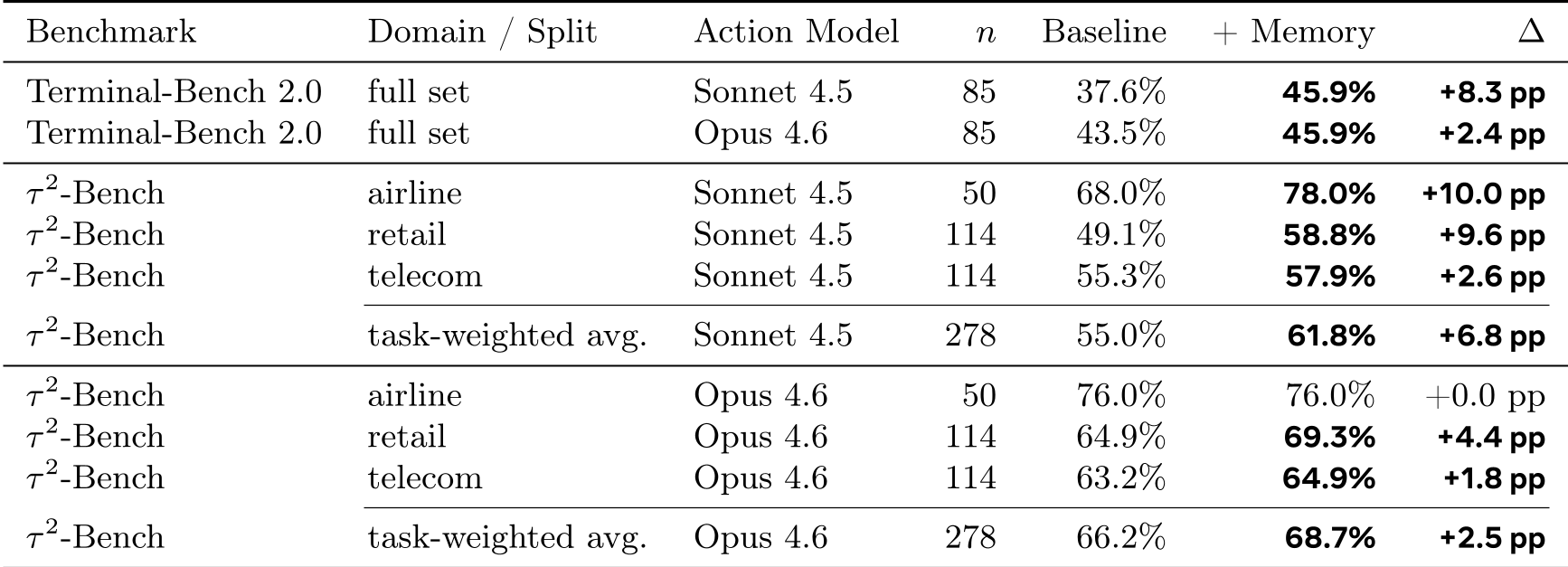 Table 1: Performance gains across different models and benchmarks.
Distilling Intelligence: Open-Weight Memory Agents
A highlight of the paper is the transition from expensive frontier models (Claude Opus) to smaller, open-weight models (Qwen 3.5-27B). By using GRPO (Group Relative Policy Optimization), the researchers trained the 27B model to master the timing of interventions. This proves that proactive memory management isn't just a byproduct of "model scale"—it's a learnable behavioral policy.
Critical Analysis & Conclusion
The "Takeaway"
The industry is currently obsessed with expanding context windows. This paper argues that context management is more important than context size. By decoupling memory maintenance from execution, we can create agents that are both more reliable and more efficient.
Limitations & Future Work
- Fixed Schedules: Currently, the memory agent runs every N steps. A more efficient version would trigger only when a "surprise" or "error" is detected.
- Inference Overhead: Running two models increases latency. Future research into joint training or KV-cache optimization for the memory bank will be vital for production use cases.
Final Thought: If agents are to become truly autonomous assistants, they need more than just a large "hard drive" of context; they need the "executive function" to remember what matters, exactly when it matters.