
RELFIN: Bridging the Gap Between Unstructured Text and Formal Ontologies
RELFIN – Topic Discovery for Ontology Enhancement and Annotation
The paper introduces RELFIN, an interactive system for topic discovery to enhance ontologies and document annotation. It employs linguistic preprocessing and bi-secting k-means clustering on fine-grained document regions (sentences), achieving semi-automatic ontology expansion.
TL;DR
RELFIN is a technical framework designed to solve the "fine-grain access" problem in documents. Instead of just searching for files, it identifies specific topics within sentences and paragraphs to automatically suggest new concepts for ontologies and generate semantic XML tags. Its secret weapon is a novel metric called Residue used to ensure that discovered topics are actually meaningful to human experts.
Background: Why Document-Level Retrieval Isn't Enough
In specialized domains like healthcare or weight management, users don't just need a document; they need to know which part of a document discusses a specific interaction or concept. Standard Information Retrieval (IR) treats documents as atomic units. While ontologies provide a map of knowledge, they are often incomplete relative to a specific corpus.
The authors argue that we need a "middle ground" where data mining discovers topics at the region level (sentences), which are then validated by experts to enrich the formal ontology.
Methodology: The Core Engine
The RELFIN system operates within the broader PARMENIDES framework. The process follows a sophisticated pipeline:
- Linguistic Preprocessing: Stemming, lemmatization, and POS tagging.
- Vectorization: Converting sentences into vectors using TF-IDF weights based on a feature space derived from both an initial ontology and corpus-specific terms.
- Bi-Secting k-Means: An iterative clustering approach that outperforms standard k-means for text.
- Residue Filtering: This is the paper's key theoretical contribution.
The "Residue" Intuition
How do you know if a cluster of sentences actually represents a "topic"? The authors define In-Cluster Support (ICS) for features. If a cluster is "pure," most of its members should share a few frequent features, while the "residue" (noise from infrequent features) should be low.
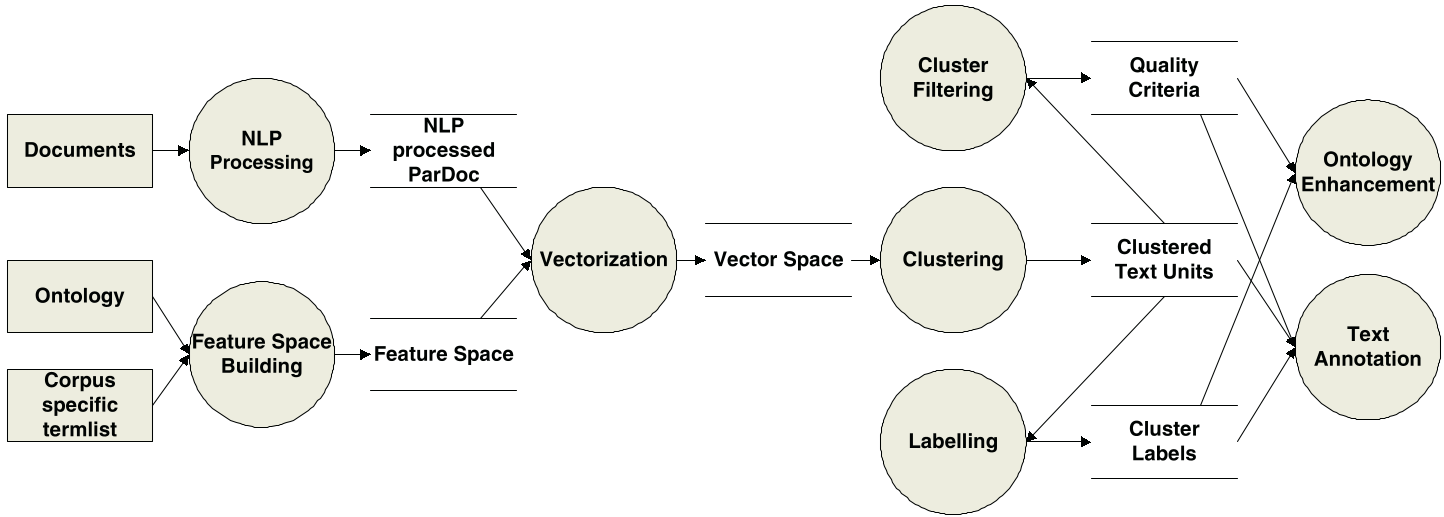 Figure 1: The RELFIN Data Flow, showing the integration of NLP, Clustering, and Expert Interaction.
Experimental Results: Real-World Use Case
The authors tested RELFIN on a "weight management" corpus provided by Unilever, consisting of 1,394 documents split into over 20,000 units.
Ontology Enhancement
The human expert wasn't just a passive observer. By reviewing the generated cluster labels (frequent terms), the expert could instantly spot missing links.
- Success: 30 clusters were accepted as highly relevant.
- Outcome: 21 new concepts and 10 new semantic links (e.g., linking "FAT" as an "ENERGY source") were added to the formal ontology.
High-Quality Labeling
By adjusting the Residue Threshold (), the system can trade off between "coverage" (how many sentences are labeled) and "purity" (how accurate the labels are).
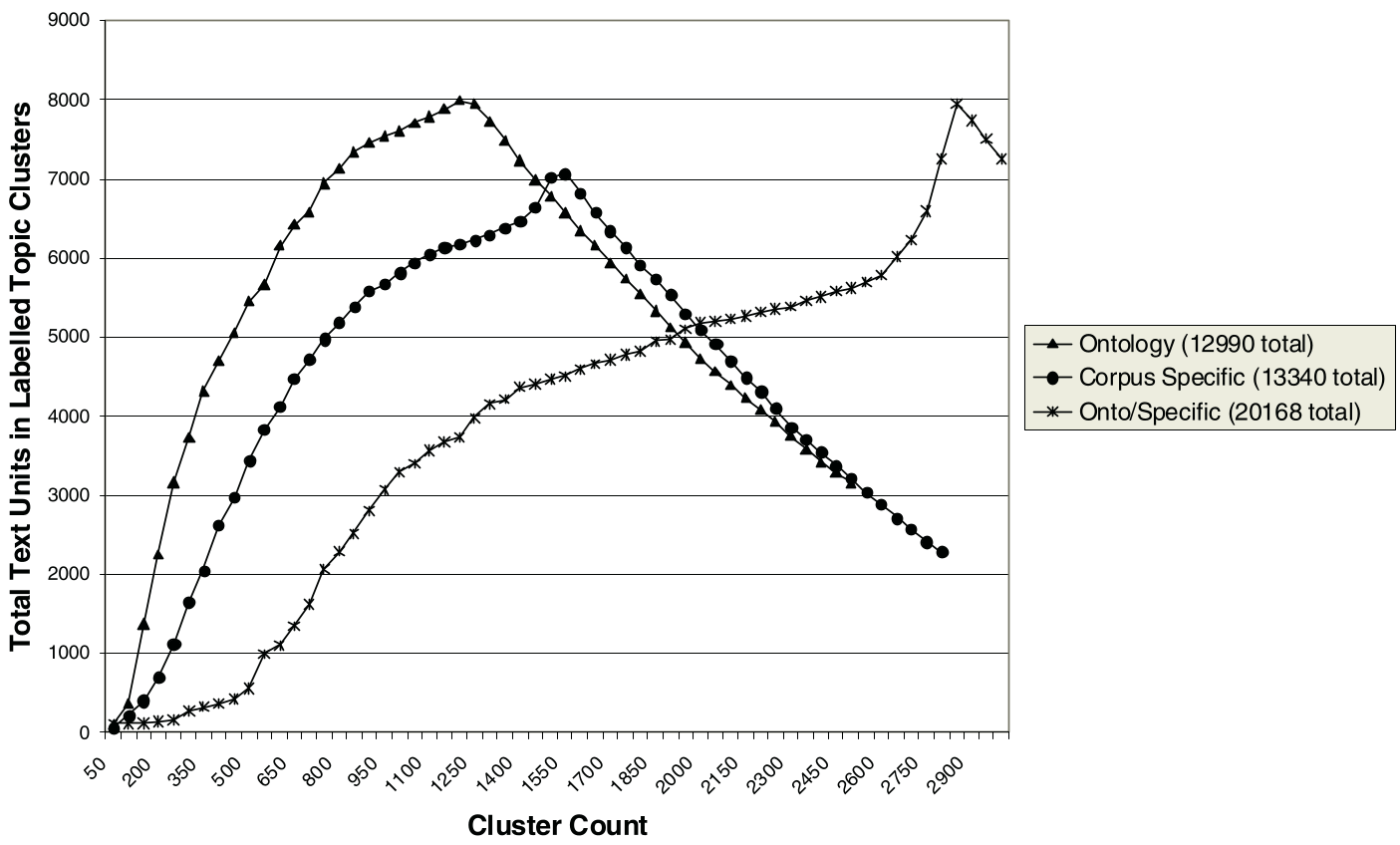 Figure 2: Performance comparison showing that using a hybrid feature space (Ontology + Corpus Terms) provides the best balance for topic discovery.
Critical Insight & Conclusion
RELFIN highlights a crucial reality in AI: fully automated ontology engineering is often a myth. The semantic richness of language requires a "human-in-the-loop" approach.
The "Residue" metric provides a mathematical way to protect an expert's time—by only showing them clusters that have a high probability of being semantically coherent. While the paper uses traditional VSM (Vector Space Model) techniques, the logic of using cluster quality metrics to drive ontology evolution remains highly relevant for modern LLM-based knowledge graph construction.
Future Outlook
As we move toward the Semantic Web, tools like RELFIN that facilitate "Semantic Web Evolution" will be vital for keeping formal knowledge structures up-to-date with the rapidly changing language found in web-scale corpora.