
The Alaska Model: Leading the Global Transition to High-Penetration Remote Microgrids
Renewable Energy Integration in Alaska’s Remote Islanded Microgrids: Economic Drivers, Technical Strategies, Technological Niche Development, and Policy Implications
This paper provides a comprehensive analysis of Alaska's 200+ remote islanded microgrids, focusing on the technical strategies and socio-political drivers for integrating high-penetration renewable energy. It highlights the successful implementation of over 70 renewable-diesel hybrid systems, positioning Alaska as a global SOTA leader in microgrid-enabling technologies despite extreme Arctic conditions.
TL;DR
Alaska has emerged as a global "living laboratory" for microgrid innovation, operating over 200 isolated systems. This paper explores how these communities have transitioned from 100% diesel reliance to high-penetration renewable hybrids. By combining grid-forming inverters, thermal energy storage, and a unique socio-technical niche, Alaska demonstrates a path toward 100% renewable energy for the world's most remote locations.
Background: Life at the Edge of the Grid
Unlike the contiguous United States, Alaska’s energy landscape is a fragmented collection of "islanded" grids. With electricity costs reaching a staggering $1/kWh in some villages, the motivation isn't just environmental—it’s existential. The paper identifies Alaska as a "technological niche," an incubation room where high-risk, high-reward energy experiments are conducted out of necessity.
The Problem: The Low-Inertia Trap
In a massive interconnected grid, a single wind gust or a large appliance turning on is "statistically irrelevant noise." In a 100kW village microgrid, however, starting a 1kW heater is a 1% instantaneous load change.
- Traditional Failure: Intermittent renewables (wind/solar) can easily destabilize these small grids, causing blackouts or damaging diesel generators forced to run at inefficient "low-load" levels.
- The Constraint: Excess energy cannot be exported; it must be consumed locally or wasted.
Methodology: Alaska’s Technical Playbook
To solve the stability problem, Alaska utilities have moved beyond simple "fuel saving" to sophisticated grid management.
1. Grid-Forming Strategies
In a standard hybrid system, the diesel generator "forms" the grid by setting the frequency and voltage. Alaska is pioneering "diesel-off" operation where Grid-Forming Inverters and energy storage take over this role, allowing the diesels to be shut down entirely during peak renewable production.
2. Dispatchable Thermal Loads (The "Energy Sponge")
One of the most innovative strategies is using excess wind energy to heat ceramic bricks in residential stoves or water in community boilers.
- Dynamic Response: These loads act as a high-speed "buffer" that absorbs frequency spikes.
- Architecture:
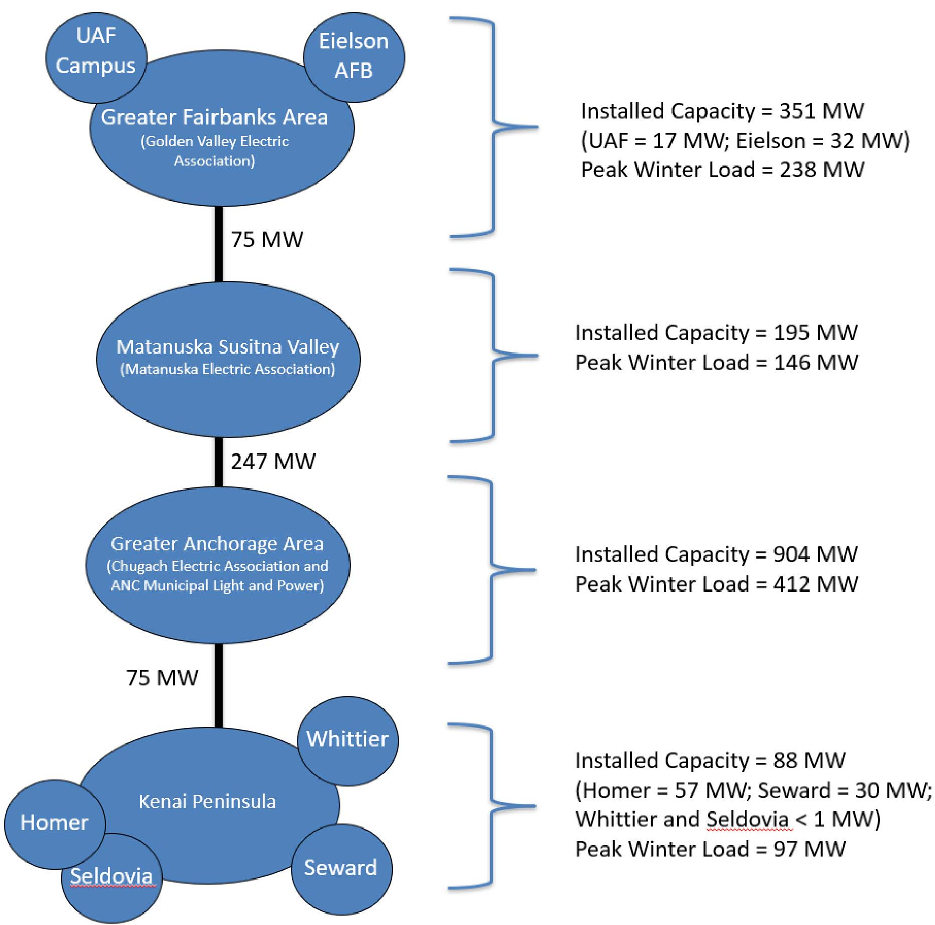 The diagram illustrates the complexity of "nested" microgrids where local systems can island from larger regional links.
3. Mechanical vs. Chemical Storage
The paper highlights the use of flywheels (for high-speed, high-cycle inrush current protection) in tandem with Lithium-ion batteries (for longer-term energy shifting). In Kodiak, this combination allows a massive electric crane in the harbor to operate without crashing the grid.
Experimental Results: SOTA Performance
The paper provides a breakdown of several high-performing projects:
- Kodiak & Metlakatla: Have achieved 100% renewable penetration using hydro and wind.
- Kongiganak (Wind-to-Heat): Features five 95kW wind turbines serving an average load of only 139kW. By using distributed thermal storage, they manage a wind capacity that is over 300% of their base electrical load.
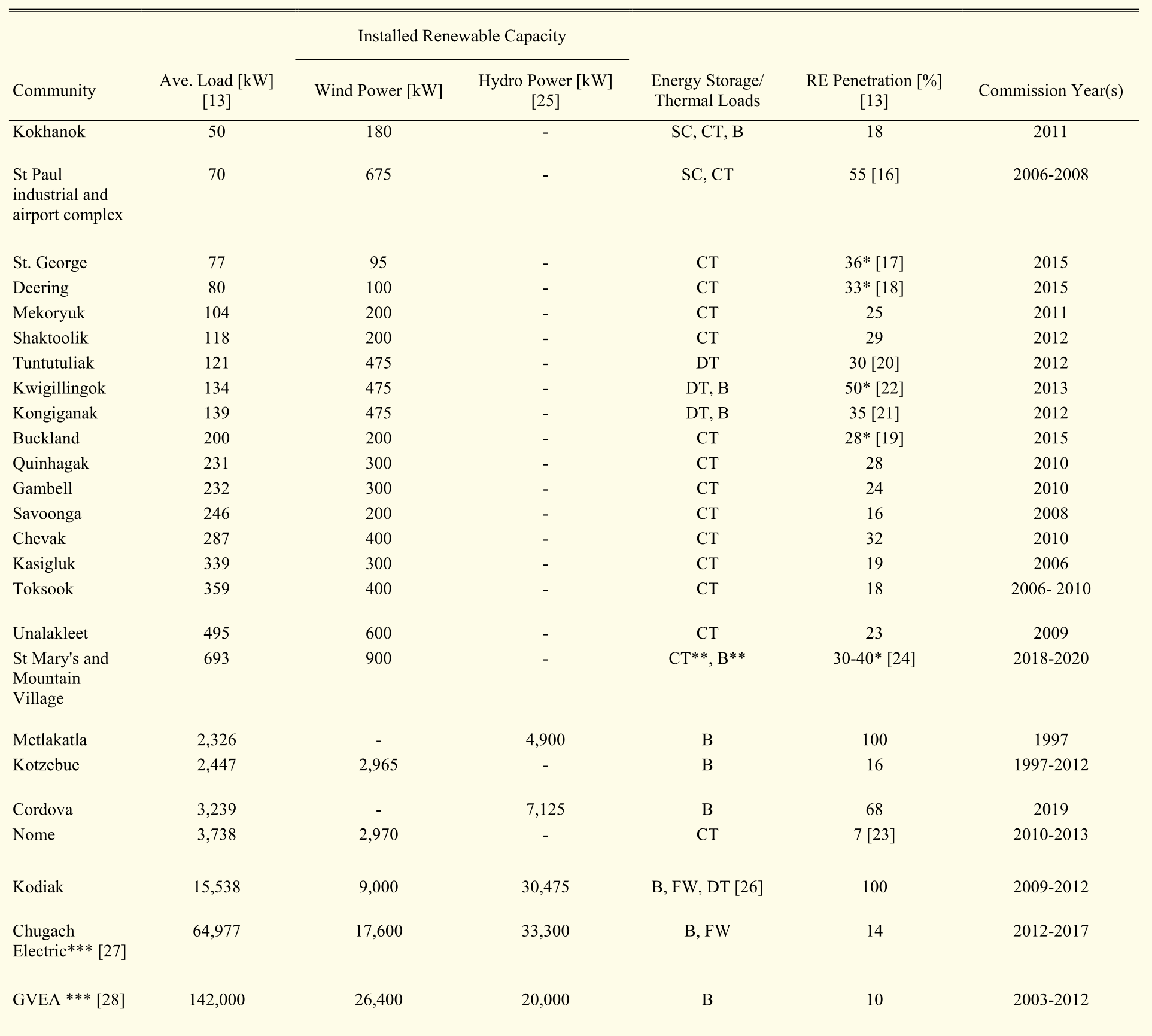 Table 1: Comparison of Alaska microgrid performance, showing high RE penetration across various community sizes.
Deep Insight: Why Alaska Succeeded (The Socio-Technical Niche)
The authors argue that Alaska's success isn't just about the "what" (technology) but the "why" (socio-economic framework):
- Low Subsidies: Unlike Russia or Canada, Alaska’s diesel subsidies for commercial users are low, making renewables immediately cost-competitive.
- Decentralized Markets: Local, member-owned cooperatives have the autonomy to innovate and take risks.
- Culture of Self-Reliance: A "fix-it-locally" mindset ensures that when equipment breaks in the Arctic, it stays running.
Conclusion and Future Outlook
The "Alaska Model" provides a blueprint for the 70% of new rural electrification expected to come from non-centralized grids worldwide. The key takeaway is that the transition to renewables is a bi-product of energy security.
Limitations: High capital costs and the need for specialized training remain hurdles. Future research must focus on lowering the cost of "grid-forming" hardware and improving the durability of equipment in extreme environments (e.g., icing and permafrost).
As the authors state, these remote systems are the "norm, not the exception" in Alaska, making it the premier global testbed for the future of resilient energy.