
LaHNet: Deciphering the Hidden Logic of Heterogeneous Social Networks
7335_Representation Learning for Classification in Heterogeneous Graphs with Application to Social Networks.
This paper introduces LaHNet (Labeling Heterogeneous Network), a transductive representation learning framework for multi-label node classification in heterogeneous graphs. It projects diverse node types into a unified latent space using a joint loss function that balances classification accuracy with graph topology preservation.
TL;DR
In modern social media, "heterogeneity" is the norm: users follow artists, artists release albums, and albums contain tracks. LaHNet is a transductive representation learning model that maps these diverse entities into a single latent space. By automatically learning which relationships matter most (e.g., your listening habits reveal more about you than your friend list), it achieves SOTA performance in multi-label node classification.
Problem & Motivation: The Homogeneity Trap
Most graph-based machine learning assumes homophily—the idea that "birds of a feather flock together." In an author-citation network, this works well. But in a heterogeneous network like LastFM, a "User" node is connected to "Track" nodes. They don't share labels (a user is "Pop-lover," a track is "Pop-music").
Prior works often tried to:
- Project the graph into several homogeneous ones (losing multi-type synergy).
- Ignore node types (forcing irrelevant label sets onto different entities).
The authors' insight is that while nodes are different, their labels are correlated. If an artist is "Rock," the tracks they produce and the users who follow them are highly likely to share "Rock" attributes.
Methodology: Bridging the Latent Gap
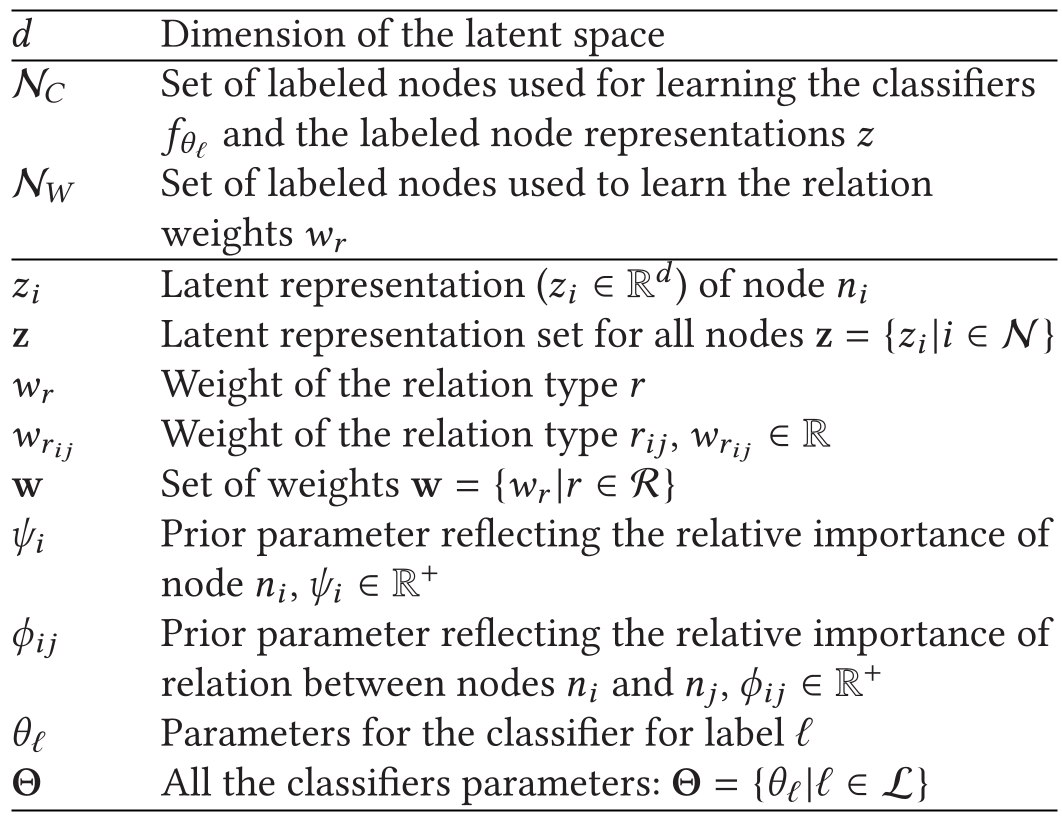
LaHNet uses a unified latent space where every node , regardless of type, is assigned a vector . The learning objective is a dual-component loss:
- Classification Loss (): Ensures node embeddings are discriminative enough for their specific label sets using a set of linear classifiers .
- Graph Regularization (): Forces connected nodes to be close in the latent space, weighted by relation importance .
Learning "What Matters"
The most sophisticated part of LaHNet is how it learns the Relation Weights (). Instead of manual tuning, it uses an alternating optimization scheme. It calculates how a small change in a relation's weight would impact the classification error on a validation set ().
Mathematically, it finds that the weight of a relation (e.g., User Track) should increase if the "center of mass" of those neighbors aligns better with the target labels than other neighbor types.
Experiments & Results: Mapping Social Tastes
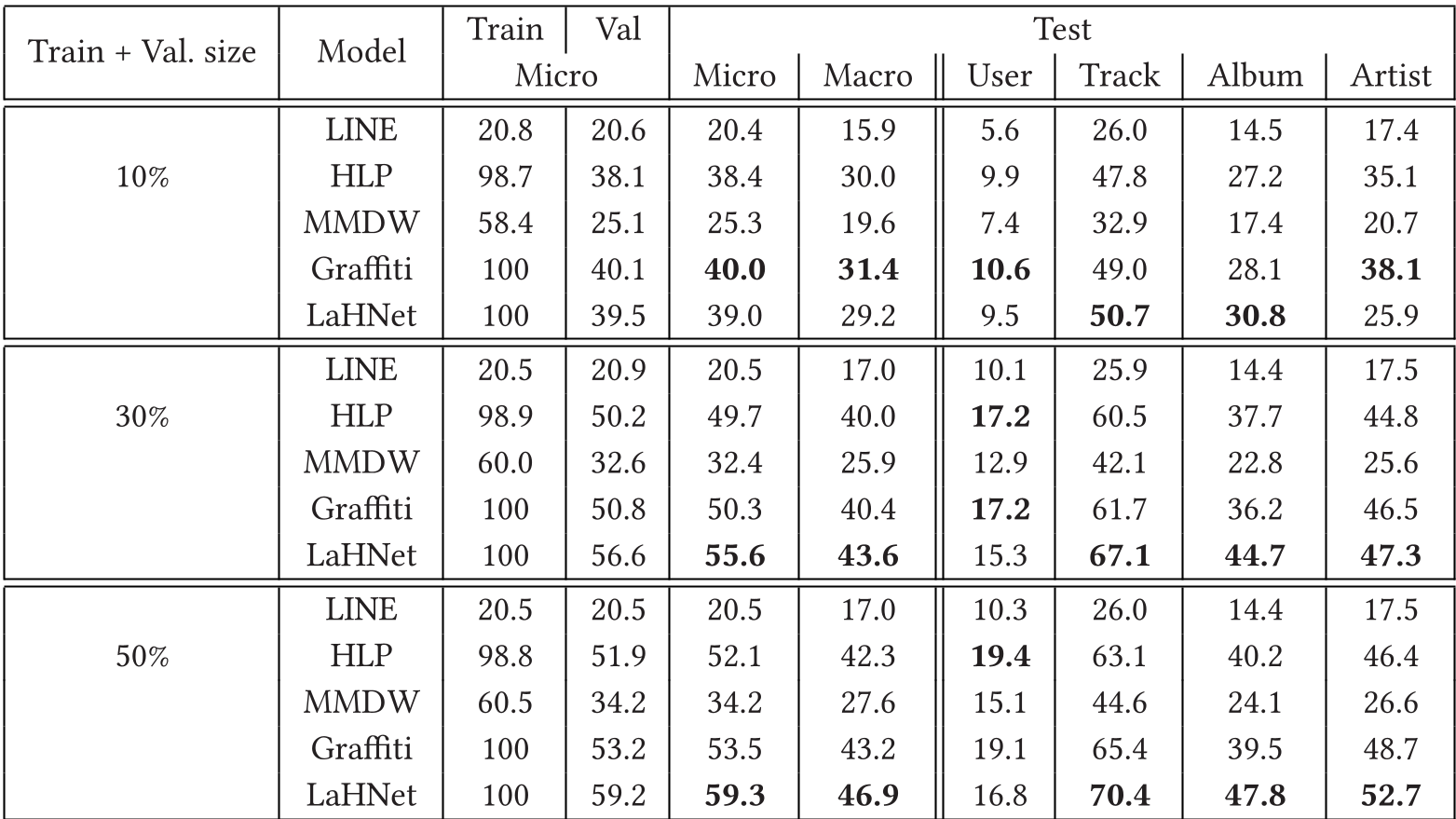
The model was tested against LINE, HLP, Graffiti, and MMDW.
SOTA Performance
LaHNet showed significant gains, particularly in complex multi-label scenarios like LastFM.
Why it Works: Label Correlation
The authors visualized the weights of the learned classifiers. Even though "Pop" for an artist and "Pop" for a track were treated as different labels, the model learned nearly identical hyperplanes for them in the latent space. This proves that LaHNet successfully captured the semantic overlap across different node types.
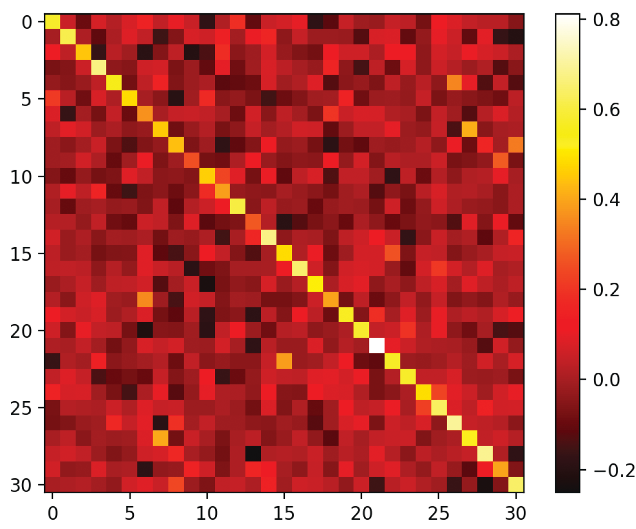
Fig: Diagonal values close to 1 show that same-name labels for different types (Artist vs Track) occupy similar regions in the latent space.
Critical Analysis & Conclusion
Takeaway
The genius of LaHNet lies in its transitive intelligence. By forcing a user to be close to their favorite tracks, and tracks to be close to their artists, the model allows "Rock" labels to flow from an Artist to an Unlabeled User through the Track intermediary, even though they are different node types.
Limitations
- Scalability: While tested on millions of nodes, the O(N) complexity per iteration might struggle with the extreme scale of global social graphs (billions of nodes) without further sampling optimizations.
- Transductive Nature: The model is transductive; it needs to be "re-run" to some extent to find embeddings for entirely new nodes that enter the system (Inference vs. Induction).
Future Outlook
LaHNet lays the groundwork for learned attention in graph structures—a concept that has since exploded with Graph Attention Networks (GATs). Its approach to hyperparameter optimization remains a robust template for any model dealing with multi-relational data.