
Beyond Words: Decoding Emotion through Smartphone Typing Patterns
Representation Learning for Emotion Recognition from Smartphone Keyboard Interactions
The paper introduces an end-to-end framework for smartphone emotion recognition utilizing Representation Learning and Multi-Task Learning (MTL). By employing an LSTM encoder-decoder to automatically extract features from raw keyboard interactions, the system achieves a state-of-the-art AUCROC of 84% across four emotion states (happy, sad, stressed, relaxed) without manual feature engineering.
TL;DR
Researchers have developed an end-to-end deep learning framework that identifies your emotions—happy, sad, stressed, or relaxed—simply by analyzing how you type, not what you type. By using LSTM-based Representation Learning and Multi-Task Learning (MTL), the system achieves an 84% AUCROC, proving that the rhythm of our thumbs is a powerful window into our mental state.
The "Prosody" of the Thumb
Just as the tone of a voice (speech prosody) or a facial twitch reveals hidden feelings, our interaction with smartphone keyboards carries an emotional signature. Prior research has attempted to capture this, but it usually required experts to manually define features like "average backspace frequency" or "typing speed."
The authors of this paper argue that manual features are limited. They ask: Can a machine learn to see the emotional patterns in raw touch data that humans might miss?
The Methodology: From Raw Touches to Emotional Vectors
The proposed framework operates in two distinct phases, moving from raw sensor data to sophisticated emotional classification.
1. Automatic Feature Discovery (Representation Learning)
Instead of calculating statistics, the authors feed raw sequences—inter-tap duration, pressure, and key types—into an LSTM Encoder-Decoder.
- The Intuition: The encoder compresses a whole typing session into a tiny 8-dimensional "representation vector."
- The Result: Vectors for "Stressed" sessions look mathematically similar to each other (0.901 correlation) but distinct from "Happy" sessions.
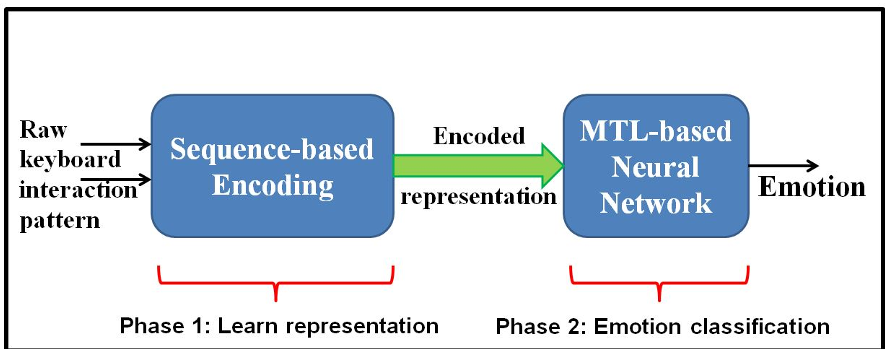 Figure 1: The two-phase pipeline: Representation Learning followed by MTL Classification.
2. Multi-Task Learning (MTL) for Personalization
The biggest hurdle in mobile sensing is Data Scarcity. One user might only provide a few "Sad" labels. The authors solved this by treating each user as a "Task" in a Multi-Task Learning network:
- Shared Layers: These layers learn "universal" typing behaviors—like how most people type faster when relaxed.
- Task-Specific Layers: These layers refine the model for the individual—recognizing that User A might press harder when stressed, while User B just types slower.
Experimental Results: In-the-Wild Success
The study wasn't done in a lab; it tracked 24 users for three weeks in their natural environments.
- Accuracy: The system hit an average 84% AUCROC. Happy states were the easiest to detect, reaching 92%.
- MTL vs. STL: The Multi-Task approach crushed Single-Task Learning (74%). This proves that "eavesdropping" on other users' data helps the model understand the current user better.
- Representation vs. Handcrafted: The learned features performed as well as features designed by human experts, successfully automating the most tedious part of AI development.
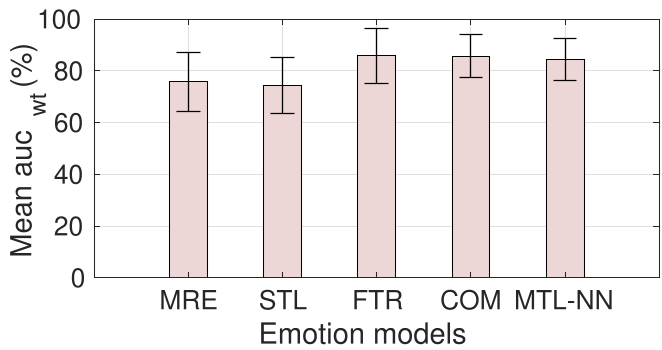 Figure 2: The MTL-NN model outperforms standard baselines (MRE and STL) and equals the performance of handcrafted feature models (FTR).
Critical Insight: Why This Matters
The true value of this work lies in the Inductive Bias of the MTL architecture. By forcing the model to learn a shared representation across multiple users, the researchers effectively used the community's data to regularize individual user models. This prevents the neural network from "overfitting" to the noisy quirks of a single person's typing habits.
Limitations & Future Work
- Session Length: The current model requires sessions of at least 80 interactions. It might struggle with short "LOL" or "OK" texts.
- Diversity: The similarity between users is key for MTL. If a user has a wildly unique typing style (e.g., due to a physical disability), the shared layers might actually provide a negative transfer.
Conclusion
This paper represents a significant shift from "Feature Engineering" to "Feature Learning" in the field of mobile Ubicomp (Ubiquitous Computing). By proving that raw keyboard interaction carries enough signal for deep learning to decode emotion, it opens the door for passive, privacy-preserving mental health monitoring tools that don't need to read your actual messages—just the way your fingers dance across the screen.