
Embedded Cascade Model: Revolutionizing Social Diffusion with Latent Representations
Representation Learning for Information Diffusion through Social Networks: an Embedded Cascade Model
The paper introduces the Embedded Cascade Model (ECM), an information diffusion framework that Maps users into a latent space to learn transmission probabilities. By integrating Representation Learning with the classic Independent Cascade (IC) model, ECM achieves SOTA performance on diffusion prediction and link inference across multiple real-world datasets like Digg, Twitter, and Movielens.
TL;DR
Information diffusion modeling is shifting from rigid graph-based lookups to fluid latent space representations. The Embedded Cascade Model (ECM) replaces discrete edge probabilities with learned user embeddings. By calculating influence as a function of distance in a d-dimensional space, ECM achieves higher predictive accuracy with a fraction of the parameters required by traditional Inductive Cascade (IC) models.
Background: The Infrastructure of Influence
In the era of viral content, understanding why information spreads is as critical as knowing where it goes. Traditionally, we used the Independent Cascade (IC) model, which treats a social network as a series of pipes (edges) with fixed leak probabilities. However, this approach fails because:
- Hidden Channels: Many users are influenced by sources they don't explicitly "follow."
- Complexity: As the number of users (|U|) grows, the number of potential edges explodes, leading to the "curse of dimensionality."
- Lack of Generalization: If a link was never seen in training, the model assumes it has zero probability of transmission.
Methodology: From Graphs to Geometry
The core insight of the authors is that diffusion is driven by latent social regularities (communities and shared interests) rather than just static links.
The Embedding Strategy
Every user is mapped to two vectors in :
- : The "Sender" embedding (how influential they are).
- : The "Receiver" embedding (how susceptible they are).
The probability of infecting is modeled using a distance-based sigmoid function:
This approach ensures that if user A is similar to user B, and user B influences user C, the geometric constraints of the latent space will naturally assign a high probability to the A C path, even if it hasn't been observed yet.
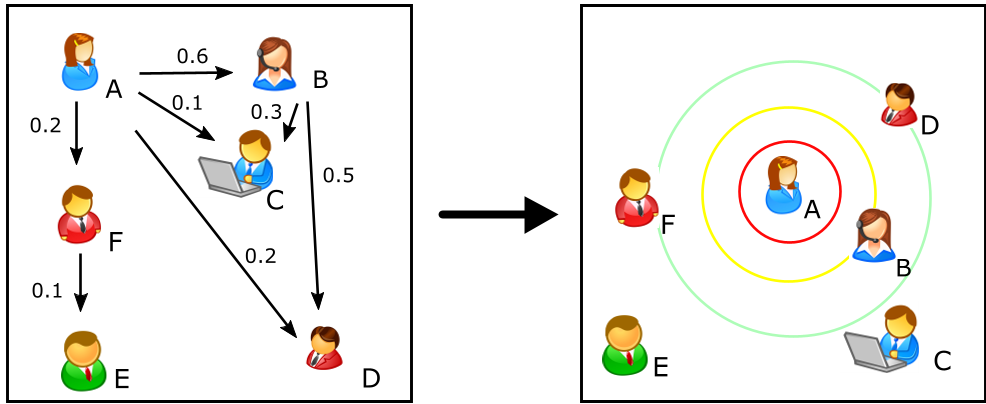 Figure 1: Transitioning from an influence graph (discrete) to a continuous influence space (geometric).
Experimental Battleground
The researchers tested ECM against heavyweights like NetRate and CTIC across six diverse datasets, including Digg, Twitter, and Memetracker.
Key Findings:
- Efficiency: On the Digg dataset, ECM achieved better results using only 164,750 parameters, compared to over 1.3 million for CTIC.
- Precision: In the task of link prediction (inferring who actually influenced whom), ECM showed a massive lead in the Precision-Recall curve, proving its ability to "uncover" the real backbone of the network.
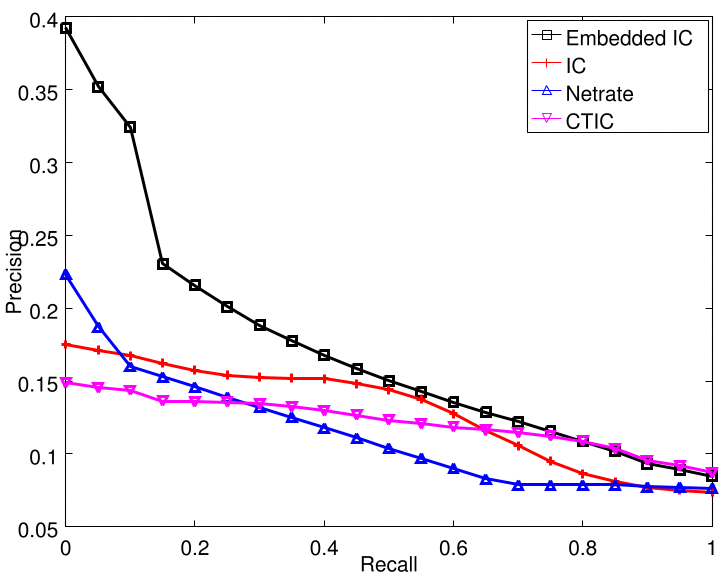 Figure 2: Precision-Recall curves on Memetracker. ECM (top line) demonstrates vastly superior link inference capabilities.
Critical Insight: Why Does It Work?
The effectiveness of ECM stems from Inductive Bias. By forcing the model to represent users in a low-dimensional space (), we provide a regularization effect. Traditional models "memorize" the training cascades (leading to overfitting), whereas ECM "generalizes" the underlying social distance.
The model is particularly effective for "Information Portals" (like Reddit or Digg) where global popularity often overrides 1-to-1 social links. The latent biases ( and ) act as a "popularity filter," allowing the model to capture both niche community interactions and global viral trends.
Conclusion and Future Outlook
The Embedded Cascade Model proves that in social network analysis, geometry is power. By mapping social influence to a latent space, we can predict the "unpredictable" viral cascades of tomorrow.
Future Directions:
- Content-Awareness: Integrating NLP (like Word2Vec or BERT) to make the embeddings dependent on the topic (e.g., a user might be a "sender" in tech but a "receiver" in cooking).
- Temporal Drift: How do these embeddings change as a user's interests evolve over time?
ECM remains a foundational work for anyone looking to build robust recommendation systems or viral marketing strategies where the "social graph" is only half the story.