
[Polymathic AI] Beyond Pixels: Why Latent Prediction is the Key to Physical Representation Learning
Representation Learning for Spatiotemporal Physical Systems
This paper introduces a Joint Embedding Predictive Architecture (JEPA) optimized for spatiotemporal dynamics in physical systems. Moving beyond traditional next-frame prediction, the authors demonstrate that learning in the latent space allows models to achieve SOTA performance on downstream scientific tasks like physical parameter estimation across active matter, shear flow, and convection systems.
TL;DR
Researchers from the Polymathic AI collaboration have demonstrated that if you want an AI to "understand" physics, you should stop asking it to predict the next pixel. By using a Joint Embedding Predictive Architecture (JEPA)—which predicts future states in the latent space—they achieved up to a 51% improvement in estimating physical parameters compared to traditional pixel-based methods.
Context: The Generative Trap in Physics
The current trend in "AI for Science" (SciML) is dominated by surrogate models: neural networks trained to emulate numerical solvers by predicting the next frame of a simulation. While these models look impressive, they are often "distracted" by low-level visual details.
The authors argue that visual fidelity physical relevance. A model might generate a visually plausible fluid simulation while completely failing to grasp the underlying Reynolds number or viscosity. The core bottleneck is the objective function: pixel-level reconstruction (like Masked Autoencoders) or auto-regressive next-frame prediction (like MPP) forces the model to spend its "capacity" on granular noise rather than the governing Partial Differential Equations (PDEs).
Methodology: Dreaming in Latent Space
To solve this, the team adapted the JEPA framework. Instead of a decoder that reconstructs pixels, JEPA uses a Predictor in the embedding space.
The Architecture
- Encoder: A ConvNeXt-based CNN that compresses 16 context frames into a compact latent representation.
- Predictor: A latent-to-latent network that takes the representation of initial frames and predicts the representation of subsequent frames.
- Loss (VICReg): To avoid the "trivial solution" (where the model outputs a constant value to minimize error), they employ VICReg (Variance-Invariance-Covariance Regularization). This ensures the embeddings are varied, decorrelated, and robust.
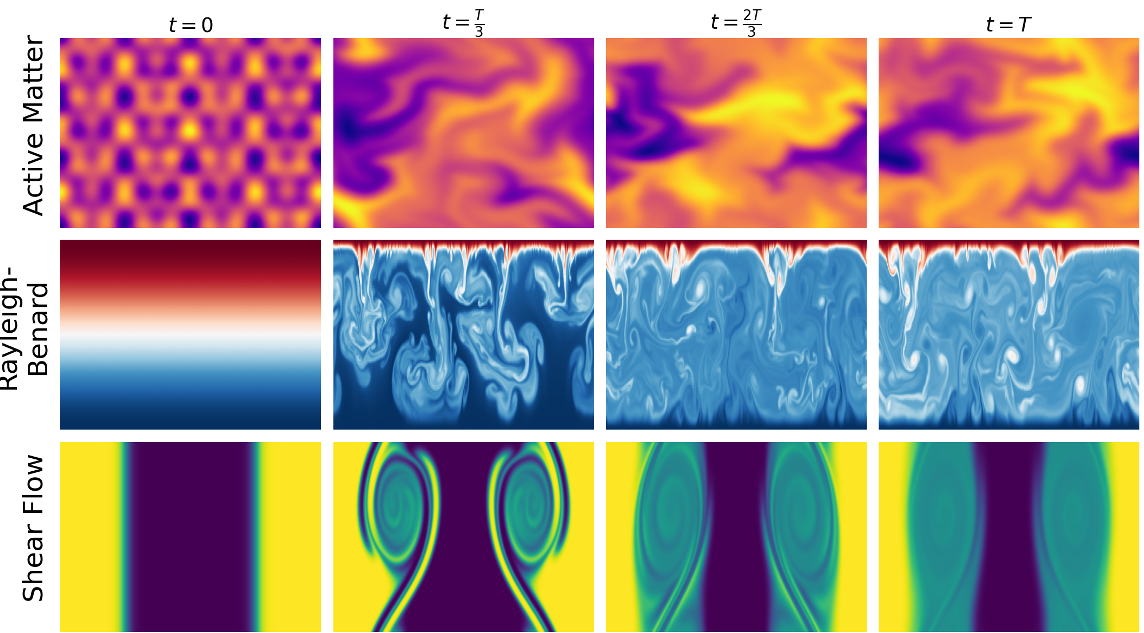 Figure 1: The model was tested on Active Matter, Shear Flow, and Rayleigh-Bénard Convection.
Experiments: Probing the "Physics IQ"
The researchers didn't just look at how pretty the videos were; they performed Physical Parameter Estimation. They froze the pretrained encoder and added a small probe to guess the system's constants (e.g., the Rayleigh number). If the probe succeeds, it proves the encoder captures the "soul" of the physics.
Performance Comparison
The results were conclusive: Latent-based models (JEPA and DISCO) crushed pixel-based models (VideoMAE and MPP).
| Method | Active Matter (MSE↓) | Shear Flow (MSE↓) | Convection (MSE↓) |
|---|---|---|---|
| JEPA (Latent) | 0.079 | 0.38 | 0.13 |
| VideoMAE (Pixel) | 0.160 | 0.67 | 0.18 |
| DISCO (Specialized) | 0.057 | 0.13 | 0.01 |
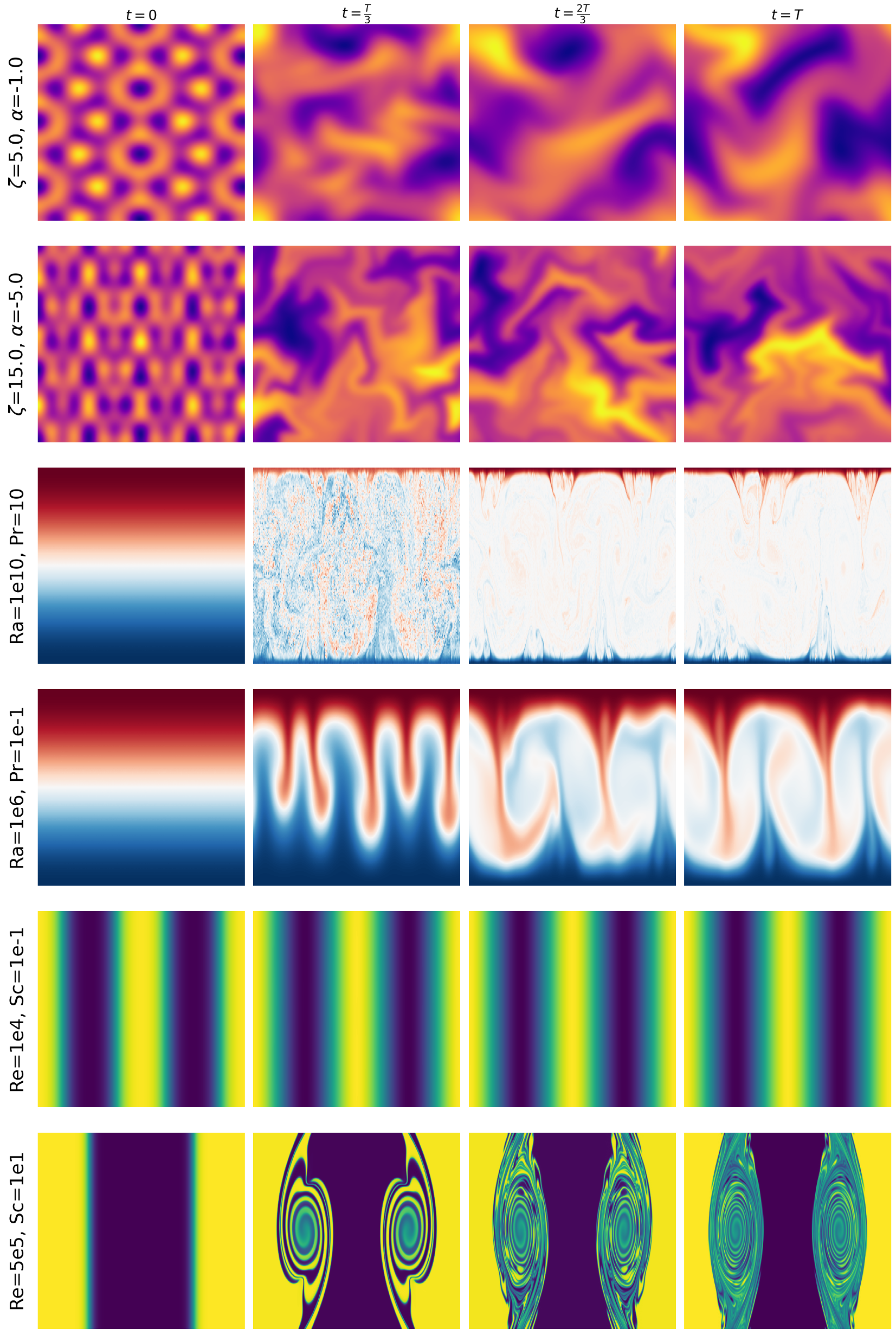 Figure 2: Small changes in parameters lead to vastly different physical evolutions, making this a rigorous test of representation quality.
Deep Insight: Sample Efficiency
One of the most striking findings was JEPA's Sample Efficiency. JEPA achieved better results with only 10% of the fine-tuning data than VideoMAE did with 100%. This suggests that latent predictive objectives build a more "linear" and accessible representation of the underlying manifold of physics.
Critical Analysis & Conclusion
Takeaway
The success of JEPA over VideoMAE suggests that for scientific discovery, prediction is better than reconstruction. By discarding the requirement to reconstruct every pixel, the model is free to learn the abstract symmetries and conservation laws that actually govern the system.
Limitations
While JEPA performed excellently, the specialized DISCO model (which uses meta-learning for operators) still holds the top spot for specialized tasks. JEPA acts as a powerful "generalist" that is easier to scale across diverse datasets without needing explicit operator inductive biases.
Future Outlook
This work paves the way for a "Foundation Model for Physics" that doesn't just act as a fast simulator, but as a feature extractor for downstream tasks like inverse design, anomaly detection, and real-time system identification.