
The Representation Race: Why Preprocessing is the Real Winner in Temporal Data Mining
The Representation Race — Preprocessing for Handling Time Phenomena
The paper presents a comprehensive framework for preprocessing time-stamped data, formalizing the "Representation Race" where input representation () is critical for learning success. It introduces the MiningMart project and maps diverse time-related phenomena to specific learning tasks and data transformation operators.
TL;DR
In the world of Machine Learning, we often obsess over the "Data Mining" step, but the real "Representation Race" is won or lost during preprocessing. This paper by Katharina Morik argues that the hardest part of KDD (Knowledge Discovery in Databases) is transforming raw, time-stamped data into a language the learner can understand. By categorizing time into Linear Precedence and Immediate Dominance, the paper provides a roadmap for turning messy database logs into structured features for everything from SVMs to Relational Learning.
The "No Free Lunch" of Data Representation
The "No Free Lunch Theorem" tells us that if a complex learning task suddenly becomes easy, it’s because we did the hard work of choosing the right representation. For temporal data, this is particularly painful. Raw databases () are built for transactions, not for discovering trends.
The author posits that the transformation from (raw input) to (tailored representation) is not a minor "administrative" task but a core learning step. If we fail to capture the temporal context—the "when" and for "how long"—even the most advanced algorithm will fail to find the signal in the noise.
Methodology: Structuring the Temporal Dimension
The core insight of the paper is the dual-structure of time phenomena:
- Linear Precedence: This is the horizontal view—the ordering of events along a timeline. Tasks here include prediction, trend characterization, and level change detection.
- Immediate Dominance: This is the vertical view—how raw measurements (e.g., stiring tea) aggregate into abstract categories (e.g., sweetening tea).
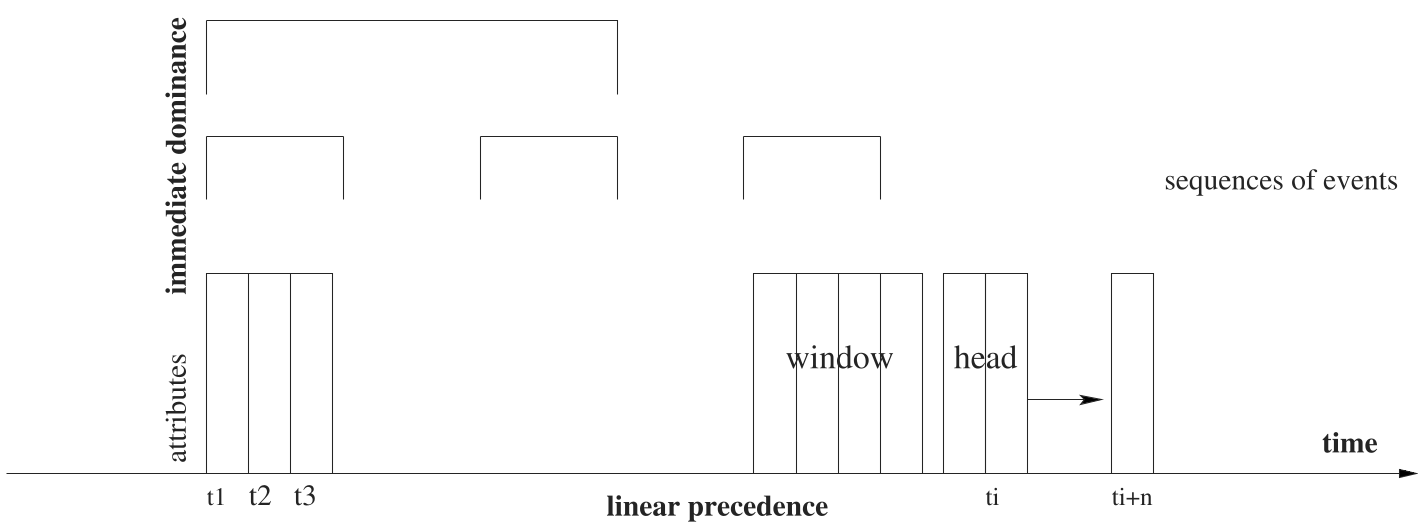
The paper defines several target languages for learning, such as Nominal Valued Time Series and Datalog Facts, providing a library of operators (like Sliding Windows and Aggregation) to reach them.
Case Studies: From Vital Signs to Robot Navigation
The paper validates this approach through three distinct domains:
- The Shop Application: By using Sliding Windows and Multiple Learning (training one model per item per shop), the researchers successfully used Support Vector Machines (SVM) to predict retail peaks. Time was implicitly handled by bundling past observations into the current input vector.
- Intensive Care (ICU): Here, the task was detecting level changes in vital signs. The authors used a phase-space transformation—interpreting time windows as dimensions in Euclidean space—to identify medical outliers visually and statistically.
- Robot Navigation: This is where Immediate Dominance shines. By discretizing 24 sensor streams into qualitative "intervals" (e.g., "distance increasing"), they used Inductive Logic Programming to learn rules.

Results of the "Race"
In the robotics case, the jump in accuracy was staggering. At the lowest level of raw sensor data, the accuracy was a dismal 27.1%. However, by using preprocessing to move up the hierarchy of abstraction (Immediate Dominance), the integrated system reached 93.8% accuracy. This proves that the representation is the intelligence.
Critical Insight & Conclusion
The "Representation Race" teaches us that there is no single "correct" way to handle time. The same raw data must be transformed differently depending on whether you are predicting the next value (Linear) or defining a high-level behavior (Dominant).
Future Outlook: The MiningMart project aims to formalize these preprocessing "chains" into a case-base. This shifts the focus of the data scientist from "tuning hyperparameters" to "selecting the right transformation sequence" based on historical best practices. While the paper acknowledges the computational difficulty of exploring all possible transformations, it sets a clear path for using meta-data to guide the search.