
Identifying the Pulse of the Crowd: How to Find Representative Reviewers in Social Media
Representative reviewers for Internet social media
The paper proposes an algorithm to identify "Representative Reviewers"—opinion leaders in online social media whose ratings closely mirror the community average. Validated on Yahoo! Music and GroupLens datasets, the method successfully identifies a small subset of users who can represent the preferences of the entire population.
In the vast ocean of Internet social media, everyone has an opinion. But whose opinion actually matters when we want to predict how the "world" will react to a new song or a movie? This paper from Yonsei University explores the math behind Representative Reviewers—the opinion leaders who act as the human barometer for digital society.
TL;DR
Instead of looking for the loudest or most popular users, the authors look for the most "typical" ones. By calculating how much a user's rating deviates from the global average, they identify a small group (10%) of users whose tastes perfectly mirror the community. These users are the key to solving recommendation cold-starts and streamlining market research.
The Problem: The Noise of the Masses
Mass media used to be the primary source of influence, but today, we trust individuals (opinion leaders) more. However, identifying these leaders is technically challenging:
- Social Graph Bias: High follower counts don't always mean a user's taste reflects the community.
- Data Sparsity: Users with only 1 or 2 ratings might appear "representative" by pure coincidence (low sample size), leading to unreliable metrics.
- The Cold-Start Dilemma: When a new product launches, we don't know who will like it because there is no historical data.
The Methodology: The Math of Representativeness
The authors propose a simple yet elegant metric, , to quantify how "representative" a user is:
- : The rating given by user to item .
- : The average rating of item by the entire community.
- : The number of items the user has rated.
A low score means the user consistently rates things similarly to the "crowd."
The Identification Pipeline
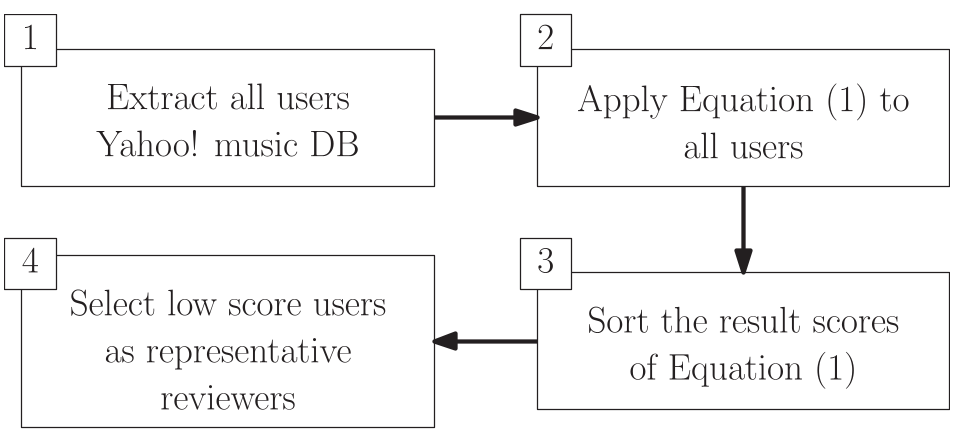
The researchers don't just take the scores at face value. They filter users based on a minimum rating threshold (e.g., at least 20 ratings) to ensure statistical significance, preventing "accidental" leaders from being selected.
Experimental Results: Proving the "Quiet Leaders"
The team tested their algorithm on the Yahoo! Music (15,400 users) and GroupLens Movie (69,898 users) datasets.
10-Fold Cross-Validation
They split the data into 900 "training" items and 100 "probe" items. They found that if a user was in the top 10% of representatives for the training set, they remained the most accurate representatives for the probe set.
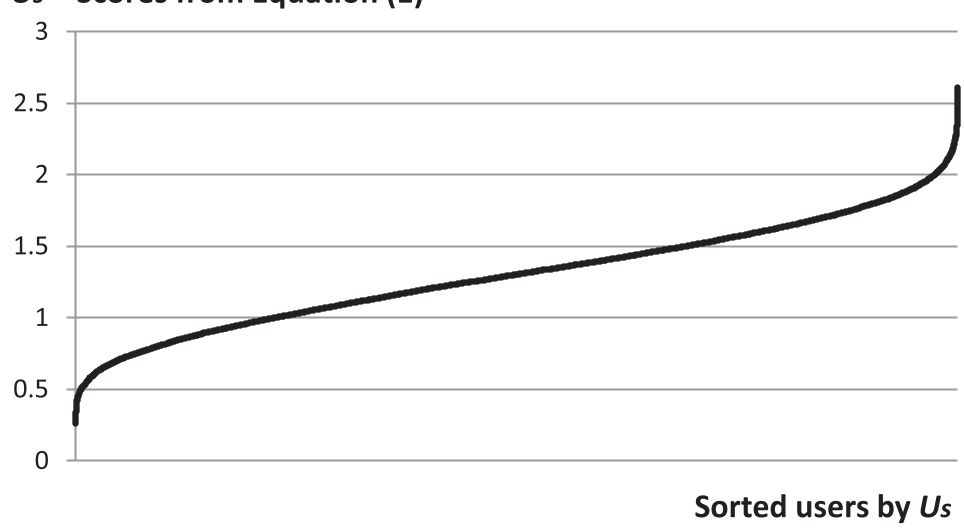 Graph: Distribution of scores. The users near the y-axis are the "Representative Reviewers" whose internal compass matches the community's North Star.
The Z-Test: Statistical Gold Standard
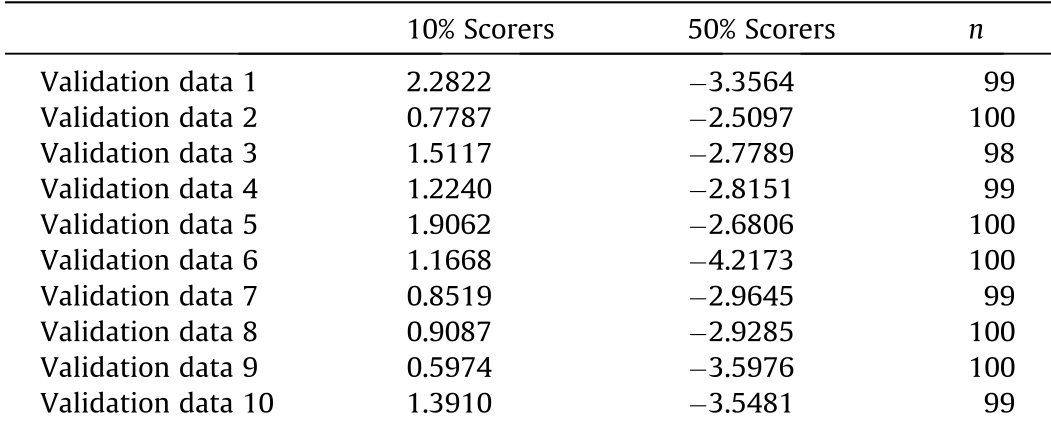
To prove this wasn't just luck, they applied a Z-test. The results showed that the 10% group's ratings were statistically valid representations of the entire population at a 95% confidence level. Interestingly, as shown in the tables below, the top 10% scorers were significantly more aligned with the population than the broader 50% group.
Critical Insight: Why This Matters
The value of this research isn't just in finding "average" people. It’s about Efficiency and Prediction:
- Solving Cold-Start: When a new movie is released, instead of waiting for 10,000 ratings, a platform can just ask its top 10% "Representative Reviewers." Their early reaction is a highly accurate predictor of the eventual final score.
- Marketing Precision: Companies can focus their surveying budget on these specific users rather than expensive broad-market campaigns.
Conclusion & Future Directions
The paper successfully demonstrates that in the chaos of social media, there exists a stable core of users who represent the "collective intelligence." While this study focused on Music and Movies, the future lies in applying this to more volatile domains like Political Sentiment or Emerging Tech Trends.
Limitations: The study assumes that a user's "representativeness" is static. In reality, tastes evolve, and future work should look at the temporal stability of these opinion leaders—do they stay representative as the community changes around them?